How to Progress in the Gym: Double Progression Explained
Double progression is the simplest way to keep adding weight in the gym. Learn the rule, see worked examples, and fix the most common stalls.
Double progression means you progress reps first and weight second. Pick a rep range such as 8–12, keep the weight fixed and add a rep or two every session. When every set hits 12, add weight and start again at 8. It is the simplest form of progressive overload that works for beginners and intermediates, with dumbbells, barbells, machines or bodyweight.
Why you need a progression rule at all
Muscle and strength are adaptations to a demand that keeps increasing. Lift the same weight for the same reps for six months and your body has no reason to change. This is called progressive overload, and it is the one principle every effective program shares.
The problem is that “add weight over time” is too vague to act on. Add it when? How much? What if the reps drop? Double progression answers all three questions with one rule you can apply to every exercise in your plan.
The rule in one paragraph
- Choose a rep range for the exercise: 5–8 for heavy compounds, 8–12 for most lifts, 12–15 or 15–20 for isolation work.
- Pick a weight you can lift for the bottom of the range on all sets with 1–2 reps in reserve.
- Every session, try to add reps while keeping the weight the same. Sets do not all have to match.
- When you hit the top of the range on all sets, add the smallest weight increment next session and go back to the bottom of the range.
- Repeat.
That is it. No percentages, no spreadsheets, no guessing.
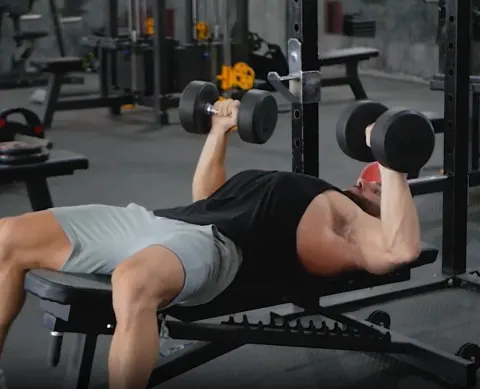
A worked example: dumbbell bench press, 3 sets of 8–12
| Session | Weight | Set 1 | Set 2 | Set 3 | Decision |
|---|---|---|---|---|---|
| 1 | 20 kg | 10 | 9 | 8 | Keep weight, add reps |
| 2 | 20 kg | 11 | 10 | 9 | Keep weight |
| 3 | 20 kg | 12 | 11 | 10 | Keep weight |
| 4 | 20 kg | 12 | 12 | 11 | Almost. Keep weight |
| 5 | 20 kg | 12 | 12 | 12 | Top of range hit. Add weight |
| 6 | 22.5 kg | 9 | 8 | 8 | New cycle starts |
Five sessions to climb from 3 × 8 to 3 × 12 is typical for an intermediate. Beginners move faster, sometimes adding weight every week. Notice that the weight only changes once in six sessions, yet every single session had a clear target. That is what keeps you motivated between weight increases.
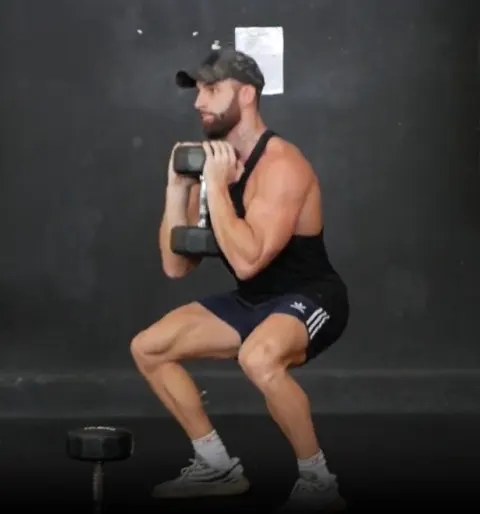
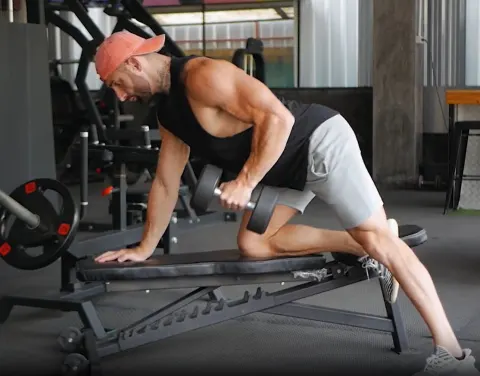
The same logic runs the dumbbell bench press, dumbbell row, goblet squat and every other exercise in a plan like the 3-day dumbbell plan for muscle gain.
Choosing the rep range for each exercise
The rep range sets how heavy the work is. Heavier compound lifts suit tighter, lower ranges; lighter isolation lifts suit wider, higher ranges.
| Exercise type | Rep range | Example |
|---|---|---|
| Heavy barbell compounds | 5–8 | Back squat, barbell bench press, deadlift |
| Dumbbell and machine compounds | 8–12 | Dumbbell row, lat pulldown, dumbbell press |
| Single-leg and unilateral work | 8–12 per side | Bulgarian split squat, split squat |
| Isolation | 12–15 or 15–20 | Dumbbell lateral raise, curls, face pull |
A range of 4 or 5 reps (8–12) is wide enough that you spend several sessions in it, but narrow enough that the weight jump does not knock you below the bottom. Ranges of 10 or more reps (5–15) work poorly because 5 and 15 reps train different qualities. Our guide on sets and reps covers the trade-offs in detail.
How much weight to add
Always the smallest jump you have. Jumping too far is the number one reason people stall.
- Dumbbells: 2–2.5 kg per hand. If your gym jumps 4 kg, use fractional plates or add a rep range cycle before moving up.
- Barbells: 2.5 kg total (1.25 kg each side). On squats and deadlifts, 5 kg is fine for beginners.
- Machines and cables: one plate, usually 2.5–5 kg.
- Bodyweight: move to a harder variation. For pushing: incline push-up to push-up to diamond push-up. For pulling: inverted row with higher feet, then assisted pull-up, then pull-up.
A 2.5 kg jump on a 20 kg dumbbell is 12.5 percent, which is why your reps drop from 12 to 8 or 9. A 2.5 kg jump on a 100 kg squat is 2.5 percent, which is why reps barely move there and you can add weight more often.
What counts as a good set
Double progression only works if your sets are honest. Two rules:
- Same form every time. Reps that cut depth, bounce or change tempo do not count. If you got 12 but the last three were half-reps, log 9.
- Stop 1–2 reps before failure. Grinding to absolute failure every set makes recovery worse and the next session suffer. Your last rep should be slow but clean.
Rest long enough to recover. Cutting rest from 2 minutes to 60 seconds on a heavy set will cost you 2–3 reps and make it look like you stalled when you did not. See how long to rest between sets.
Why it works so well
- A target every session. Even when the weight stays fixed, you are chasing one more rep. That is a measurable win three times a week.
- Self-regulating. Had a bad night? You add zero reps and nothing breaks. Great day? You add three and move up sooner.
- Works across equipment. Dumbbells with big jumps, machines with small jumps, bodyweight with none. The rule is the same.
- Builds volume automatically. Going from 3 × 8 to 3 × 12 at the same weight is a 50 percent increase in work. The muscle-building stimulus grows even on weeks where the dumbbell does not change.
When you stall
You will eventually have two or three sessions in a row where reps do not go up. In order, check:
- Logging. Are you actually writing down every set? Memory is generous.
- Recovery. Fewer than 7 hours of sleep or a week of under-eating shows up in the gym first.
- Rest periods. Are you resting less than last week?
- Weight jump. If you moved from 20 to 25 kg instead of 22.5, you may simply be too far below the range. Drop back.
If all four are fine, use one of these resets:
- Back-off reset. Drop the weight 10 percent, rebuild to the top of the range over 2–3 weeks. You will usually pass the old sticking point.
- Add a set. Go from 3 to 4 sets at the same weight for two weeks, then return to 3 sets with the heavier weight.
- Deload. After 6–8 weeks of hard pushing, a lighter week restores performance better than anything else. Our deload week guide explains how.
Stalls on one exercise while others progress are normal. Stalls on everything at once mean recovery, not programming.
Putting it into a plan
Any plan built from the generator already lists a rep range for each exercise, so double progression plugs straight in: write the weight next to the exercise, add reps each week, bump the weight when all sets hit the top. The plan generator does the structure; the rule does the progress.
Two good places to apply it from week one: the 4-day gym plan for muscle gain, where every lift has a set rep range, and the 3-day gym strength plan for beginners, where the big barbell lifts run in the 5–8 range. Once you can lift roughly your bodyweight on the bench and 1.5 times it on the squat, compare your numbers on the strength standards page and decide whether to shift to a more specialised strength program.
Ready plans for this guide


Exercises mentioned


Frequently asked questions
What is double progression?
You work in a rep range, for example 8 to 12. Keep the weight fixed and add reps each session. When you hit the top of the range on every set, increase the weight and drop back to the bottom of the range. Reps first, then weight: two things progress, hence the name.
How much weight should I add?
The smallest jump available. With dumbbells that is usually 2 to 2.5 kg per hand, with barbells 2.5 kg total, on machines one plate. Smaller jumps mean you progress more often and stall less.
What if I cannot add a rep for two sessions in a row?
That is normal after the first few months. Check sleep, food and rest times first. If those are fine, drop the weight 10 percent, rebuild over three weeks, or take a deload week and come back.
Does double progression work for bodyweight exercises?
Yes. Add reps until you hit the top of your range, then move to a harder variation instead of adding weight, for example from incline push-ups to regular push-ups to diamond push-ups.