Kettlebell Training for Beginners: Swing, Press, Squat, Carry
One kettlebell, four movements. Learn the swing, goblet squat, press and carry, which weight to buy, and get a 3-day beginner plan.
One kettlebell and four movements is a complete beginner program. The swing trains your hips and conditioning, the goblet squat trains your legs, the press trains your shoulders and arms, and the carry ties it all together with grip and core work. Add a row and you’ve covered every major pattern.
This guide tells you which bell to buy, how to learn each movement in the right order, and gives you a 3-day plan for your first 8 weeks.
Why kettlebells work for beginners
A kettlebell’s handle sits above its mass, so the weight hangs below your hand. That does two useful things: it makes hinge movements like swings and deadlifts feel natural, and it forces your shoulder to stabilise during presses and carries.
Compared with dumbbells, kettlebells are better for ballistic work (swings, cleans) and carries. Compared with a gym, they’re cheaper, quieter and always available. The trade-off is that the weight jumps are large (usually 4 kg), which makes progression lumpy. The dumbbell-only training guide covers a tool with finer increments, and the two combine well.
Which kettlebell to buy
Buy one bell to start. A second one comes later, once you know you’ll use it.
| Who | Swing / squat / deadlift | Press |
|---|---|---|
| Women, new to training | 8–12 kg | 6–8 kg |
| Women, some training history | 12–16 kg | 8–12 kg |
| Men, new to training | 12–16 kg | 8–12 kg |
| Men, some training history | 16–20 kg | 12–16 kg |
If you must choose one, choose the heavier swing weight. Swings and squats need it, and you can press it for lower reps or use a two-handed press until your shoulders catch up. Cast-iron bells are fine; competition-style bells have a uniform size across weights, which matters only if you plan to buy several.
Learn the movements in this order
Don’t start with the swing. Start with the deadlift, because it teaches the hinge that the swing depends on.
1. Kettlebell deadlift
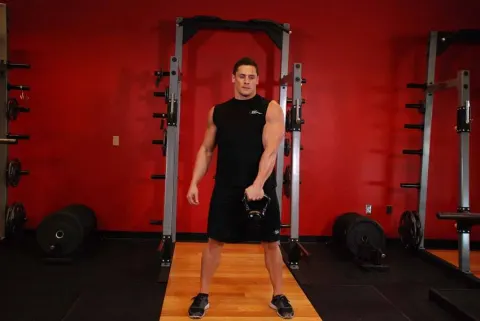
Stand with the bell between your feet. Push your hips back, keep your shins nearly vertical, and grab the handle with both hands. Stand up by driving your feet into the floor. Lower by pushing your hips back again. Your back stays flat the whole time.
Do 3 sets of 8–10 for two or three sessions until it feels automatic. Full description: kettlebell deadlift. If the hinge is new to you, the bodyweight hip hinge is where to start.
2. Goblet squat
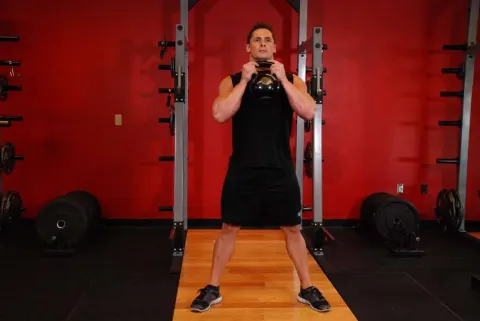
Hold the bell by the horns at your chest, elbows pointing down. Squat between your knees, keeping your chest up and heels down. Stand up. The front load helps most beginners squat deeper and more upright than they can with no weight at all.
3 sets of 8–12. See the kettlebell squat page for cues on depth and knee tracking.
3. Two-hand swing
Now the swing. Set the bell about 30 cm in front of you. Hinge, grab it, and hike it back between your legs like a football snap. Snap your hips forward and stand tall; the bell floats to chest height on its own. Let it fall, hinge again as it passes your thighs, repeat.
Key cues:
- It’s a hinge, not a squat. Hips go back, knees bend a little.
- Your arms are ropes. Don’t lift the bell; the hips throw it.
- Stand fully upright at the top. Glutes squeezed, ribs down.
- Chest height is enough. You don’t need an overhead swing.
Start with sets of 10. Full breakdown on the kettlebell swing page.
4. Press
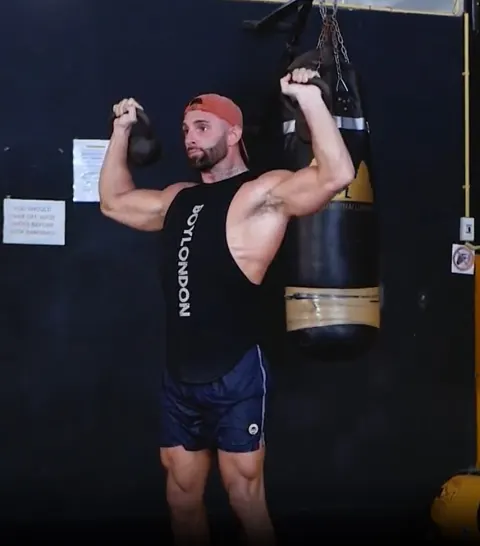
Clean the bell to the rack position (bell resting on the outside of your forearm, elbow tucked against your ribs). Press straight up, rotating your palm slightly forward at the top. Lower under control. Do all reps on one side, then switch.
3 sets of 5–8 per arm. The kettlebell press is harder than a dumbbell press of the same weight because the bell pulls your wrist back, so go lighter than you think.
5. Row and carry
The kettlebell row is a one-arm row with your free hand braced on a bench or your knee. The farmer’s carry is simply walking with the bell: shoulders level, no leaning. Both are hard to do wrong and both build real strength.
Your first 8-week plan
Three sessions a week, non-consecutive days. Each session takes 30–40 minutes including a warm-up. Before every session do 5 minutes of cat-cow, bodyweight hinges and goblet squats with no weight; the warm-up guide has a full routine.
Weeks 1–4: learn and build volume
| Exercise | Sets × reps | Rest |
|---|---|---|
| Kettlebell deadlift | 3 × 8–10 | 60 s |
| Goblet squat | 3 × 8–12 | 60 s |
| Kettlebell press | 3 × 5–8 per arm | 60 s |
| Kettlebell row | 3 × 8–10 per arm | 60 s |
| Two-hand swing | 5 × 10 | 45 s |
| Farmer’s carry | 3 × 30 m per hand | 60 s |
Weeks 5–8: add density
Keep the same exercises. Add one set to squats and presses (4 sets), and turn swings into an interval block: 10 swings at the top of every minute for 10 minutes. In week 7, try 12 minutes. By week 8 most people are ready for a heavier bell on deadlifts and squats.
If you’d rather have this laid out day by day with progression tracked, the plan generator can build a kettlebell-only plan; the 3-day beginner kettlebell plan follows the same structure.
How to progress with big weight jumps
A 4 kg jump is 25% when you’re using 16 kg. You can’t just pick up the next bell and do the same reps. Use these steps instead:
- Add reps to the top of the range (squats from 8 up to 12).
- Add a set (3 to 4).
- Slow the eccentric on squats and presses (3 seconds down).
- Then jump weight and drop reps back to the bottom of the range.
For presses, a two-hand press with the heavy bell is a useful bridge. For swings, add reps per set or shorten the rest; moving from 16 kg to 24 kg is common once your hinge is solid.
Track every session: bell weight, sets, reps. Progress with kettlebells is slower on paper but very real in the mirror.
Swings for conditioning and fat loss
Swings are one of the most efficient conditioning tools you can own. A 10-minute block of 10 swings every minute with a 16 kg bell burns roughly as many calories as a brisk 20-minute walk, and it builds your glutes and grip while doing it. Check your own numbers with the calories burned calculator.
For fat loss, the 3-day kettlebell weight loss plan pairs swing intervals with strength work. Remember that the diet does most of the work; training keeps the muscle.
Common beginner mistakes
- Squatting the swing. If your knees bend a lot and the bell goes low, you’re squatting. Push your hips back instead.
- Lifting with the arms. The bell should feel weightless at the top. If your shoulders are tired after swings, your hips aren’t doing enough.
- Bending the wrist on the press. Keep the bell on your forearm, not hanging off your hand.
- Rushing to the next weight. Earn it with reps and sets first.
- Skipping the deadlift. It’s boring, and it’s the foundation. Keep it in your program for at least two months.
When to add a second bell
When you can do 15+ goblet squats and 12+ deadlifts with your current bell and the movement feels easy, buy the next size up. A second bell of the same weight unlocks double-bell front squats and presses, which turns one-bell training into a muscle-building program; the 4-day kettlebell plan for muscle gain is built for exactly that stage.
Until then, one bell, four movements, three days a week. That’s enough to get noticeably stronger in two months.
Ready plans for this guide


Exercises mentioned
Frequently asked questions
What kettlebell weight should a beginner start with?
Most men do well with 16 kg and most women with 12 kg for swings, squats and deadlifts. For overhead pressing you'll want one size lighter (12 kg and 8 kg). If you can only buy one bell, buy the swing weight.
Is one kettlebell enough to get fit?
Yes. One bell covers the hinge, squat, press, row and carry patterns, which is a complete strength program. You'll outgrow it for deadlifts and squats within months, but by then you'll know whether you want a second bell.
Can kettlebell swings replace cardio?
Swings done in intervals (for example 10 swings every minute for 10–15 minutes) give a strong conditioning effect and burn a lot of calories per minute. They don't fully replace walking or steady cardio, but they're a good complement.
Are kettlebells bad for your back?
Not when the hinge is done right. The swing is a hip movement, not a back movement: hips go back, spine stays neutral, and the bell floats forward from leg drive. Learn the kettlebell deadlift first and the swing becomes safe.