How to Warm Up Before Lifting (6 Minutes, No Fluff)
A 6-minute warm-up before lifting: raise your temperature, open the joints you'll load, ramp up to working weight. Routines for upper and lower days.
A good warm-up before lifting takes six minutes and has three parts: raise your body temperature, move the joints you’re about to load through their full range, then ramp up to your working weight with a few light sets. That’s it. Everything else is either stretching that reduces your strength or foam rolling that eats your training time.
Here’s the routine, with specific versions for upper- and lower-body days.
What a warm-up is actually for
Three things, and only three:
- Temperature. Warm muscle contracts faster and tendons stretch more safely. Two minutes of movement gets you there.
- Range of motion. Your hips, ankles, thoracic spine and shoulders need to move through the range the lift demands before you load them. Dynamic drills do this; long static stretches don’t help and slightly reduce force output.
- Rehearsal. Ramp-up sets prime your nervous system for the movement and let you check how the weight feels today before committing to the working load.
A warm-up is not a workout. If it leaves you tired, it was too long. If you’re still cold and stiff on your first working set, it was too short.
The 6-minute template
| Phase | Time | What |
|---|---|---|
| 1. General | 2 min | Easy movement: brisk walk, jumping jacks, step jacks or bike |
| 2. Targeted mobility | 3 min | 3–4 dynamic drills for the joints you’ll load (see below) |
| 3. Ramp-up sets | 1–3 min | 2–4 light sets of your first exercise, building to working weight |
Phases 1 and 2 are the fixed six minutes. Phase 3 is part of the lift itself and scales with how heavy you’re going.
Phase 2: targeted mobility by session type
Pick the version that matches your session. Each drill: 8–10 reps or 30 seconds per side, moving, not holding.
Lower body day (squats, deadlifts, lunges)
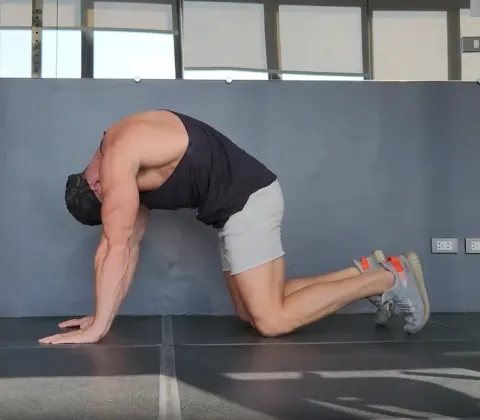
- Cat-cow × 8: wakes up the spine and hips.
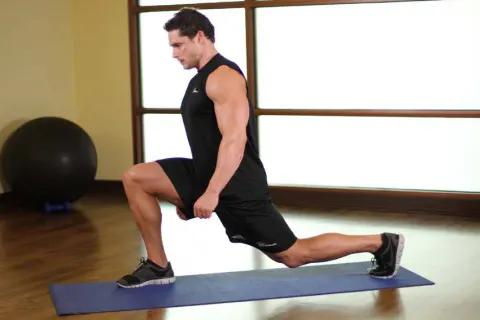
- World’s greatest stretch × 5 per side: hip flexors, hamstrings, thoracic rotation in one move.
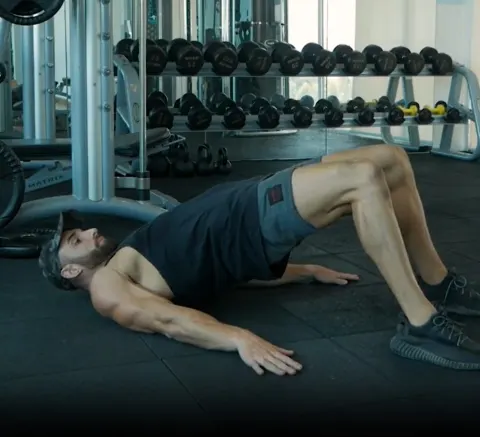
- Glute bridge × 10: turns the glutes on so they do their share in the squat.
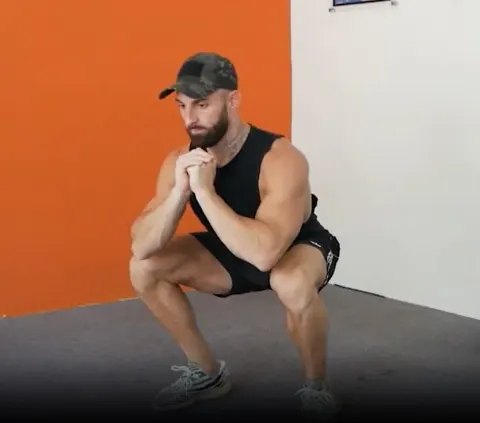
- Bodyweight squat × 10, slow, pausing at the bottom: rehearses the pattern and opens the ankles.
Optional if hips are tight: hip flexor stretch 20 seconds per side, kept short.
Upper body day (pressing and pulling)
- Cat-cow × 8.
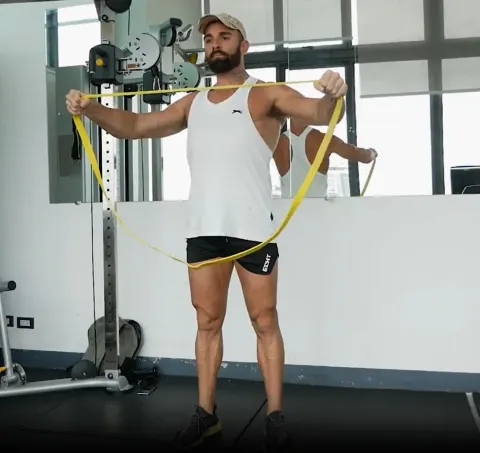
- Band pull-apart × 15: rear delts and upper back, the muscles that keep the shoulder stable under a bar.
- Wall angel × 8 or thoracic extension × 8: upper-back mobility for a stable bench press and a clean overhead press.
- Doorway chest stretch 20 seconds per side: brief, dynamic, not a long hold.
If your shoulders are cranky, add face pulls with a light band for 15 reps. The shoulder pain guide has more on that.
Full body day
Combine: cat-cow, world’s greatest stretch, band pull-aparts, bodyweight squats. Four drills, three minutes.
Phase 3: ramp-up sets
Ramp-up sets are the most important and most skipped part. They’re not about getting warm; they’re about rehearsing the exact movement with increasing load so your first working set is sharp.
For a working weight of 100 kg on squats:
| Set | Weight | Reps |
|---|---|---|
| 1 | Empty bar (20 kg) | 8 |
| 2 | 50 kg | 5 |
| 3 | 70 kg | 3 |
| 4 | 85 kg | 1–2 |
| Working | 100 kg | as programmed |
Rules of thumb:
- Start around 40–50% of working weight (or the empty bar).
- Reduce reps each set so you don’t accumulate fatigue.
- Rest 45–60 seconds between ramp sets, closer to a full rest before the first working set.
- Lighter working weights need fewer ramp sets. For a 3 × 10 at 60 kg, two sets (bar × 8, 40 kg × 5) is enough.
- Dumbbell work: one or two sets with a weight that’s half your working load.
Later exercises in the session need one light “feel” set at most. If you squatted first and are now doing Romanian deadlifts, you’re warm; a single set with half the weight is plenty.
What to leave out
- Static stretching for 30+ seconds. It slightly reduces force output for the next 30–60 minutes. Stretch after lifting if you want flexibility work.
- Ten minutes on the treadmill. Two minutes is enough to raise temperature. Ten minutes burns energy you need for sets.
- Foam rolling the whole body. Fine if you enjoy it, but it adds time without measurable benefit for most people. If anything, roll one tight spot for 30 seconds and move on.
- Twenty mobility drills. Four targeted ones beat a 20-minute circuit. If you have a specific limitation, add one drill for it, not ten.
- Warm-up sets to failure. Ramp sets are rehearsals. The last one should feel crisp, not hard.
Adjusting for your situation
- Morning training: add 2 minutes to phase 1 and one extra ramp set. You’re stiffer after sleep.
- Cold gym or winter: keep a layer on through phase 2, and add one ramp set.
- Over 40: the full six minutes is non-negotiable, plus an extra ramp set on heavy days. The training after 40 guide explains why connective tissue needs the extra time.
- Returning from a layoff or injury: double phase 2 for the affected area and start ramp sets lighter.
- Short on time: cut phase 1 to one minute and phase 2 to two drills, but never skip ramp sets on your first lift.
A worked example: 4-day upper/lower
Here’s how the warm-up slots into a real session from the 4-day gym plan for muscle gain, lower day:
- 2 minutes brisk walking or bike.
- Cat-cow × 8, world’s greatest stretch × 5 per side, glute bridge × 10, bodyweight squat × 10. (3 minutes)
- Back squat ramp: bar × 8, 50% × 5, 70% × 3, 85% × 1. Then working sets.
- Romanian deadlift: one set at 50% × 6. Then working sets.
- Everything else: straight into the working weight.
Total warm-up overhead: about 9 minutes including ramp sets, for a 60-minute session. The plans from the plan generator build this structure in; the 3-day beginner dumbbell plan and the 3-day gym plan for strength both include it.
The short version
Two minutes to get warm. Three minutes of four dynamic drills matched to the session. Two to four ramp sets on your first lift, reducing reps as weight goes up. Skip static stretching and long cardio. Then lift, and use the time you saved for proper rest between sets.
Ready plans for this guide


Exercises mentioned
 video
beginner
 beginner
 video
beginner
 video
beginner
 video
beginner
Frequently asked questions
How long should a warm-up before lifting be?
Six to ten minutes is enough for most sessions: 2 minutes of general movement, 3–4 minutes of targeted mobility, then 2–4 ramp-up sets of your first exercise. Longer warm-ups mostly waste energy you need for the working sets.
Should I stretch before lifting?
Do dynamic movement, not long static holds. Holding stretches for 30+ seconds before lifting slightly reduces strength for the next hour. Save static stretching for after the session or a separate time.
How many warm-up sets do I need?
Two to four for your first heavy exercise, starting around 40–50% of your working weight and stepping up with fewer reps each set. Later exercises in the session need one light set at most, since you're already warm.
Do I need to warm up for every exercise?
Only the first one or two compound lifts need a full ramp. For exercises later in the session, one feel-it set with a light weight is plenty. Isolation exercises like curls need no separate warm-up.