Workouts for Weight Loss: What Actually Matters
The best workout for weight loss keeps your muscle while your diet does the work. What to train, how often, and why strength beats endless cardio.
The best workout for weight loss is a strength program that preserves your muscle while a modest calorie deficit does the actual work of losing fat. Training doesn’t burn as many calories as people hope; what it does is decide whether the weight you lose comes from fat or from muscle. Lift three times a week, walk every day, and let the diet handle the number on the scale.
Here’s what actually matters, in order of importance.
1. The deficit does the losing, not the workout
A 45-minute strength session burns somewhere between 200 and 350 kcal. A 30-minute jog burns 300–400. Both are small next to a single restaurant meal, and both make you hungrier. That’s why “working out to lose weight” fails for so many people: the exercise is real, but the deficit never shows up.
Start with the number. Use the calorie deficit calculator to find a daily target that puts you 300–500 kcal below maintenance. That’s a loss of roughly 0.3–0.5 kg per week, which is slow enough to keep your muscle and fast enough to see in a month.
Training’s job in this picture:
- Keep muscle. In a deficit, your body will burn muscle for fuel unless it has a reason to keep it. Lifting is that reason.
- Keep strength and energy. People who diet without training often end up lighter, weaker and softer.
- Make the result look good. Losing 5 kg while keeping muscle looks very different from losing 5 kg of which half was muscle.
2. Strength training comes first
If you only have three hours a week, spend them lifting. Full-body sessions with compound movements give you the most muscle-retaining stimulus per minute.
What a session looks like:
| Pattern | Example | Sets × reps |
|---|---|---|
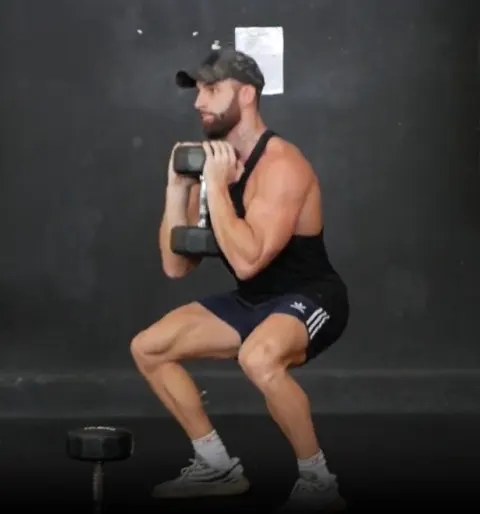
| Squat | Goblet squat | 3 × 8–12 |
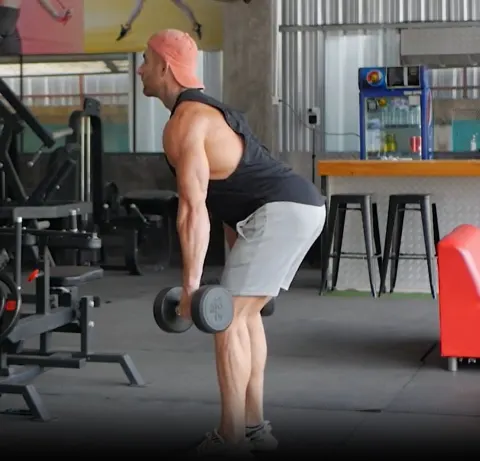
| Hinge | Dumbbell Romanian deadlift | 3 × 8–12 |
| Push | Push-up or dumbbell press | 3 × 8–12 |
| Pull | Dumbbell row | 3 × 8–12 |
| Core / carry | Plank or farmer’s carry | 2–3 sets |
Thirty-five to forty-five minutes, three days a week. Rest 60–90 seconds between sets. Push each set to within 1–2 reps of failure, and try to add a rep or a little weight each week; the double progression guide explains how.
The structure doesn’t need to be clever. The full-body vs split guide explains why full-body wins for three days a week. If you have four days, an upper/lower split works too, as in the 4-day gym plan for weight loss.
Don’t drop the weights to “tone.” Light weights for 25 reps don’t burn more fat, and they don’t signal your body to keep muscle as strongly as heavier sets of 8–12 do.
3. Walking is the best cardio for fat loss
Not because it burns the most per minute, but because it burns a lot per week without costing you anything. Walking doesn’t make you ravenous, doesn’t need recovery, and doesn’t compete with your lifting.
| Daily steps | Approx. extra kcal/day (75 kg person) | Per week |
|---|---|---|
| 5,000 | 150–200 | 1,000–1,400 |
| 8,000 | 250–320 | 1,750–2,250 |
| 10,000 | 320–400 | 2,250–2,800 |
Check your numbers with the walking calories calculator. A move from 4,000 to 9,000 steps a day is worth roughly half a kilogram of fat a month on its own, with zero impact on your training.
Add walking anywhere: after meals, phone calls, the last stop on your commute. Treat the step count as a daily habit, not a workout.
4. HIIT and intense cardio: optional, and easy to overdo
High-intensity intervals do burn calories fast, and a short finisher like 10 minutes of kettlebell swings or mountain climbers at the end of a lifting session is a good use of time. But in a calorie deficit your recovery is already limited, and three or four HIIT sessions a week on top of lifting is a reliable way to feel exhausted, get hungrier and plateau.
A sane limit: one or two short interval blocks per week, 10–15 minutes each, after a strength session. If you’d rather run, the running calories calculator shows what a session actually earns you. Everything else is walking.
5. Protein and sleep are part of the workout
You can’t out-train a bad night’s sleep or a protein intake of 50 grams a day.
- Protein: 1.6–2.2 g per kg of body weight daily. For a 75 kg person that’s 120–165 g. It protects muscle in a deficit and keeps you full.
- Sleep: under 7 hours consistently raises hunger hormones and lowers the amount of fat lost relative to muscle. Sleep is a fat-loss tool.
- Water and fibre: both make the deficit easier to stick to. Neither burns fat directly.
6. A sample week
| Day | Session |
|---|---|
| Monday | Full-body strength (40 min) + walk |
| Tuesday | Walk, 8,000+ steps |
| Wednesday | Full-body strength (40 min) + 10 min swing intervals |
| Thursday | Walk, 8,000+ steps |
| Friday | Full-body strength (40 min) + walk |
| Saturday | Long walk, hike or anything active you enjoy |
| Sunday | Rest, 5,000+ steps |
Pick the equipment you actually have. No equipment: the 3-day no-equipment weight loss plan. A pair of dumbbells: the 3-day dumbbell plan for weight loss. A gym: the 4-day plan above. Or have the plan generator build one for your schedule and gear.
7. How to tell if it’s working
Don’t judge by a single weigh-in. Water, salt and glycogen move the scale by 1–2 kg day to day. Instead:
- Weigh yourself daily and average each week. Compare weekly averages.
- Measure your waist every two weeks.
- Track your lifts. If strength is stable or rising while the weekly average drops, you’re losing fat and keeping muscle. That’s the goal.
- Expect 0.3–0.5 kg per week. Faster than 1 kg a week for more than a couple of weeks usually means you’re losing muscle too.
If the weekly average hasn’t moved in three weeks, the deficit isn’t real. Cut 150–200 kcal or add 2,000 steps, not both at once.
What doesn’t matter much
- Fasted cardio. Same total fat loss as fed cardio over a week.
- “Fat-burning zone.” You burn a higher share of fat at low intensity but fewer total calories. Total matters.
- Ab exercises for belly fat. You can’t target where fat comes off. Train abs for strength, lose belly fat through the deficit.
- Sweating more. Sweat is water. It comes back with your next drink.
- Exercise order or timing. Morning or evening, cardio before or after weights: pick what you’ll stick to.
The short version
Eat 300–500 kcal below maintenance. Lift three times a week with compound movements and push the sets hard. Walk 8,000+ steps a day. Get protein and sleep. Give it twelve weeks and judge by trends. The how many days a week guide helps you pick a frequency you can keep, and keeping it is the whole game.
Ready plans for this guide


Exercises mentioned



Frequently asked questions
Is cardio or weights better for weight loss?
Weights, if you have to pick one. A calorie deficit drives the fat loss; strength training makes sure what you lose is fat rather than muscle. Cardio is a useful add-on for burning extra calories and for heart health, but it doesn't protect muscle the way lifting does.
How many days a week should I work out to lose weight?
Three full-body strength sessions a week is enough for almost everyone. Add daily walking, 7,000–10,000 steps, and you have a complete fat-loss routine. More training days give diminishing returns and make it harder to recover while eating less.
Do I need to do HIIT to lose weight?
No. HIIT burns calories quickly but it's hard to recover from in a deficit and easy to overdo. Low-intensity walking burns a surprising amount over a week and doesn't interfere with your lifting.
Why am I not losing weight even though I work out?
Almost always because the deficit isn't there. Training burns fewer calories than most people assume, and appetite rises to match. Track intake for two weeks, aim for a 300–500 kcal daily deficit, and judge by the trend over 3–4 weeks, not single weigh-ins.