Full Body vs Split Routine: Which Is Better for You?
Full body vs split routine compared: muscle growth, recovery, time per session and who each suits. Pick the right one for your days and experience.
If you train 2 or 3 days a week, do full body. If you train 4 days, run an upper/lower split. If you train 5 or 6 days, use push/pull/legs or a similar split. At the same weekly volume, both approaches build about the same muscle, so the right choice comes down to your schedule, your experience and how long you want each session to be.
What each one actually means
Full body trains every major muscle group in every session: a squat, a hinge, a push, a pull and some core work each time. You do fewer exercises per muscle per session, but you hit each muscle 2 to 4 times a week.
Split routines divide the body across sessions. The common ones:
- Upper/lower: upper body one day, lower body the next, each twice a week.
- Push/pull/legs: pushing muscles, pulling muscles and legs on separate days, once or twice a week.
- Bro split: one muscle group per day, each trained once a week.
You do more exercises and sets per muscle per session, but each muscle gets trained less often.
Head to head
| Full body | Upper/lower | Push/pull/legs | Bro split | |
|---|---|---|---|---|
| Days per week | 2–4 | 4 | 3 or 6 | 5 |
| Each muscle trained | 2–4×/week | 2×/week | 1× (3-day) or 2× (6-day) | 1×/week |
| Session length | 50–75 min | 45–60 min | 45–60 min | 40–60 min |
| Exercises per session | 5–7 | 5–7 | 5–7 | 4–6 |
| Sets per muscle per session | 3–6 | 6–9 | 6–12 | 12–20 |
| Missed session cost | Low | Medium | High (3-day) | High |
| Best for | Beginners, 2–3 days, busy people | Most intermediates | 6-day lifters, muscle focus | Advanced bodybuilders |
Why weekly volume is what matters
Muscle growth tracks the number of hard sets each muscle gets per week, roughly 10 to 20. Whether those sets happen in one session or spread across four changes the experience but not the result, as long as the total is the same and the sets are quality.
Where the two approaches diverge is in how easy it is to make the sets quality:
- Doing 12 sets for chest in one session (bro split) means sets 9 to 12 are done by a tired muscle with lower weight. Spreading those 12 sets over three full-body days means every set is fresh.
- But a full-body session with 4 sets each for six muscle groups is 24 hard sets in one workout. By exercise five you are fatigued and the sets for that muscle suffer.
Full body wins on per-set quality when total volume per session is modest. Splits win when you want 15+ sets per muscle a week and need sessions short enough to recover from.
When full body is the better choice
You train 2 or 3 days a week. This is the big one. On three days, full body trains each muscle three times; a 3-day push/pull/legs trains each muscle once. Three hits a week means more practice on the lifts and more frequent growth stimulus. See how many days a week to train.
You are a beginner. Beginners need frequent practice of the main movements more than they need volume. Squatting three times a week teaches the squat far faster than once. A full-body plan like the 3-day dumbbell plan for muscle gain is where most people should start.
Your schedule is unpredictable. Miss a full-body day and you lose a third of a week’s stimulus for everything. Miss leg day on a split and legs get nothing for 7 to 10 days.
You train for general fitness or fat loss. Full-body sessions move more muscle per workout, which means more calories burned per session and more total-body strength per hour. Pair with daily walking and the calorie deficit calculator and you have a complete fat-loss setup.
A typical full-body session:
- Goblet squat – 3 × 8–12
- Dumbbell bench press – 3 × 8–12
- Dumbbell row – 3 × 8–12
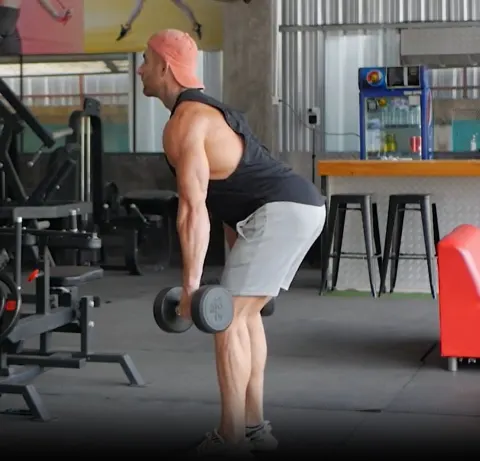
- Dumbbell Romanian deadlift – 3 × 8–12
- Dumbbell lateral raise – 2 × 12–15
- Plank – 3 × 30–45 s
When a split is the better choice
You can train 4 or more days, reliably. At four days, full body means squatting four times a week, which gets hard on the knees and lower back. An upper/lower split trains legs twice and upper body twice with less overlap. The 4-day gym plan for muscle gain is built this way.
Your full-body sessions have grown past 75 minutes. Once you want 2 exercises per muscle, full body gets long. Splitting the body halves the exercises per session.
You want to prioritise specific muscles. On a split you can give shoulders or back 4 exercises in a session without compromising everything else. Full body does not have room for that.
You are intermediate or advanced. After 1 to 2 years, growth needs 15 to 20 sets per muscle per week, and that volume fits much better across a split. The 6-day push/pull/legs plan is the standard high-volume setup; see the push/pull/legs guide for how to run it.
The hybrid: full body on 4 days
There is a middle option: a 4-day full-body routine with fewer exercises per session, alternating heavier and lighter days. It keeps the frequency advantage of full body while letting you train four times. It works well for people who like short, 40-minute sessions and want to train every other day. It is harder on recovery than upper/lower for the same volume, so most intermediates still do better with upper/lower.
Common mistakes with each
Full body mistakes:
- Too many exercises per session (10+). Keep it to 5 to 7.
- Going heavy on every lift every day. Rotate: heavy squat Monday, moderate Wednesday, light Friday.
- Skipping rest days because “it’s only three days”. Day-on, day-off exists so you recover.
Split mistakes:
- Running a split on 3 days and training each muscle once a week.
- Skipping legs or treating leg day as optional.
- Doing 20 sets for chest and 6 for back. Balance push and pull volume.
Decision in 30 seconds
- 2–3 days a week → Full body. Start with the 3-day full-body split.
- 4 days a week, under 1 year of training → Full body 4-day or upper/lower, either is fine.
- 4 days a week, over 1 year → Upper/lower.
- 5 days → PPL + upper/lower.
- 6 days → Push/pull/legs twice through.
Whatever you pick, the plan has to come with a progression rule, or the structure does not matter. Read how to progress with double progression and apply it from week one.
The plan generator picks full body or the appropriate split automatically from the days you can train, so you can start with 3 full-body days now and regenerate as a 4-day upper/lower when your schedule opens up. The exercises, sets and rest times carry over; only the structure changes.
Ready plans for this guide


Exercises mentioned



Frequently asked questions
Is full body better than a split for building muscle?
At equal weekly sets, both build muscle equally well. Full body wins when you train 2 to 3 days because it hits each muscle more often. Splits win when you train 4 or more days because they let you do more quality volume per muscle.
Can I build muscle with 3 full-body workouts a week?
Yes. Three full-body sessions give every muscle 9 to 15 hard sets a week, which is squarely in the range that builds muscle. Most lifters can run full body for years.
Is a split routine bad for beginners?
Not bad, just inefficient. A beginner on a 5-day bro split hits each muscle once a week and misses sessions constantly. Three full-body days deliver more practice on the big lifts and more frequent stimulus.
When should I switch from full body to a split?
When you can reliably train 4 days a week, your full-body sessions run past 75 minutes, or you have 1 to 2 years of training and want more volume for specific muscles.