Training Around Shoulder Pain: Pressing, Pulling and What to Swap
Train around shoulder pain: which presses and pulls sore shoulders tolerate, swaps for bench, overhead press and pull-ups, and a 4-week plan.
Shoulder pain is a reason to change how you press and pull, not to stop training. Most lifting-related shoulder pain comes from a predictable pattern: a lot of pressing, not much pulling, and a front shoulder that’s much stronger than the back of the shoulder. Swap the movements that hurt for ones that don’t, add rear-delt and upper-back work, keep training everything else, and most shoulders settle in four to eight weeks.
This guide covers which presses and pulls are usually tolerated, exact swaps for the big lifts, what to park for now, and a 4-week plan.
When to see someone first
Train around it if the pain is a dull ache, a pinch at certain angles, or stiffness that warms up. See a doctor or physio first if you have: pain after a fall or sudden pop, inability to lift the arm, night pain that wakes you, numbness down the arm, or a shoulder that feels unstable or slips. Those need a diagnosis.
For everything else, use a pain rule: 0–3 out of 10 during the exercise, and no worse the next morning, is fine. Above that, reduce range, reduce load or swap.
Why shoulders get sore in the gym
Three common contributors:
- Push/pull imbalance. Bench, overhead press, dips and push-ups every week; a couple of rows if there’s time. The front of the shoulder tightens, the back weakens, and the joint sits forward.
- End-range loading. Deep dips, bar touching the chest with a wide grip, behind-the-neck anything. The shoulder is weakest at its extremes.
- Volume jumps. Adding a second press day or doubling push-up reps in a week.
The fix follows directly: more pulling, better positions, and gradual progression.
Pressing: what to swap
| If this hurts | Try this | Why |
|---|---|---|
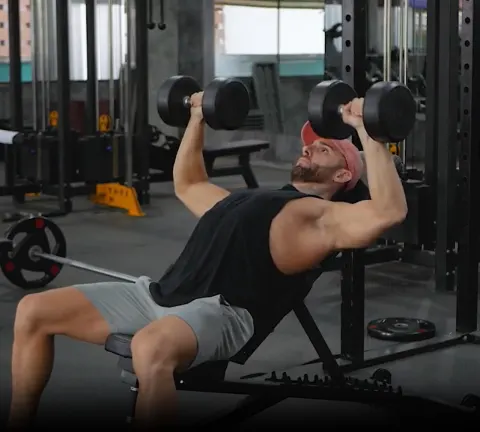
| Flat barbell bench press | Incline dumbbell press at 15–30° | Dumbbells allow a natural arm path; a slight incline reduces front-shoulder strain |
| Barbell bench, any angle | Dumbbell bench press, neutral grip | Palms facing each other keeps the elbows tucked and the shoulder in a stronger position |
| Standing barbell overhead press | Seated dumbbell press with palms slightly turned in | Less arch, less end-range abduction |
| Any overhead press | Landmine press or high-incline dumbbell press | Pressing at an angle rather than straight overhead is tolerated by most shoulders |
| Push-ups | Incline push-up, hands on a bench, elbows at 45° | Shorter range and lower load |
| Dips | Bench dip with short range, or skip | Full-depth dips are a common irritant; park them for now |
| Dumbbell flyes | Skip, or band chest press | Flyes load the shoulder at its most vulnerable stretch |
Two universal adjustments: tuck the elbows to about 45° from your torso instead of flaring to 90°, and shorten the range by stopping 5–8 cm above full depth. Both reduce stress on the front of the shoulder immediately.
Pulling: what to add and what to swap
Pulling is the part most people need more of. The target is at least as many pulling sets as pressing sets each week, ideally 1.5 times as many while the shoulder is sore.
Add these to every session:
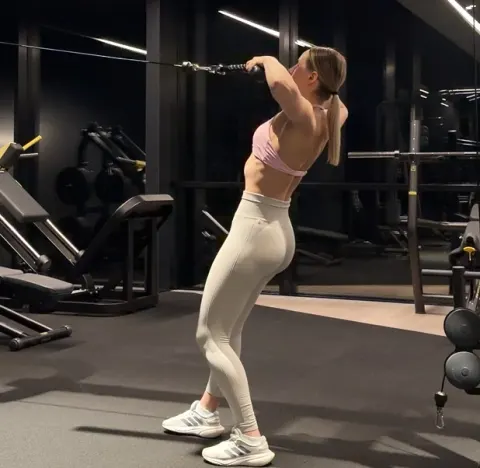
- Face pull: 2–3 × 15 with a band or cable. Pull toward your forehead, elbows high, squeeze the shoulder blades together, rotate the hands back at the end.
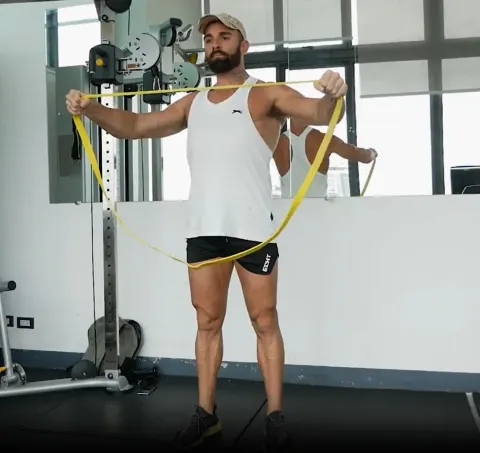
- Band pull-apart: 2–3 × 15–20. Simple and nearly impossible to do wrong.
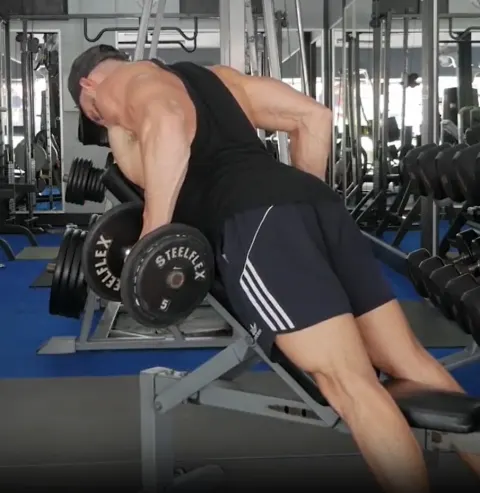
- Rear delt fly: 2 × 12–15, light weight, slow.
Swaps for the main pulls:
| If this hurts | Try this |
|---|---|
| Behind-the-neck pulldown | Lat pulldown to the chest, slightly narrower grip |
| Wide-grip pull-up | Chin-up or neutral-grip pull-up |
| Upright row | Skip. Dumbbell lateral raise with a slight forward lean instead |
| Heavy barbell row | Chest-supported row or seated cable row |
Most rows are fine. If a row pinches, it’s usually from pulling the elbow too far back; stop with the elbow level with your torso.
Mobility: two drills, not twenty
- Wall angel: 2 × 8, slow. Back flat against the wall, arms sliding up and down while staying in contact. Builds the upper-back mobility that lets the shoulder blade move properly.
- Thoracic extension: 2 × 8 over a foam roller or bench. A stiff upper back forces the shoulder to make up the range.
Add the doorway chest stretch for 20–30 seconds per side after training if the front of your shoulder feels tight. That’s the complete mobility list. Do it in your warm-up; the warm-up guide shows where it fits.
What to park for now
Not forever, just until the shoulder has been calm for a few weeks:
- Behind-the-neck presses and pulldowns
- Upright rows
- Wide-grip flat bench to full depth
- Dips to full depth
- Heavy barbell overhead press
- Kipping or fast, swinging pull-ups
- Anything that produces a sharp pinch at a specific point
A 4-week shoulder-friendly plan
Three days a week, full body. Pressing volume is reduced, pulling volume is increased, and every session finishes with rear-delt work.
| Exercise | Sets × reps |
|---|---|
| Goblet squat or Romanian deadlift (alternate sessions) | 3 × 8–12 |
| Chest-supported row | 3 × 10–12 |
| Incline dumbbell press, neutral grip, short range | 2–3 × 10–12 |
| Lat pulldown or chin-up | 3 × 8–12 |
| Seated dumbbell press, palms in (only if 0–3 pain) | 2 × 10–12 |
| Face pull | 3 × 15 |
| Band pull-apart | 2 × 20 |
Week 1: light loads, learn the new positions. Weeks 2–4: add reps, then load, staying inside the pain rule. If pressing is pain-free by week 4, add a third set and begin extending range of motion by a few centimetres per week.
For a ready-made structure, the 3-day dumbbell plan for muscle gain adapts easily with these swaps, and the 3-day band plan is a good option while the shoulder is at its most irritable, since bands are lightest at the start of each rep. If you train four days, the 4-day gym plan for general fitness splits upper and lower, which makes it easy to keep the shoulder work organised. The plan generator can build any of these around the swaps above.
Returning to the full lifts
Once you’ve had three or four pain-free weeks:
- Reintroduce the parked lift at 50% of your old weight, short range, 2 sets.
- Add range before load. Get to full depth with the light weight first.
- Then add load slowly, one small step per week.
- Keep the face pulls and pull-aparts permanently. They’re the reason the shoulder stays healthy.
If a lift flares the shoulder on the way back, go back one step and spend another week there. The push/pull/legs guide is a useful structure once you’re pressing freely again, because it builds pulling volume in by design.
The habits that keep shoulders healthy
- Pull at least as much as you push, every week, forever.
- Warm up with pull-aparts and wall angels before pressing.
- Tuck the elbows. Shorten the range when in doubt.
- Progress load slowly on presses; the shoulder adapts slower than the chest.
- Sleep on your back or the non-painful side while it settles.
Most gym shoulders are a volume and balance problem, not a structural one. Fix the balance, give it six weeks, and you’ll usually be pressing again, with a stronger upper back than before. If your back or knees are also limiting you, the bad back guide uses the same approach.
Ready plans for this guide


Exercises mentioned
 video
beginner
 video
beginner
 video
beginner
 video
beginner
Frequently asked questions
Should I stop training if my shoulder hurts?
Usually not. Keep training everything that doesn't hurt, swap the movements that do for better-tolerated versions, and add rear-delt and upper-back work. Complete rest tends to leave the shoulder weaker and no less painful.
Can I bench press with shoulder pain?
Often yes, with changes: switch to dumbbells, raise the bench to a 15–30° incline, use a neutral or slightly angled grip, and stop a few centimetres short of full depth. If flat barbell bench still hurts after those changes, park it for a few weeks.
What exercises should I avoid with a sore shoulder?
While it's irritable: behind-the-neck presses and pulldowns, upright rows, wide-grip bench to full depth, dips to full depth, and heavy overhead pressing with a barbell. Most can return once the shoulder has calmed down and the upper back is stronger.
Which exercises help shoulder pain?
Face pulls, band pull-aparts, chest-supported rows and wall angels strengthen the rear shoulder and upper back, which is where most lifters are weak relative to their chest and front shoulder. Two or three of these in every session is the usual fix.