Upper/Lower Split: The 4-Day Routine That Works for Most Lifters
The upper lower split explained: a full 4-day routine with exercises, sets and reps, how to schedule it, and why it suits most intermediate lifters.
An upper/lower split trains your upper body on two days and your lower body on two days each week, four sessions total. Every muscle gets worked twice a week, workouts last under an hour, and there is a natural rest day between each pair of sessions. For lifters past the beginner stage who can train four days, it is the most reliable routine there is.
How the upper/lower split works
The split divides the body at the waist. Upper days cover chest, back, shoulders and arms. Lower days cover quads, hamstrings, glutes, calves and core.
Standard weekly layout:
| Day | Session | Focus |
|---|---|---|
| Monday | Lower A | Squat-focused, heavier |
| Tuesday | Upper A | Horizontal push and pull, heavier |
| Wednesday | Rest | |
| Thursday | Lower B | Hinge-focused, moderate |
| Friday | Upper B | Vertical push and pull, moderate |
| Saturday–Sunday | Rest |
The two upper days and two lower days are not copies. They use different main lifts so you squat once and deadlift once per week, bench once and overhead press once. That keeps the heavy barbell lifts from piling onto the same joints.
Why it works so well
Twice-a-week frequency. Training a muscle twice a week is the best-supported frequency for growth and strength. Once a week (bro split) leaves gains on the table; three or four times (full body) gets hard to recover from once the weights are heavy.
Enough volume, fresh sets. Six to eight sets per muscle per session, twice a week, gives 12 to 16 weekly sets. Because you only train half the body, those sets are done with energy left.
Short sessions. Half the body means five to seven exercises and a session that fits in 50 to 60 minutes with proper rest between sets.
Simple to schedule. Two on, one off, two on, two off. Monday to Friday with a free weekend, or Monday, Tuesday, Thursday, Friday. A missed day just shifts the week by one.
Scales from dumbbells to barbells. The structure does not care what equipment you have. See the 4-day dumbbell plan for muscle gain for the home version.
The full 4-day upper/lower routine
Progress each exercise with double progression: fill the rep range, then add weight. Rest 2 to 3 minutes on the first two exercises each day, 60 to 90 seconds on the rest.
Lower A (Monday)
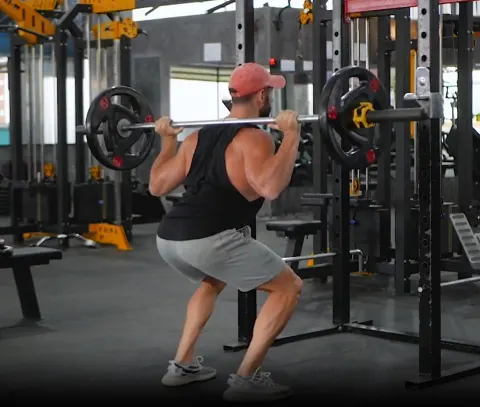
- Back squat – 4 × 5–8
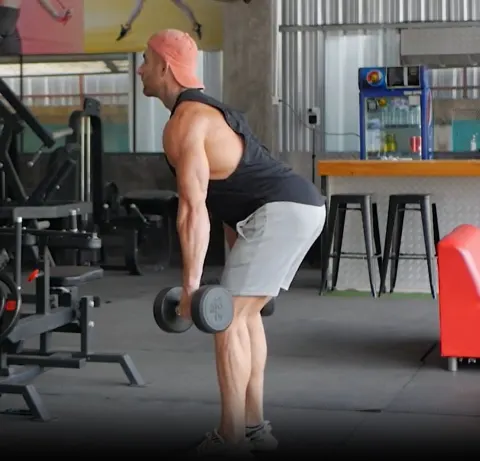
- Dumbbell Romanian deadlift – 3 × 8–12
- Bulgarian split squat – 3 × 8–10 per leg
- Seated leg curl – 3 × 12–15
- Standing calf raise – 3 × 12–15
- Plank – 3 × 30–45 s
Upper A (Tuesday)
- Barbell bench press – 4 × 5–8
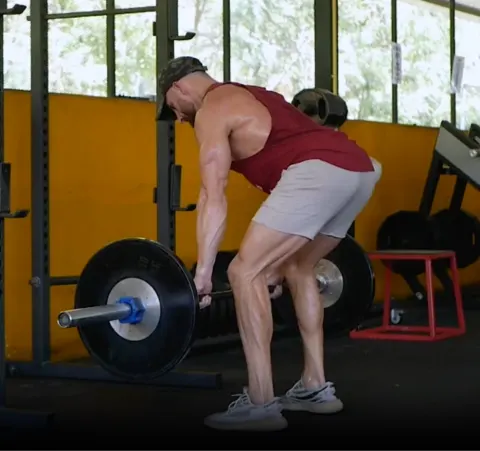
- Barbell row – 4 × 6–8
- Seated dumbbell press – 3 × 8–12
- Lat pulldown – 3 × 8–12
- Dumbbell lateral raise – 3 × 12–15
- Rope pushdown – 2 × 12–15
Lower B (Thursday)
- Trap bar deadlift or conventional deadlift – 4 × 4–6
- Front squat or goblet squat – 3 × 8–10
- Walking lunge – 3 × 10 per leg
- Barbell hip thrust – 3 × 10–12
- Leg extension – 3 × 12–15
- Hanging leg raise – 3 × 10–12
Upper B (Friday)
- Overhead press – 4 × 6–8
- Pull-up or assisted pull-up – 4 × 6–10
- Incline dumbbell press – 3 × 8–12
- Chest-supported row – 3 × 10–12
- Face pull – 3 × 15
- Dumbbell curl – 2 × 10–12
This is the layout behind the 4-day gym plan for muscle gain. Weekly volume lands at roughly 14 sets for chest, 16 for back, 12 for shoulders, 14 for quads, 12 for hamstrings and glutes, right in the growth range from the sets and reps guide.
Upper/lower for strength
If your goal is a bigger squat, bench and deadlift, keep the same four days and shift the main lifts lower in reps:
| Day | Main lift | Sets × reps | Supporting work |
|---|---|---|---|
| Lower A | Back squat | 5 × 3–5 | RMD 3 × 8, split squat 2 × 8, core |
| Upper A | Bench press | 5 × 3–5 | Barbell row 4 × 6, dumbbell press 3 × 10, pulldown 3 × 10 |
| Lower B | Deadlift | 4 × 3–5 | Front squat 3 × 6, hip thrust 3 × 10, leg curl 3 × 12 |
| Upper B | Overhead press | 5 × 3–5 | Pull-up 4 × 6, incline press 3 × 8, face pull 3 × 15 |
Rest 3 to 4 minutes on the main lifts. Use the one rep max calculator to set your working weights around 80 to 87 percent, and track your progress against the strength standards. The 4-day gym strength plan follows this template.
Upper/lower with dumbbells at home
The split works just as well with a pair of adjustable dumbbells and a bench:
- Lower: goblet squat, dumbbell Romanian deadlift, Bulgarian split squat, glute bridge with a dumbbell, standing calf raise.
- Upper: dumbbell bench press, dumbbell row, dumbbell shoulder press, chest-supported row on an incline bench, lateral raises, curls and overhead triceps extensions.
Our dumbbell-only training guide explains how to keep legs challenging once the heaviest dumbbell is no longer heavy enough for a goblet squat.
Scheduling variations
Can’t do Monday to Friday? Any pattern that keeps a rest day between the two pairs works: Monday, Tuesday, Thursday, Saturday is fine.
Only 3 days some weeks? Alternate upper, lower, upper then lower, upper, lower across two weeks. Each muscle gets 3 sessions per fortnight.
Want 5 days? Add a push/pull/legs block: the PPL + upper/lower hybrid is the cleanest 5-day structure.
Want to add cardio? Rest days, or 15 to 20 minutes after upper sessions. Avoid hard cardio right before lower days.
Common mistakes
- Making upper days a chest day. Upper days need as much pulling as pushing. Count your sets: rows plus pulldowns should match or exceed presses.
- Two identical lower days. Squatting heavy twice a week is hard on the knees and lower back for most people. Squat one day, hinge the other.
- Running it as a beginner on 4 days with no base. If you are in your first few months, 3 days full body teaches the lifts faster. Read full body vs split first.
- Skipping the rest day midweek. Four days in a row leaves you dragging by Thursday. The Wednesday rest is part of the program.
- Ignoring deloads. Every 6 to 8 weeks, cut the weights by 10 to 20 percent for a week. The deload guide explains when and how.
Who should run upper/lower
- Intermediates with 1 or more years of training who can commit to 4 days: this is your default.
- Anyone whose full-body sessions have crept past 75 minutes.
- Lifters who want strength and size from the same program.
- Beginners with 4 days available: fine, but 3 days full body is slightly more efficient in the first 6 months.
If you can only train 3 days, stay with full body. If you have 5 or 6, read the push/pull/legs guide. For everything in between, upper/lower is the answer. The plan generator builds a 4-day upper/lower routine automatically from your equipment and goal, with the A and B days already differentiated.
Ready plans for this guide


Exercises mentioned
 video
intermediate
 video
intermediate
 video
intermediate
 video
beginner
 video
beginner
Frequently asked questions
Is an upper/lower split good for building muscle?
Yes. It trains every muscle twice a week with 12 to 16 hard sets, which is the range most research points to for growth, and sessions stay under an hour. It is the default recommendation for intermediate lifters with 4 days.
Can I do upper/lower on 3 days?
Yes, by alternating: upper, lower, upper one week, then lower, upper, lower the next. Each muscle gets 3 sessions every 2 weeks. It works, but a 3-day full-body plan is simpler at that frequency.
Should upper or lower day come first in the week?
Start with the day you are most likely to skip. For most people that is lower. Monday lower, Tuesday upper also means you press on fresh shoulders the day after legs.
How long should an upper/lower workout take?
45 to 65 minutes including warm-up. Five to seven exercises with 2 to 3 minute rests on the compounds and 60 to 90 seconds on isolation work fits in that window.