Resistance Band Training: How to Build Muscle With Bands
Can you build muscle with resistance bands? Yes, if you train them right. Exercises, sets, progression and a weekly plan for band training at home.
Resistance bands can build real muscle. The muscle doesn’t know whether tension comes from iron or latex; it responds to hard sets taken close to failure, done consistently and progressed over weeks. Bands do that job well for the upper body, core and glutes, and well enough for the legs if you’re willing to work in higher rep ranges.
This guide covers what bands do well, which exercises are worth your time, how to progress without a number on a plate, and a 3-day template you can start this week.
Why bands work (and where they fall short)
A band gets harder as you stretch it. That’s called linear variable resistance: the load is lightest at the start of the rep and heaviest at the end. For pressing and pulling movements this matches your strength curve nicely, so the hardest part of the rep lands where your leverage is best.
What bands do well:
- Constant tension. You can’t rest at the bottom of a row or at lockout on a press. Every rep stays loaded.
- Joint-friendly loading. The light start of each rep is kind to shoulders, elbows and knees. Many people with cranky joints tolerate bands better than free weights.
- Portability and price. A full set costs less than one month of gym membership and fits in a drawer.
Where they fall short:
- Heavy lower-body work. A strong person squats more than any band can provide. Once squats hit 25+ reps per set, you’ve outgrown bands for that movement.
- Measuring progress. There’s no plate to add. You need a system (covered below).
- Band wear. Latex degrades. Inspect for nicks before every session and replace bands that show cracks.
If you want the free-weight version of the same ideas, see the dumbbell-only training guide. If you have no equipment at all, start with the no-equipment home workout guide.
What to buy
You don’t need much. A set of 41-inch loop bands in 4–5 thicknesses covers every exercise in this article. Tube bands with handles are more convenient for presses and rows but less versatile for squats and pull-aparts.
| Band | Approx. tension | Main uses |
|---|---|---|
| Extra light | 2–7 kg | Pull-aparts, face pulls, lateral raises |
| Light | 7–15 kg | Curls, triceps, rows for beginners |
| Medium | 15–30 kg | Rows, presses, glute bridges |
| Heavy | 30–50 kg | Squats, good mornings, assisted pull-ups |
| Extra heavy | 50+ kg | Deadlift patterns, squats for stronger trainees |
Add a door anchor (a strap with a foam stopper) so you can set up rows and presses at any height. Browse everything on the band exercise page.
The best band exercises by muscle group
You don’t need 40 exercises. One or two solid movements per pattern is enough.
Pull (back and biceps)
- Band row: the staple. Anchor at chest height, step back until the band is taut with arms extended, row to your ribs. Pause for one second at the end.
- Band lat pulldown: anchor high, pull down and back. Lean slightly forward to feel the lats.
- Band pull-apart: the best shoulder-health exercise there is. 2 sets of 20 at the end of every session.
- Band curl: stand on the band, curl, slow 3-second lowering.
Push (chest, shoulders, triceps)
- Band chest press: anchor behind you at chest height, press forward. Stagger your stance for balance.
- Band shoulder press: stand on the band, press overhead. The top of the rep is brutally hard, which is exactly where most people are weak.
- Band triceps extension: anchor high, extend down.
- Band lateral raise: light band, 15–20 reps, no swinging.
Legs and glutes
- Banded glute bridge: band across the hips held down by your hands, or a loop above the knees. Squeeze hard at the top.
- Banded lateral walk: loop above the knees, 10–15 steps each way.
- Band good morning: band under the feet and behind the neck. The best band hamstring builder.
- Hamstring curl with band: anchor low, lie face down, curl.
- Squats: stand on a heavy band and hold it at the shoulders. Once you pass 20 reps, switch to single-leg work like the split squat with the band for extra load.
How to progress without a weight number
This is where most band programs fail. “Do more reps” works for a few weeks, then stalls. Use a ladder instead: each step is a small, concrete increase, and you only move when the current step feels manageable.
- Add reps. Start at 10, work up to 15 (or 20 for isolation moves).
- Add a pause. 1 second at peak tension on every rep. Reset reps to 10.
- Shorten the band. Grip lower, or take one more step from the anchor. Reset to 10.
- Slow the eccentric. 3 seconds on the way back. Reset to 10.
- Move up a band. Back to the top of the ladder.
Write down the band color, grip position and reps every session. The double progression guide explains the same logic for weights, and it transfers directly.
The target for every working set is 1–2 reps short of failure. If the last rep looked exactly like the first, the set was too easy.
Sets, reps and rest
| Goal | Sets per exercise | Reps | Rest |
|---|---|---|---|
| Build muscle | 3–4 | 10–20 | 60–90 s |
| General fitness | 2–3 | 12–15 | 60 s |
| Fat loss (keep muscle) | 3 | 12–20 | 45–60 s |
Aim for 10–15 hard sets per muscle group per week. For a 3-day full-body plan that means 3–5 sets per muscle per session, which is very doable in 40 minutes.
A 3-day band plan
Full body three times a week, non-consecutive days (Mon/Wed/Fri works). Alternate Workout A and B.
Workout A
| Exercise | Sets × reps |
|---|---|
| Band squat (heavy band at shoulders) | 3 × 12–20 |
| Band chest press | 3 × 10–15 |
| Band row | 3 × 10–15 |
| Banded glute bridge | 3 × 15–20 |
| Band curl | 2 × 12–15 |
| Band pull-apart | 2 × 20 |
Workout B
| Exercise | Sets × reps |
|---|---|
| Band good morning | 3 × 12–15 |
| Band shoulder press | 3 × 10–15 |
| Band lat pulldown | 3 × 10–15 |
| Split squat with band | 3 × 10–12 per leg |
| Band triceps extension | 2 × 12–15 |
| Banded lateral walk | 2 × 12 steps each way |
Finish each session with 2 minutes of dead bug or plank. If you want the schedule built out with warm-ups and progression tracked for you, the plan generator can produce a band-only plan for 3 or 4 days a week; the 4-day band plan for muscle gain is a good template if you have the extra day.
Common mistakes
- Using the same band for everything. Your lats are far stronger than your rear delts. Match the band to the muscle.
- Fast, bouncy reps. Bands reward control. Snapping back to the start removes half the tension.
- Skipping legs. Yes, bands are weaker there. Use higher reps, single-leg variations and pauses, and legs will still grow.
- No log. Without recording grip and reps, you’ll repeat the same workout for months. Thirty seconds of notes fixes this.
- Ignoring wear. A snapped band at full stretch is a face injury. Check them.
Who bands suit best
Bands are the best option if you train in a small space, travel often, are returning from a joint injury, or are starting out and want something non-intimidating. The 3-day beginner band plan is a sensible starting point, and the 3-day band plan for weight loss pairs well with a walking habit.
If your goal is maximal strength on squats and deadlifts, bands are a supplement, not the main course. For everyone else, they’re a complete tool. Pick five exercises, train them hard three times a week, track your progression ladder, and give it twelve weeks.
Ready plans for this guide


Exercises mentioned
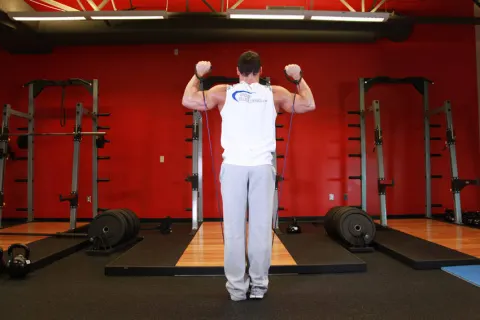 beginner
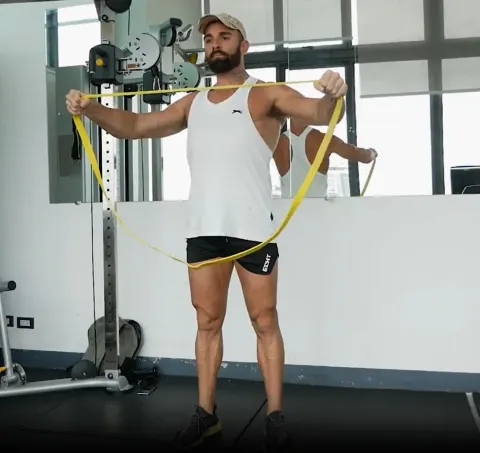 video
beginner
Frequently asked questions
Can you really build muscle with resistance bands?
Yes. Muscle grows when a set is taken close to failure with enough tension, and bands can deliver that for every major muscle group. The limit is on big lower-body lifts, where you eventually run out of band resistance.
Which resistance bands should I buy?
A set of 4–5 loop bands (41-inch) in increasing thickness covers everything from face pulls to squats. A door anchor and a pair of handles make rows and presses much easier to set up.
How many reps should I do with bands?
Work in the 10–20 rep range and stop 1–2 reps short of failure. Because band tension rises toward the end of the movement, counting reps is less important than reaching a hard final rep.
How do I make a band exercise harder?
Shorten the band by gripping lower or stepping further from the anchor, double up two bands, slow down the eccentric, or add a pause at peak tension. Change only one variable at a time.