How to Build Muscle at Home With No Equipment
How to build muscle at home with no equipment: the bodyweight exercises that work, how to make them harder, a 3-day routine and how to keep progressing.
You can build muscle at home with nothing but your bodyweight, as long as every set is hard enough. Muscle grows when a set is taken within a couple of reps of failure, and a push-up variation that fails at 12 reps builds chest just like a bench press that fails at 12. The job is to pick exercises that are hard in the 6 to 15 rep range, make them harder as you get stronger, and train 3 to 4 times a week.
What bodyweight training can and cannot do
It can: build a strong, visibly muscular chest, shoulders, arms, core and legs over the first one to two years. Bodyweight exercises load the muscles just like weights; the body cannot tell the difference between resisting gravity on a push-up and on a dumbbell press.
It cannot: load your legs and back as heavily as a barbell. After a year or two, a strong person can do 20+ squats with ease, and at that point leg growth slows. The fixes are single-leg exercises, slow tempo and, eventually, a pair of dumbbells or a backpack full of books. The back is the hardest area because you need something to pull on; a table, a door frame or a cheap pull-up bar changes everything.
The exercises that actually build muscle
Not every bodyweight exercise is a muscle builder. Jumping jacks and high knees are cardio. These are the ones that count, by movement pattern:
| Pattern | Beginner | Intermediate | Advanced |
|---|---|---|---|
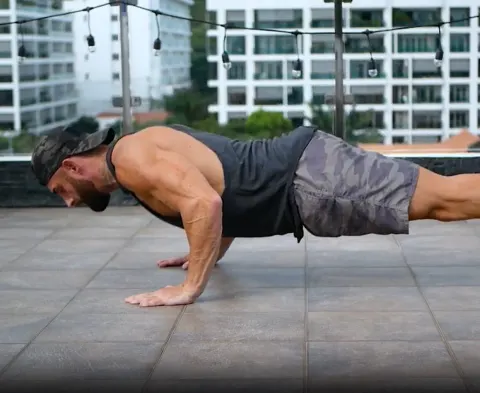
| Horizontal push (chest) | Incline push-up | Push-up | Diamond push-up, feet-elevated push-up |
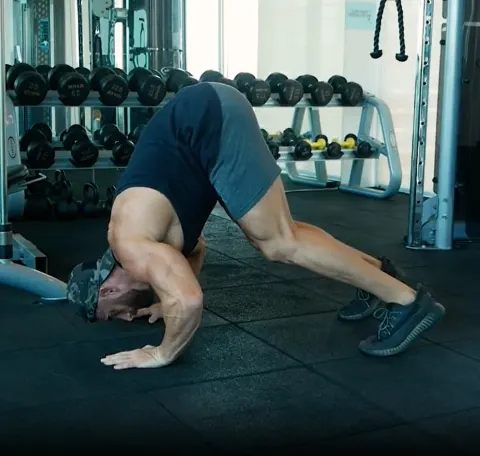
| Vertical push (shoulders) | Pike push-up on knees | Pike push-up | Feet-elevated pike push-up |
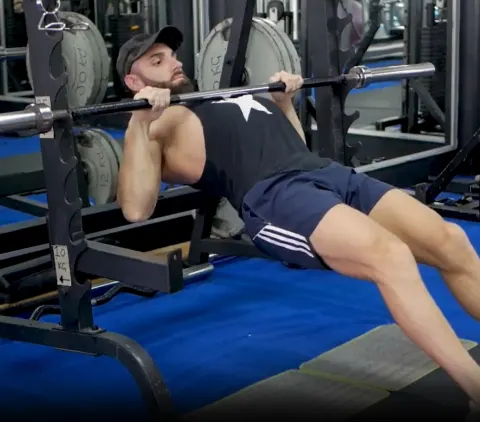
| Horizontal pull (back) | Doorway row | Inverted row under a table | Feet-elevated inverted row |
| Vertical pull (back) | Assisted pull-up | Chin-up | Pull-up |
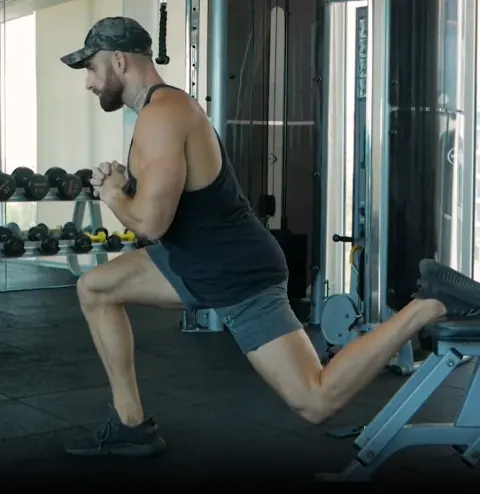
| Squat (quads, glutes) | Bodyweight squat | Split squat | Bulgarian split squat |
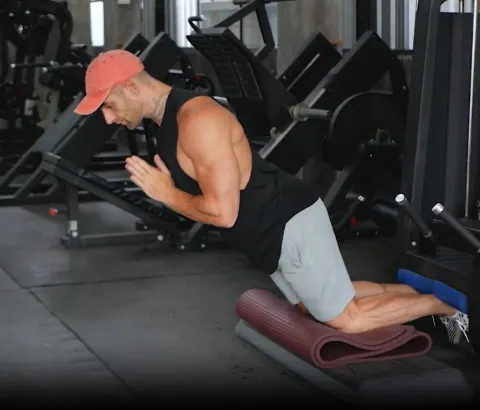
| Hinge (hamstrings, glutes) | Glute bridge | Single-leg hip hinge | Nordic curl |
| Lunge | Reverse lunge | Walking lunge | Step-up to a high box |
| Core | Dead bug | Plank, side plank | Hanging leg raise |
Pick one exercise per pattern at the level where you fail between 6 and 15 reps. When you pass 15 clean reps, move one column right. The bodyweight exercise library has form notes for every exercise above.
How to make bodyweight exercises harder
This is the core skill of no-equipment training. With a barbell you add 2.5 kg; with bodyweight you have five levers:
- Change the angle. Hands higher makes a push-up easier; feet higher makes it harder. The same applies to inverted rows: the closer to horizontal your body, the harder the pull.
- Go to one limb. Two-leg squat to split squat to Bulgarian split squat roughly doubles the load on the working leg each step.
- Slow down. Three seconds down, one second pause, one second up. A 5-second rep at 12 reps is a minute of tension, far more than a 2-second bounce.
- Shorten the lever. Diamond push-ups move the hands closer, pike push-ups shift weight to the shoulders, Nordic curls make the hamstrings control the whole body.
- Add pauses and ranges. Pause at the bottom of a squat, do 1.5 reps (down, halfway up, down, up), or add a deficit by putting hands on books.
Add external load only when those run out: a backpack with 10 kg of books for squats and push-ups, a towel over a door for rows. Our guides on dumbbell-only training and resistance band training cover the next step if you decide to buy one cheap piece of kit.
The 3-day no-equipment muscle routine
Three full-body sessions a week, Monday, Wednesday and Friday. Each exercise follows double progression: add reps until you hit the top of the range on all sets, then move to a harder variation and start again at the bottom. Rest 90 seconds between sets, 2 minutes on the single-leg work.
Day A
- Push-up variation – 4 × 6–15
- Inverted row or doorway row – 4 × 6–15
- Bulgarian split squat – 3 × 8–12 per leg
- Single-leg hip hinge – 3 × 10–15 per leg
- Plank – 3 × 30–60 s
Day B
- Pike push-up – 3 × 6–12
- Chin-up, assisted pull-up or feet-elevated inverted row – 4 × 5–12
- Reverse lunge – 3 × 10–12 per leg
- Glute bridge (single-leg when 20 reps become easy) – 3 × 12–20
- Side plank – 3 × 20–40 s per side
Day C
- Diamond or decline push-up – 3 × 6–12
- Inverted row with a pause – 3 × 8–12
- Step-up to a chair – 3 × 10 per leg
- Nordic curl (partial range at first) – 3 × 5–8
- Dead bug – 3 × 10 per side
- Bear crawl – 3 × 20 m
Finish with 5 minutes of cat-cow and the world’s greatest stretch. Weekly volume lands at 10 to 12 sets each for chest, back, shoulders and legs. The 3-day no-equipment plan for muscle gain delivers this structure with exercise swaps for your level; the 4-day version splits it upper/lower if you have a fourth day.
Reps, sets and effort without weights
The rules from the gym apply, with one change: because you cannot fine-tune load, you control effort with reps and tempo.
- Rep range: 6 to 15. Below 6 the exercise is too hard and form breaks; above 15 to 20 it has become endurance work, pick a harder variation.
- Effort: every set ends 1 to 2 reps before failure. The last two reps should be slow. This matters more without weights, because an easy set of 15 push-ups builds nothing.
- Sets: 3 to 4 per exercise, 10 to 15 per muscle per week. See the sets and reps guide.
- Tempo: when in doubt, slow down. A controlled 3-1-1 tempo turns a too-easy exercise into a productive one instantly.
Fixing the two weak spots: back and legs
Back. Without something to pull on, the back gets nothing, and a chest-dominant body with weak upper back leads to rounded shoulders. Options in order of cost: a sturdy dining table (inverted rows, free), a towel looped over a closed door (rows, free), a door-frame pull-up bar (vertical pulls, cheap), a single resistance band (band rows, cheap). Get at least one of these in the first month.
Legs. Two-leg squats stop being hard quickly. Move to split squats, then Bulgarian split squats with a slow tempo. Then single-leg work on a step. Then add a loaded backpack. For hamstrings, Nordic curls are brutal enough to work for years; start with a partial range and a cushion for the knees.
Eating to build muscle at home
Training at home does not change the nutrition rules. You need enough protein, roughly 1.6 to 2 g per kg of bodyweight per day, and enough total food to be in a small surplus if the goal is size. If fat loss is the priority instead, keep the same training to protect muscle and set calories with the calorie deficit calculator. The 3-day no-equipment plan for weight loss pairs the strength work with short conditioning finishers for that goal.
Common mistakes
- Doing 50 push-ups and 100 squats. That is cardio with extra steps. Make the exercise hard enough that 8 to 15 reps is the limit.
- Skipping pulling entirely. Find something to row on in week one.
- Changing exercises daily for variety. Stick with one variation per pattern for 4 to 6 weeks and progress it.
- No logbook. Write down the variation, reps and tempo. Progress in bodyweight training is subtle and you will miss it without records.
- Never adding load. After a year, a 10 kg backpack is the cheapest upgrade you can make and doubles the useful life of every lower-body exercise.
When to add equipment
Bodyweight alone carries most people 12 to 24 months. The signs you have outgrown it: 15+ clean Bulgarian split squats per leg with slow tempo, 15+ feet-elevated push-ups and 12+ pull-ups. At that point a pair of adjustable dumbbells unlocks loaded squats, rows and presses for another several years. The plan generator can switch your plan from no-equipment to dumbbell with the same structure, so the transition costs you nothing but the dumbbells.
Ready plans for this guide


Exercises mentioned
Frequently asked questions
Can you really build muscle with no equipment?
Yes, as long as the sets are hard. Muscle grows when a set is taken close to failure, whether that is 8 reps with a barbell or 15 reps of a push-up variation. The limit is finding exercises that get you there in under 20 reps.
How long does it take to see results from bodyweight training?
Strength improves in 2 to 3 weeks. Visible changes in the chest, shoulders, arms and legs usually show after 8 to 12 weeks of 3 sessions a week, provided you are eating enough protein.
What is the hardest muscle to train without equipment?
The back. Pulling needs something to pull on. A sturdy table for inverted rows, a door-frame pull-up bar or a towel over a door solves it. Without any of those, the back will fall behind.
How many reps should I do with bodyweight exercises?
Aim for 6 to 15 per set and stop 1 to 2 reps before failure. If you can do more than 15 to 20, the exercise is too easy: move to a harder variation instead of adding reps.