How Many Steps a Day Do You Need? Health and Weight Loss
How many steps a day for health and weight loss: what the research says about 7,000, 8,000 and 10,000 steps, steps to km and calories, and how to add more.
For health, aim for roughly 7,000 to 9,000 steps a day if you are under 60, and 6,000 to 8,000 if you are older. Most of the benefit arrives by then, and 10,000 is a fine goal but not a magic number. For weight loss, steps help most as a way to raise daily calorie burn alongside a moderate calorie deficit, and 8,000 to 10,000 is a practical target.
Where 10,000 came from
The 10,000-step target was not born in a laboratory. It traces back to a Japanese pedometer sold in the 1960s whose name translates roughly as “10,000 steps meter”. The number was round, memorable and stuck.
It is not a bad target. It is simply higher than most people need for the main health benefits, and missing it does not mean the day was wasted.
What the research says
Large pooled analyses that followed tens of thousands of adults wearing step counters point in the same direction:
- Risk of early death falls steadily as daily steps rise from very low levels.
- The curve flattens at about 6,000–8,000 steps for adults over 60 and about 8,000–10,000 for younger adults.
- A more recent review of many health outcomes found that most of the improvement had already arrived by around 7,000 steps.
- There is no sign of harm from doing more. The extra benefit just gets smaller.
Put together: going from 3,000 to 7,000 steps matters much more than going from 9,000 to 13,000.
| Daily steps | What it means for most adults |
|---|---|
| Under 4,000 | Low activity. Any increase is worth making. |
| 4,000–6,000 | A meaningful base. Health risk is already lower than at 2,000–3,000. |
| 6,000–8,000 | Where benefits level off for adults over 60. |
| 7,000–9,000 | Most of the benefit for adults under 60. |
| 10,000+ | Small additional health gains; useful for weight control and fitness. |
These are associations from observational studies, not guarantees for any one person. If you have a heart, lung or joint condition, ask your doctor what level of walking is right for you.
Steps to kilometres and calories
Stride length depends on height and pace, so every conversion is an estimate. For an adult of average height, 1,000 steps is about 0.7–0.8 km and takes around ten minutes at a brisk pace.
| Steps | Distance | Walking time | Approx. kcal (70 kg) |
|---|---|---|---|
| 3,000 | 2.1–2.4 km | 30 min | 100–120 |
| 5,000 | 3.5–4 km | 50 min | 160–200 |
| 7,500 | 5.3–6 km | 75 min | 250–300 |
| 10,000 | 7–8 km | 100 min | 330–400 |
Heavier people burn more per step and lighter people burn less. Pace and hills change the figure too. Get a number for your own weight with the steps to calories calculator, or enter a walk by time in the walking calories calculator. Both are based on MET values, the standard way of estimating energy cost.
How many steps to lose weight
Walking does not melt fat on its own. A 70 kg person who adds 4,000 steps a day burns roughly 130–160 kcal more, which is easily cancelled by one biscuit and a latte. What steps do well is widen the gap between what you eat and what you burn without making you hungrier or more tired.
A workable approach:
- Find your maintenance calories with the TDEE calculator, using your real activity level.
- Set a moderate target with the calorie deficit calculator, aiming for a loss of 0.5–1 percent of body weight per week.
- Raise your daily steps to 8,000–10,000 and keep them there.
- If weight stalls for three weeks, add 1,500–2,000 steps before you cut more food.
Over a month, an extra 4,000 steps a day adds up to about 4,000–5,000 kcal, roughly the energy in half a kilogram of body fat. Slow, but almost free. The weight loss workout plan pairs daily walking with strength sessions, and cardio vs weights for fat loss explains why you want both.
Does pace matter?
Volume matters most. Pace adds a bonus. Around 100 steps per minute is a common marker of moderate intensity, the level at which talking is possible but singing is not. If you want to be more precise, the heart rate zones calculator shows your zone 2 range, which is where a brisk walk should sit.
You do not need to walk fast all day. Let everyday steps be relaxed and make one 15–30 minute walk purposeful.
How to add steps without finding extra time
Do not jump from 3,000 to 10,000 overnight. Add about 1,000 steps a day each week and let your feet and shins adapt.
- Walk for ten minutes after meals. Three meals, 3,000 steps. Post-meal walks also help blunt blood sugar spikes.
- Take calls standing or walking. A 20-minute call is 2,000 steps.
- Change the commute. Get off one stop early or park at the far end.
- Use stairs for anything under four floors.
- Set an hourly reminder to move for two or three minutes if you work at a desk.
- Anchor one fixed walk. Same time every day, rain or shine. Habits attached to a time survive better than vague intentions.
- Go long once at the weekend. A 60–90 minute walk lifts the weekly average.
On days when you cannot get outside, a short indoor session such as the 15-minute low-impact workout or a 10-minute morning workout keeps you moving. It will not show on your step counter in full, and that is fine.
Steps are not the whole picture
Walking is excellent for the heart, blood sugar, mood and weight control. It does not do much for muscle or bone strength above the hips, and public health guidelines recommend muscle-strengthening activity at least twice a week in addition to aerobic activity.
Two short strength sessions cover that. If you are over 50, where both muscle and balance matter more each year, see strength training after 50 and 60 or the workout plan for seniors.
Tracking tips
- Use weekly averages. One low day does not matter; the seven-day average does.
- Stick to one device. Phones and watches count differently. Consistency matters more than accuracy.
- Carry your phone if it is your counter. Steps taken while it sits on the desk are not recorded.
- Find your baseline first. Track a normal week before setting a target, then add 1,000–2,000.
The short answer
Under 60: 7,000–9,000 a day covers most of the health benefit. Over 60: 6,000–8,000. For weight loss: 8,000–10,000 plus a modest calorie deficit and two or three strength sessions. Whatever your current number is, the most valuable steps are the next thousand.
Ready plans for this guide









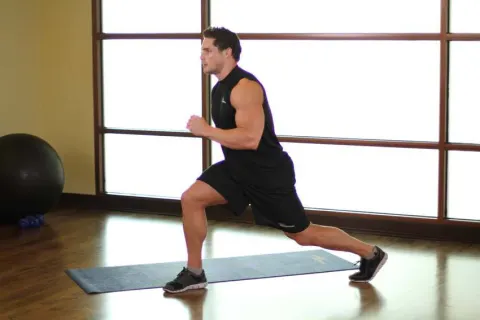

Exercises mentioned




Frequently asked questions
Is 10,000 steps a day necessary?
No. The figure started as a marketing name for a Japanese pedometer in the 1960s, not as a research finding. Studies since then show that most of the health benefit is reached at lower counts, roughly 7,000 to 9,000 for younger adults. Ten thousand is a perfectly good target if you enjoy it, but it is not a threshold.
How many steps a day to lose weight?
Steps alone rarely cause much weight loss, but they make a calorie deficit far easier to reach. Raising your daily average by 3,000 to 4,000 steps burns roughly 100 to 160 extra kilocalories for most adults. Paired with a modest reduction in food, 8,000 to 10,000 daily steps is a practical range.
How many steps is 30 minutes of walking?
About 3,000 to 3,500 at a brisk pace of around 100 to 115 steps per minute, and closer to 2,500 at a stroll. A simple way to remember it: ten minutes of purposeful walking adds about a thousand steps, which covers roughly 700 to 800 metres for an adult of average height.
Is walking 5,000 steps a day enough?
It is clearly better than 2,000 or 3,000, and in studies each extra thousand steps is linked with lower health risk. Five thousand is still below the range where benefits level off, so treat it as a base to build from. Adding one fifteen-minute walk a day takes most people past 6,500.
Does it matter how fast I walk?
Total steps matter most, but pace adds something. Walking briskly enough to feel slightly breathless, about 100 steps a minute or more, counts as moderate-intensity exercise and trains the heart more than a slow amble. A good compromise is to keep your everyday steps relaxed and make one walk a day deliberately brisk.