Workout Plan for Beginners: Your First 12 Weeks, Step by Step
A workout plan for beginners built on three full-body days a week. See how to choose home or gym, how hard to push and what the first 12 weeks look like.
Example week
3-Day Dumbbell Workout Plan for Muscle Gain (Beginners)
A complete week you can start today: exercises, sets, reps and rest for every session, with swaps for each exercise. Open this plan on its own page (PDF) →
Split
Full Body
Sessions / week
3
Avg. session
45 min
Schedule
Mon · Wed · Fri
Warm-up (every session, ~6 min)
- 3–5 min easy cardio: brisk walk, bike, jump rope or marching in place.
- Dynamic mobility: 10 leg swings each way, 10 hip circles, 10 arm circles, 8 cat-cows.
- Ramp-up sets on the first exercise: 1–2 light sets of 8 before your working sets.
Day 1
Full Body A
Squat + push + pull
-
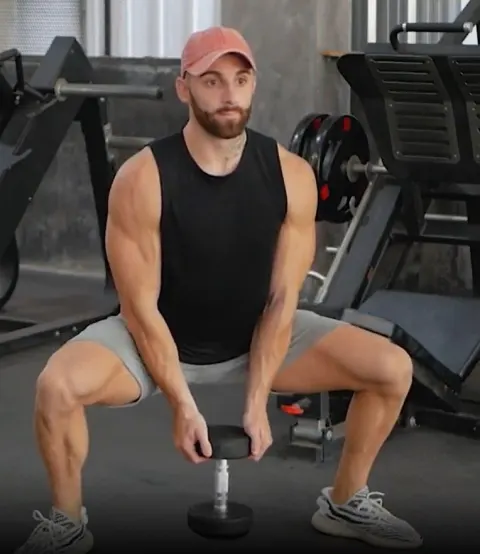
Glutes, Adductors, Quads · Dumbbell
- Sets
- 3
- Reps
- 6–10
- Rest
- 120s
- Effort
- RPE 8
-
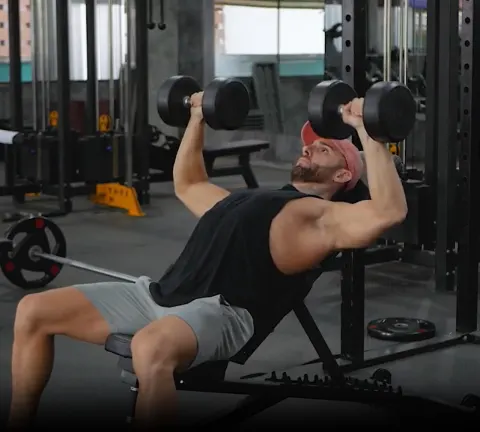
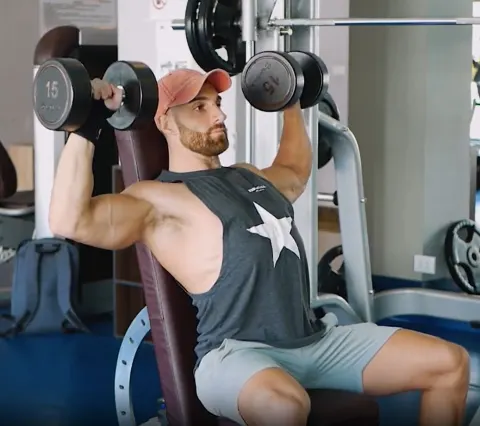
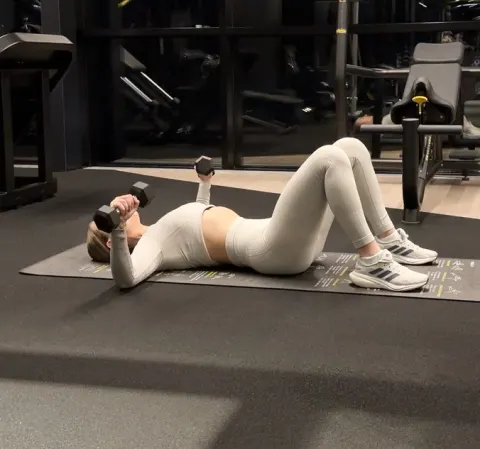
Chest, Front Delts · Dumbbell
- Sets
- 3
- Reps
- 6–10
- Rest
- 120s
- Effort
- RPE 8
-
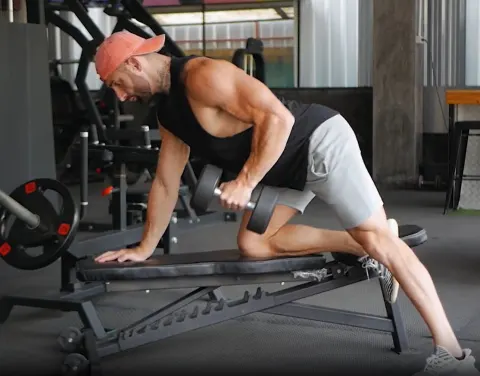
Lats, Upper Back · Dumbbell
- Sets
- 3
- Reps
- 6–10 / side
- Rest
- 120s
- Effort
- RPE 8
-
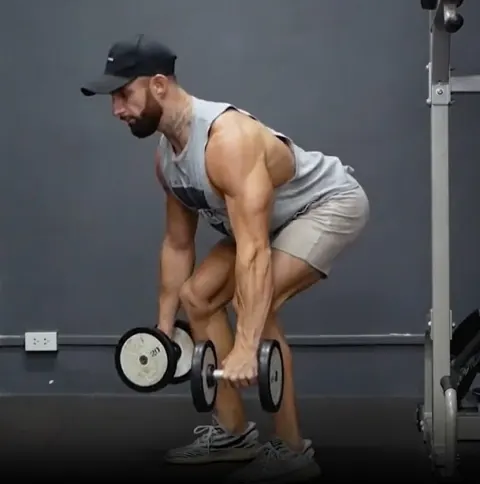
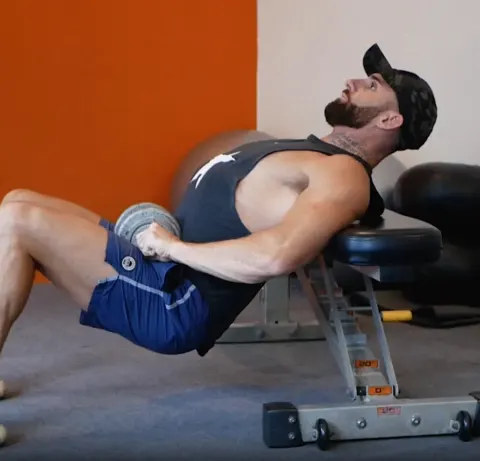
Hamstrings, Glutes · Dumbbell
- Sets
- 2
- Reps
- 8–12
- Rest
- 90s
- Effort
- RPE 8
-
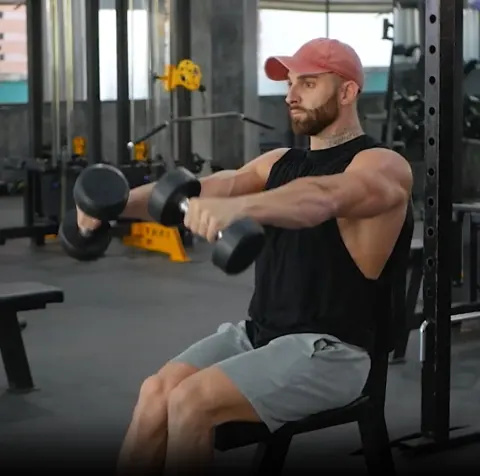
Front Delts, Side Delts · Dumbbell
- Sets
- 3
- Reps
- 10–15
- Rest
- 60s
- Effort
- RPE 8–9
-
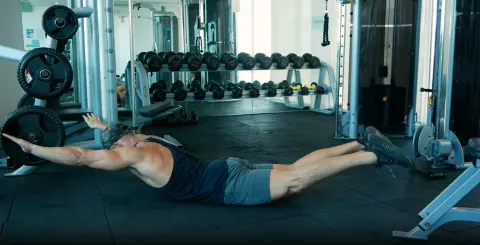
Lower Back, Glutes · Bodyweight
- Sets
- 3
- Reps
- 12–15
- Rest
- 60s
- Effort
- controlled
swap: Bird Dog, Glute Bridge, Plank
Day 2
Full Body B
Hinge + vertical push/pull
-
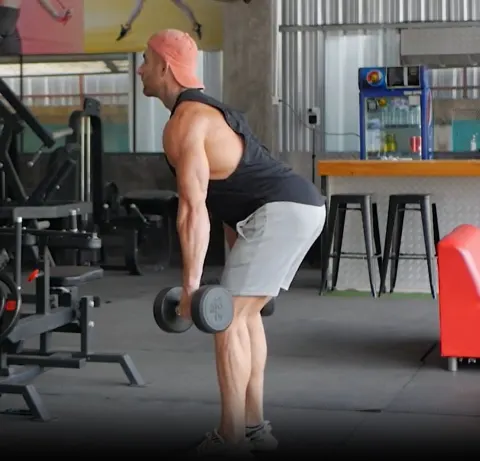
Hamstrings, Glutes · Dumbbell
- Sets
- 3
- Reps
- 6–10
- Rest
- 120s
- Effort
- RPE 8
swap: Bodyweight Hip Hinge, Dumbbell Deadlift, Bodyweight Good Morning
-
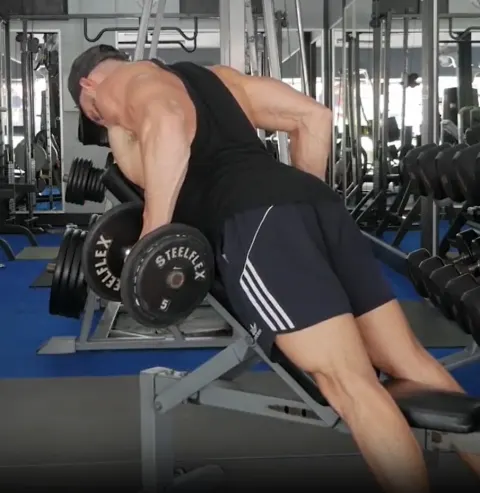
Upper Back, Lats · Dumbbell
- Sets
- 3
- Reps
- 6–10
- Rest
- 120s
- Effort
- RPE 8
swap: Dumbbell Row, Inverted Row, Rear Delt Fly
-
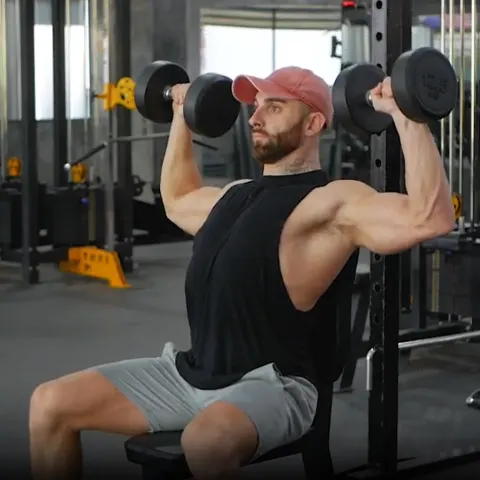
Front Delts, Side Delts · Dumbbell
- Sets
- 3
- Reps
- 6–10
- Rest
- 120s
- Effort
- RPE 8
-
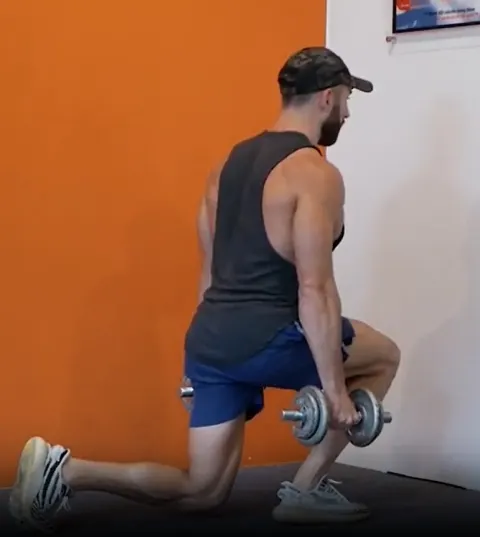
Quads, Glutes · Dumbbell
- Sets
- 2
- Reps
- 8–12 / side
- Rest
- 90s
- Effort
- RPE 8
swap: Reverse Lunge, Split Squat, Step-Up
-
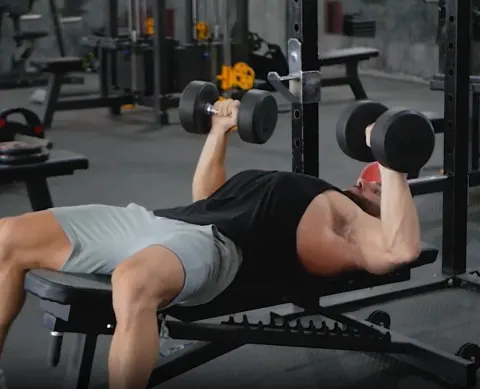
Chest, Triceps · Dumbbell
- Sets
- 3
- Reps
- 10–15
- Rest
- 60s
- Effort
- RPE 8–9
-
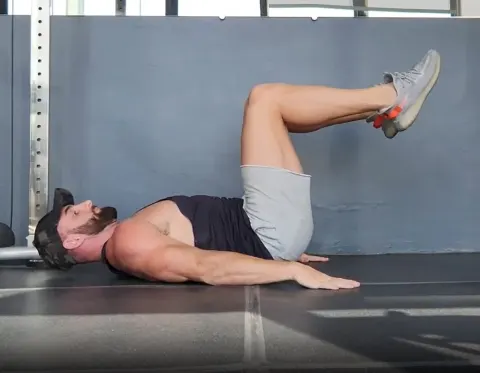
Core · Bodyweight
- Sets
- 3
- Reps
- 30–60 sec
- Rest
- 60s
- Effort
- controlled
swap: Bird Dog, Plank, Lying Leg Raise
Day 3
Full Body C
Single-leg + chest + back
-
Glutes, Adductors, Quads · Bodyweight
- Sets
- 3
- Reps
- 6–10 / side
- Rest
- 120s
- Effort
- RPE 8
swap: Sumo Squat, Forward Lunge, Reverse Lunge
-
Chest, Triceps · Dumbbell
- Sets
- 3
- Reps
- 6–10
- Rest
- 120s
- Effort
- RPE 8
-
Upper Back, Lats · Bodyweight
- Sets
- 3
- Reps
- 6–10
- Rest
- 120s
- Effort
- RPE 8
-
Front Delts · Dumbbell
- Sets
- 3
- Reps
- 10–15
- Rest
- 60s
- Effort
- RPE 8–9
swap: Dumbbell Shoulder Press, Dumbbell Lateral Raise, Dumbbell Shrug
-
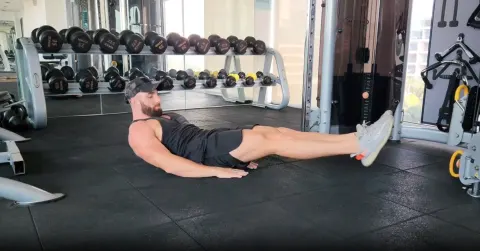
Core, Hip Flexors · Bodyweight
- Sets
- 3
- Reps
- 30–60 sec
- Rest
- 60s
- Effort
- controlled
swap: Lying Leg Raise, Dead Bug, Bicycle Crunch
8-week progression: what to change each week
Same exercises for the whole block. Weeks move the reps, then the load; the last week is a deload.
| Week | Load | Reps | Effort | What to watch |
|---|---|---|---|---|
| 1 | Light: learn the movements | bottom of range (6–8) | RPE 6–7 | Stop every set 3 reps before failure; film one set per exercise to check form. |
| 2 | Same weight | +1 rep per set (8–9) | RPE 8 | Same exercises, same order; only the reps move. |
| 3 | Same weight | top of range (9–10) | RPE 8 | All sets at the top of the range → add load next week. Missed a set? Repeat the week. |
| 4 | next dumbbell / harder variation | bottom of range (6–8) | RPE 8 | New weight feels hard at low reps; that is the plan working. |
| 5 | Same weight | +1 rep per set (8–9) | RPE 8 | Keep rest periods the same. |
| 6 | Same weight | top of range (9–10) | RPE 8–9 | Second time at the top: take the last set of each main lift to 1 rep in reserve. |
| 7 | next dumbbell / harder variation | bottom of range (6–8) | RPE 8 | Bodyweight moves: slow the lowering phase to 3 s or move to the harder variation. |
| 8 | Deload: 60 % | bottom of range | RPE 5–6 | Half the sets, then regenerate a variation or change the split for the next block. |
How to progress
- First 2 weeks: focus on form with light weights, stop each set 3 reps before failure.
- Double progression: hit the top of the rep range on every set, then add weight (2.5–5 %) and start from the bottom of the range.
- Bodyweight moves: add reps, then slow the tempo (3 sec down), then move to a harder variation.
- Deload every 6–8 weeks: same exercises, half the sets.
Notes for this plan
- Home setup: if a weight gets too light, slow the lowering phase to 3–4 seconds or add a pause at the hardest point.
- Sessions can move between days; keep at least one rest day between hard sessions for the same muscles.
Start with three full-body sessions a week, around 45 minutes each, built from a handful of basic movements, and add a rep or a little weight whenever a set stops being challenging. That is exactly what the example week above does. The rest of this page covers the decisions around it: where to train, how many days, how hard to push and what your first three months should look like.
Three decisions before your first session
Where you train. Home and gym both work for the first year. A gym offers barbells, machines and small weight jumps. Home offers zero travel time, which is often what decides whether session number 20 happens. If the gym is more than 15 minutes away, start at home.
- No kit at all: the home workout plan for beginners uses a chair, a table and floor space.
- Two or three pairs of weights: the dumbbell plan for beginners explains what to buy and how to start.
- A membership: the gym plan for beginners covers your first weeks on the gym floor.
Which goal. Muscle gain, fat loss, strength or general fitness. For a novice the training differs less than you would think: the rep ranges shift a little and fat-loss plans end with a short conditioning finisher.
Which days. Put sessions on fixed weekdays and treat them as appointments. “Whenever I find time” produces about one workout a week.
Two, three or four days a week?
| Days | How the week is split | Suggested days | Who it suits |
|---|---|---|---|
| 2 | Full body A and B | Mon, Thu | Shift workers, parents of small children, anyone returning after a long break |
| 3 | Full body A, B and C | Mon, Wed, Fri | Most beginners. This is the default |
| 4 | Upper/lower, each twice | Mon, Tue, Thu, Fri | People who are already active and want a fourth session |
There are no five- or six-day beginner plans on this site, on purpose. In the first months your limit is skill and recovery, not training time, and a fifth session mostly adds fatigue. Our guide on how many days a week to work out has the detail.
Why the example week uses three full-body days
Every session in the example trains legs, a push, a pull and the core, so each muscle is worked two or three times a week. For a beginner that frequency matters more than volume: you are learning movements, and a squat practised three times a week improves faster than one practised once. This layout is called a full-body split.
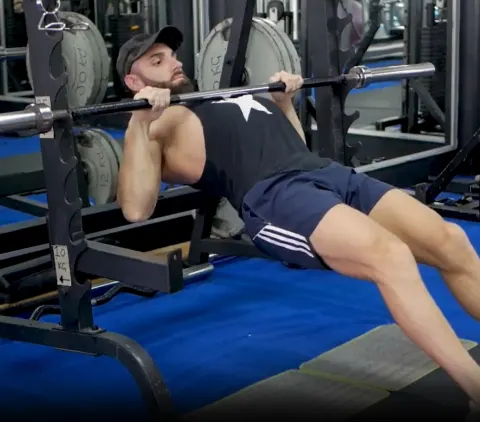
The three days are not copies. Each opens with a different lower-body pattern: a squat on the first day, a hip hinge on the second, a lunge on the third. After that comes a press and a row, taken from a different angle each time, then a second leg movement, a shoulder or chest accessory and a core exercise. No workout goes beyond six exercises. One of the rows is an inverted row under a sturdy table or bar; with neither at hand, choose another dumbbell row from its alternatives.
The set counts are deliberately modest: 3 sets of 6–10 reps on the first three lifts with 2 minutes of rest, 2 sets of 8–12 on the fourth, and 3 sets of 10–15 reps with 60 seconds of rest on the smaller movements. The big lifts carry one set fewer than the intermediate version of the same week. It adds up to roughly 9 hard sets a week for chest, back and shoulders and more for legs: just under the 10–20 that experienced lifters use, and plenty for a body that has never done this before.
Your first 12 weeks, phase by phase
| Weeks | What you work on | Effort | What you should notice |
|---|---|---|---|
| 1–2 | Learning each movement, finding starting weights | RPE 6–7, about 3 reps left | Sore legs for a day or two, wobbly reps getting smoother |
| 3–4 | Climbing to the top of each rep range, first load increase | 2–3 reps left | The same weights feel clearly lighter |
| 5–7 | Adding load, restarting at the bottom of the range | RPE 7–8, about 2 reps left | A new best on some lift nearly every week |
| 8 | Deload: about 60 % of the weight, half the sets | Easy | Small aches clear, motivation returns |
| 9–12 | A second run with heavier starting weights | 1–2 reps left on the last set | Changes in the mirror and in how clothes fit |
Expect your main lifts to rise 30–50 % in the first eight weeks. Most of that is technique and coordination rather than new muscle, and it is still real progress.
How hard should a set feel?
Use RPE, a 1–10 scale of effort. RPE 7 means you could have done three more reps; RPE 9 means one. For the first fortnight stay at 6–7. You are practising, and a set that ends with clean reps teaches more than one that ends in a grind.
To find a starting weight, pick one you could lift for three or four reps more than the plan asks. Say the plan lists 6–10 dumbbell rows and you manage 10, 10 and 9 with 8 kg: keep the 8s next time. Once every set reaches 10, pick up the 10 kg and start again at 6 reps. Add reps or add weight, never both in one session.
Soreness, rest days and food
Muscle soreness a day or two after training has a name, DOMS, and it peaks 24–48 hours after a session. It is strongest in week one and mostly gone by week three.
- Mild stiffness: train as planned. The warm-up usually clears it.
- Still struggling with stairs after 72 hours: you did too much. Remove one set per exercise next session.
- Sharp or one-sided joint pain is not soreness. Swap the exercise for one of the alternatives listed in the plan.
Sleep 7–9 hours and eat 1.6–2.2 g of protein per kg of body weight; the protein intake calculator turns that into a daily number.
Making the plan stick
- Anchor it. Same days, same time, straight after something you already do, such as the school run or the end of work.
- Have a minimum session. On bad days do only the first three exercises. Twenty minutes keeps the habit alive.
- Log everything. Exercise, weight, reps. Watching the numbers climb is what replaces motivation after week four.
- Never miss twice. One skipped session changes nothing. Two in a row is the start of quitting.
Mistakes that stall new lifters
- Starting with five sessions a week. By week three the plan collapses. Three done beats five planned.
- Going to failure from day one. It makes you too sore to train again and teaches sloppy reps.
- Changing program every fortnight. Progress comes from repeating the same lifts with slightly more load.
- Skipping the lower-body work. Squats and hinges train the largest muscles you have.
Which beginner plan to pick, and when to leave it
- The example above is the 3-day dumbbell plan for muscle gain for beginners.
- Only two free evenings and no kit: the 2-day no-equipment beginner plan.
- Fat loss with a gym membership: the 3-day gym plan for weight loss for beginners.
Stay on a beginner plan while you can add a rep or some load most weeks, usually three to six months. When progress slows to once every two or three weeks, rebuild the week in the plan generator at intermediate level, which adds a set to the big lifts, or step up to a 4-day workout plan.
Workout Plan for Beginners: all 60 plans
- 2-Day Dumbbell Workout Plan for Weight Loss (Beginners)
- 2-Day Dumbbell Workout Plan for Muscle Gain (Beginners)
- 2-Day Dumbbell Workout Plan for Strength (Beginners)
- 2-Day Dumbbell Workout Plan for General Fitness (Beginners)
- 2-Day Gym Workout Plan for Weight Loss (Beginners)
- 2-Day Gym Workout Plan for Muscle Gain (Beginners)
- 2-Day Gym Workout Plan for Strength (Beginners)
- 2-Day Gym Workout Plan for General Fitness (Beginners)
- 2-Day Kettlebell Workout Plan for Weight Loss (Beginners)
- 2-Day Kettlebell Workout Plan for Muscle Gain (Beginners)
- 2-Day Kettlebell Workout Plan for General Fitness (Beginners)
- 2-Day Resistance Band Workout Plan for Weight Loss (Beginners)
- 2-Day Resistance Band Workout Plan for Muscle Gain (Beginners)
- 2-Day Resistance Band Workout Plan for General Fitness (Beginners)
- 2-Day Calisthenics Workout Plan for Weight Loss (Beginners)
- 2-Day Calisthenics Workout Plan for Muscle Gain (Beginners)
- 2-Day Calisthenics Workout Plan for General Fitness (Beginners)
- 3-Day Dumbbell Workout Plan for Weight Loss (Beginners)
- 3-Day Dumbbell Workout Plan for Muscle Gain (Beginners)
- 3-Day Dumbbell Workout Plan for Strength (Beginners)
- 3-Day Dumbbell Workout Plan for General Fitness (Beginners)
- 3-Day Gym Workout Plan for Weight Loss (Beginners)
- 3-Day Gym Workout Plan for Muscle Gain (Beginners)
- 3-Day Gym Workout Plan for Strength (Beginners)
- 3-Day Gym Workout Plan for General Fitness (Beginners)
- 3-Day Kettlebell Workout Plan for Weight Loss (Beginners)
- 3-Day Kettlebell Workout Plan for Muscle Gain (Beginners)
- 3-Day Kettlebell Workout Plan for General Fitness (Beginners)
- 3-Day Resistance Band Workout Plan for Weight Loss (Beginners)
- 3-Day Resistance Band Workout Plan for Muscle Gain (Beginners)
- 3-Day Resistance Band Workout Plan for General Fitness (Beginners)
- 3-Day Calisthenics Workout Plan for Weight Loss (Beginners)
- 3-Day Calisthenics Workout Plan for Muscle Gain (Beginners)
- 3-Day Calisthenics Workout Plan for General Fitness (Beginners)
- 4-Day Dumbbell Workout Plan for Weight Loss (Beginners)
- 4-Day Dumbbell Workout Plan for Muscle Gain (Beginners)
- 4-Day Dumbbell Workout Plan for Strength (Beginners)
- 4-Day Dumbbell Workout Plan for General Fitness (Beginners)
- 4-Day Gym Workout Plan for Weight Loss (Beginners)
- 4-Day Gym Workout Plan for Muscle Gain (Beginners)
- 4-Day Gym Workout Plan for Strength (Beginners)
- 4-Day Gym Workout Plan for General Fitness (Beginners)
- 4-Day Kettlebell Workout Plan for Weight Loss (Beginners)
- 4-Day Kettlebell Workout Plan for Muscle Gain (Beginners)
- 4-Day Kettlebell Workout Plan for General Fitness (Beginners)
- 4-Day Resistance Band Workout Plan for Weight Loss (Beginners)
- 4-Day Resistance Band Workout Plan for Muscle Gain (Beginners)
- 4-Day Resistance Band Workout Plan for General Fitness (Beginners)
- 4-Day Calisthenics Workout Plan for Weight Loss (Beginners)
- 4-Day Calisthenics Workout Plan for Muscle Gain (Beginners)
- 4-Day Calisthenics Workout Plan for General Fitness (Beginners)
Related programs
Frequently asked questions
How many days a week should a beginner work out?
Three non-consecutive days, such as Monday, Wednesday and Friday, suit most beginners. Each muscle gets trained two or three times a week and there is a rest day after every session. Two days still works if your schedule is tight. Four is the upper limit worth considering in the first six months.
How long should a beginner workout last?
About 40 to 50 minutes including a five-minute warm-up. That covers six exercises at two or three sets each with proper rests. If a session runs past an hour you are either resting far too long or adding exercises the plan does not ask for.
Should a beginner do cardio or weights first?
Weights first if getting stronger or building muscle is the goal, because technique suffers when you are already tired. Keep cardio to a three to five minute warm-up before lifting, then walk or do longer cardio afterwards or on the days between sessions.
How long does it take a beginner to see results?
Strength goes up within two to three weeks as your coordination improves, and most lifts rise 30 to 50 percent in the first eight weeks. Changes you can see in the mirror usually take 8 to 12 weeks of three sessions a week plus enough protein and sleep.
Can a beginner work out every day?
You can move every day, but lifting every day is a poor idea in the first months. Muscles and tendons adapt between sessions, not during them. Lift two to four days a week, walk on the others, and you will progress faster than someone doing seven tired sessions.