How to Do More Push-Ups: Progression and 4-Week Plan
How to do more push-ups: the progression from wall to incline, knee and full push-ups, correct form, grease-the-groove practice and a 4-week plan.
To do more push-ups, practise them more often while staying short of failure. Start with a version you can do for at least 5 clean reps (wall, incline or knee), do several sets of roughly half to two thirds of your maximum three or four days a week, and retest every four weeks. Frequent, submaximal practice raises your push-up count faster than occasional all-out sets.
Get the form right first
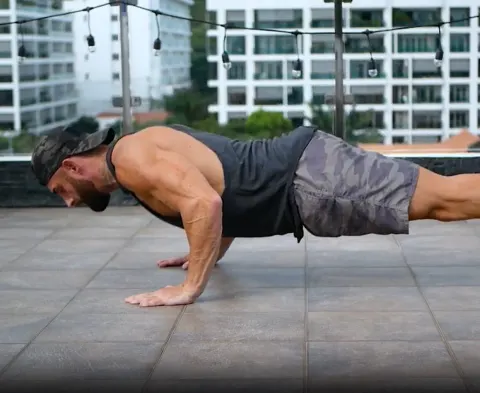
More reps only count if each rep is the same. A strict push-up:
- Hands slightly wider than shoulders, fingers forward, under the lower chest, not up by the ears.
- Body in one line from head to heels. Squeeze glutes and brace your abs as in a plank.
- Elbows angle back at roughly 30–45 degrees from your sides, not flared straight out.
- Depth: lower until your chest is a fist-height from the floor or touches it.
- Top: press until arms are straight, without letting the hips sag or pike.
If your hips drop first, the weak link is your midsection, not your arms. Add planks and use an easier push-up variation until the line holds. Full details are on the push-up exercise page.
The progression: wall to floor
The lower your hands, the more of your body weight you lift. Work down this ladder.
| Level | Variation | Roughly how much body weight | Move on when you can do |
|---|---|---|---|
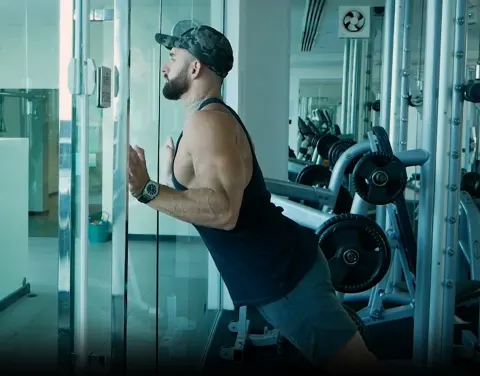
| 1 | Wall push-up | 10–20 % | 3 × 15 |
| 2 | Incline push-up, hands on a counter or table | 35–50 % | 3 × 12 |
| 3 | Incline push-up, hands on a chair or low step | 50–60 % | 3 × 10 |
| 4 | Knee push-up | about 50 % | 3 × 12 |
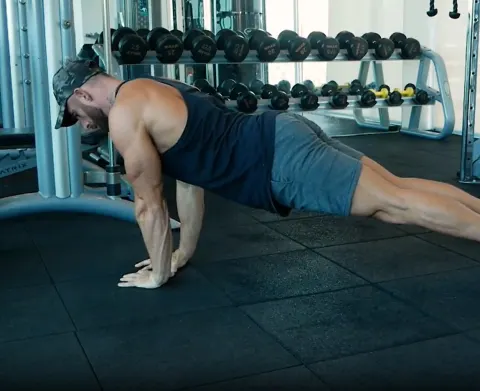
| 5 | Full push-up | 65–70 % | 3 × 5, then start the plan below |
Tips for the ladder:
- Inclines beat knees for most people, because your body stays in the same straight line you will need on the floor. Use stairs: each step down is a small, measurable increase.
- Add slow negatives. From the top of a full push-up, lower for 4–5 seconds, then drop to your knees to press up. Three sets of 3–5 bridges the gap between levels 4 and 5.
- Stay strict. Half reps at a harder level build less than full reps at an easier one.
Why submaximal practice works
Push-up endurance is partly strength and partly skill. Every clean rep teaches your nervous system to fire the chest, shoulders and triceps more efficiently. Sets taken to failure produce a lot of fatigue for only a few extra reps, and they limit how often you can train.
So do most of your work at 50–70 percent of your maximum. If your best set is 12, your training sets are 6–8. It feels too easy, and that is the point: you can repeat it tomorrow.
Grease the groove
“Grease the groove” means spreading easy sets through the day:
- Test your maximum strict set.
- Do sets of about half that number, 4–6 times a day, at least an hour apart.
- Never go near failure. Each set should feel crisp.
- Do this 4–5 days a week and retest after two weeks.
It suits people who work from home or can drop to the floor between tasks. If that is not you, use the session-based plan below.
The 4-week plan
First, test: one set of as many strict reps as possible. Call that number M. Train three days a week with a rest day between, 60–90 seconds between sets. Round fractions up.
| Week | Day 1 | Day 2 | Day 3 |
|---|---|---|---|
| 1 | 5 sets × 50 % of M | 5 sets × 50 % of M | 4 sets × 60 % of M |
| 2 | 5 sets × 60 % of M | 6 sets × 50 % of M | 5 sets × 60 % of M, last set max |
| 3 | 5 sets × 70 % of M | 6 sets × 60 % of M | 5 sets × 70 % of M, last set max |
| 4 | 4 sets × 60 % of M | 3 sets × 50 % of M | Rest 2 days, then retest M |
Example with M = 10: week 1 is 5 × 5, 5 × 5, 4 × 6. Week 3 is 5 × 7, 6 × 6, 5 × 7 with an all-out final set. An “as many reps as possible” set is known as AMRAP, and one per week is enough.
After the retest, start again with your new M. A gain of 20–40 percent per cycle is common for beginners; it slows as the numbers climb. If you prefer a daily schedule with the targets written out, follow the 30-day push-up challenge.
Build the muscles that push
Practice alone stalls eventually. Once or twice a week, add work that makes the pushing muscles stronger:
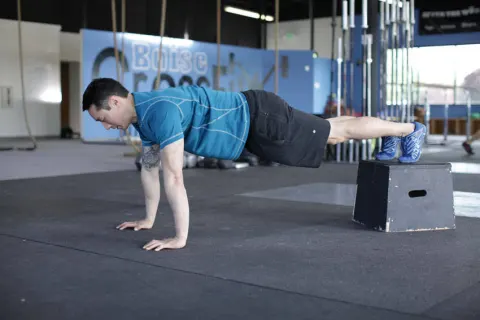
- Harder variations for low reps. Decline push-ups with feet on a chair, or slow 3-second lowering, for 3 × 5–8. Strength gained here makes ordinary reps feel light.
- Triceps. Diamond push-ups or bench dips, 2–3 × 6–12.
- Core. Planks and hollow holds, 3 × 30 s.
- Pulling. Rows or pull-ups balance all the pressing and keep shoulders comfortable. See how to do your first pull-up.
The chest workout at home covers the pushing side in one session, and the 10-minute upper-body workout is a quick option on busy days.
Common reasons the count is stuck
- Maxing out every session. Failure every day means you never recover. Keep most sets easy.
- Changing form to hit a number. Flared elbows, half depth and sagging hips inflate the count and hide the lack of progress.
- Training once a week. Push-ups respond to frequency. Three short sessions beat one long one.
- No stronger variation. If you can do 25, sets of 25 are endurance work. Add a harder version.
- Body weight creeping up. A push-up moves a share of your body, so a few kilograms either way changes the count.
- Sore wrists. Use push-up handles or dumbbells to keep the wrist straight, or make fists on a mat.
Where push-ups fit in a full routine
Push-ups cover chest, front shoulders and triceps. A balanced week also needs a pull, a squat, a hinge and core work. The bodyweight workout plan builds that around push-ups, and the no-equipment home workout guide explains how to keep progressing without weights.
If you feel sharp pain in the shoulder, elbow or wrist, stop and try an incline. Pain that persists, or a previous injury in those joints, is a reason to see a doctor or physiotherapist before continuing.
Ready plans for this guide

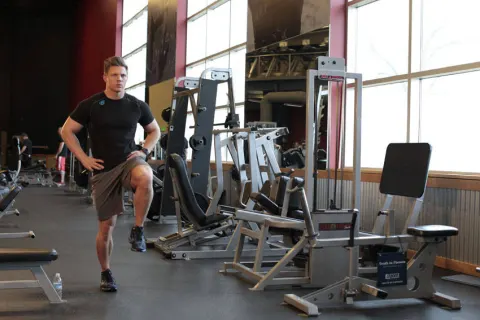
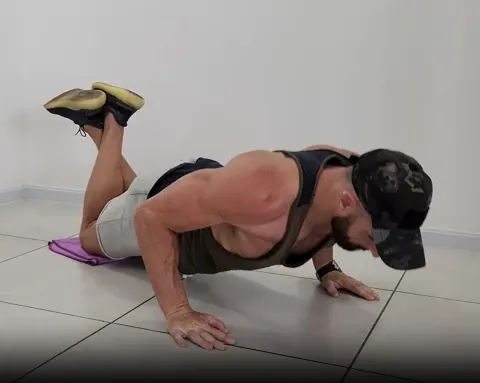
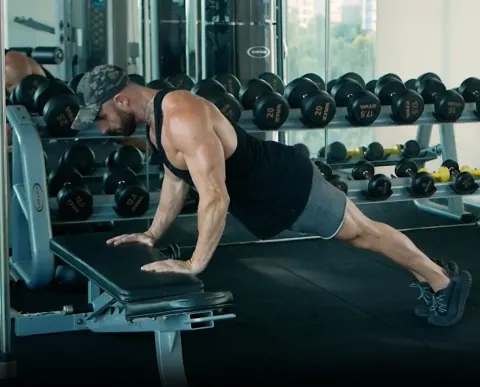
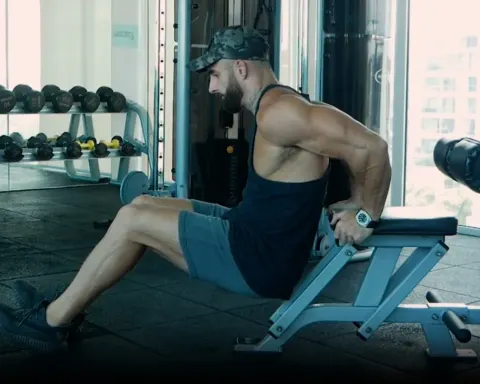
Exercises mentioned
 video
beginner
video
beginner
video
beginner
 video
beginner
 video
intermediate
 intermediate
Frequently asked questions
How many push-ups should I be able to do?
There is no official standard, but rough benchmarks help. For adults under 40, ten to twenty strict reps is a decent general level for men and five to fifteen for women. Numbers fall with age. What matters more is that your count goes up over a few months and every rep uses full range.
Why can't I do a push-up?
Usually because the full version is simply too heavy for your current strength: a push-up from the toes loads the arms with around two thirds of your body weight. The other common cause is a sagging midsection. Reducing the load with an incline lets you train the exact pattern until your strength catches up.
Should I do push-ups every day?
You can, as long as daily sets are easy, about half of your maximum, and nothing hurts. That is how grease-the-groove practice works. Hard sessions where you push close to failure need at least a day between them. Wrists, elbows and shoulders are the early warning signs if you overdo it.
Are knee push-ups or incline push-ups better?
Incline push-ups are generally the better tool. They keep the same straight-body position as a full push-up, and you can lower the surface a little at a time. Knee push-ups shorten the lever and train the core less, though they remain useful when you have nothing to lean on.
How long does it take to go from 10 to 30 push-ups?
With three or four sessions a week, most people need two to three months. The first extra ten reps come quickly, the next ten more slowly. Progress depends on body weight, sleep and whether you practise below failure most of the time, since constant max-outs tend to stall the count.