Bodyweight Workout Plan: No-Equipment Progressions That Keep Working
A bodyweight workout plan that keeps getting harder: progression ladders for push, squat, hinge and core, plus fixes for pulling without a bar.
Example week
3-Day Bodyweight Workout Plan for General Fitness
A complete week you can start today: exercises, sets, reps and rest for every session, with swaps for each exercise. Open this plan on its own page (PDF) →
Split
Full Body
Sessions / week
3
Avg. session
29 min
Schedule
Mon · Wed · Fri
Warm-up (every session, ~6 min)
- 3–5 min easy cardio: brisk walk, bike, jump rope or marching in place.
- Dynamic mobility: 10 leg swings each way, 10 hip circles, 10 arm circles, 8 cat-cows.
- Ramp-up sets on the first exercise: 1–2 light sets of 8 before your working sets.
Day 1
Full Body A
Squat + push + pull
-
Upper Back, Lats · Bodyweight
- Sets
- 2
- Reps
- 8–10
- Rest
- 90s
- Effort
- RPE 7
swap: Doorway Row, Reverse Snow Angel
-
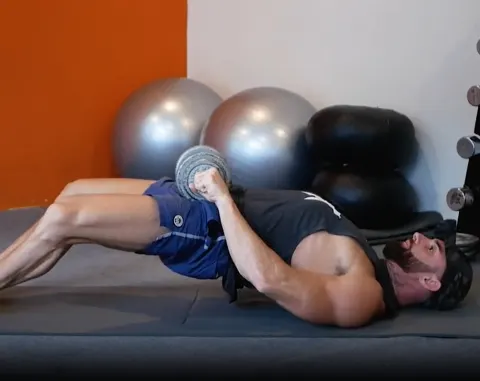
Hamstrings, Glutes · Bodyweight
- Sets
- 2
- Reps
- 8–12 / side
- Rest
- 75s
- Effort
- RPE 7
swap: Bodyweight Hip Hinge, Glute Bridge, Bodyweight Good Morning
-
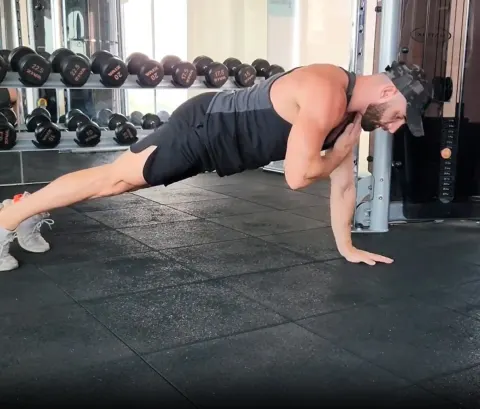
Core, Obliques · Bodyweight
- Sets
- 2
- Reps
- 30–60 sec
- Rest
- 45s
- Effort
- controlled
swap: Plank, Mountain Climber, Bird Dog
Day 2
Full Body B
Hinge + vertical push/pull
-
Hamstrings, Glutes · Bodyweight
- Sets
- 2
- Reps
- 8–10
- Rest
- 90s
- Effort
- RPE 7
-
Upper Back, Lats · Bodyweight
- Sets
- 2
- Reps
- 8–10
- Rest
- 90s
- Effort
- RPE 7
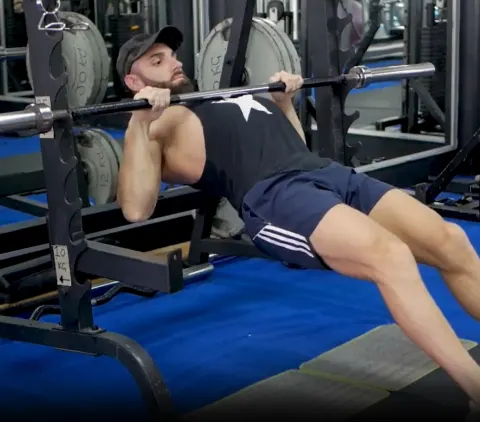
swap: Inverted Row, Reverse Snow Angel
-
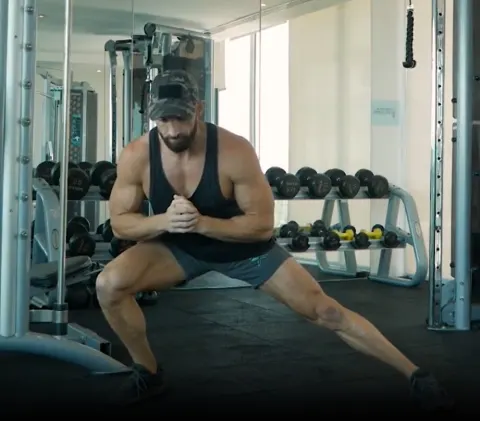
Glutes, Adductors, Quads · Bodyweight
- Sets
- 2
- Reps
- 8–12 / side
- Rest
- 75s
- Effort
- RPE 7
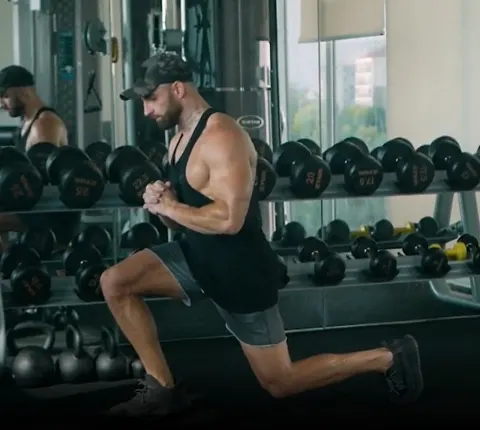
swap: Forward Lunge, Reverse Lunge, Split Squat
-
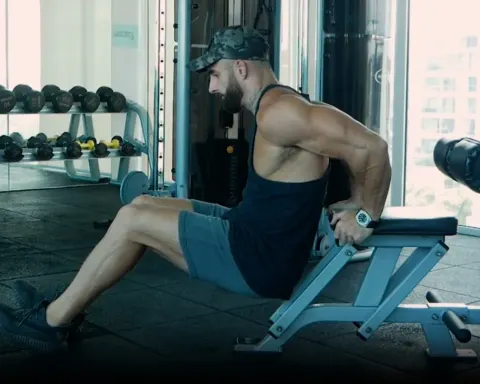
Triceps · Bodyweight
- Sets
- 2
- Reps
- 12–15
- Rest
- 60s
- Effort
- RPE 7
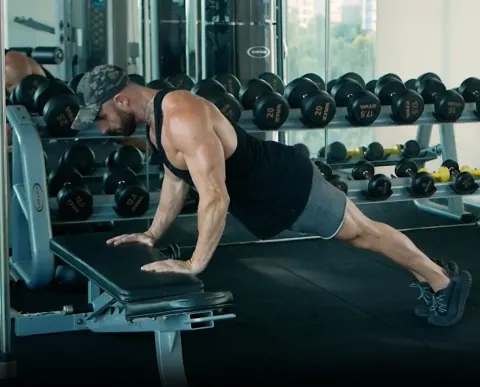
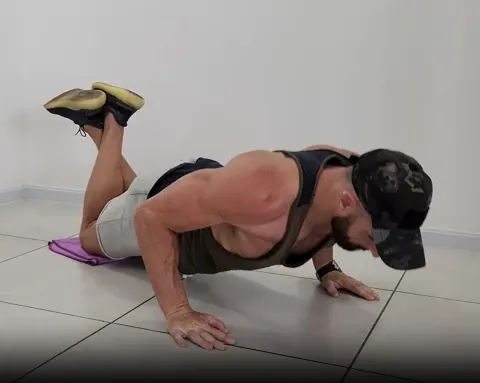
swap: Incline Push-Up, Knee Push-Up, Push-Up
-
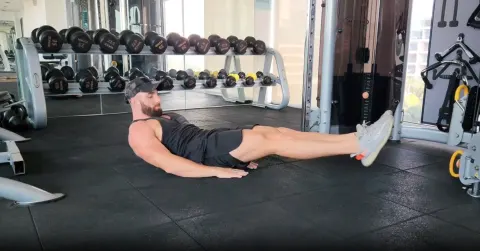
Core, Hip Flexors · Bodyweight
- Sets
- 2
- Reps
- 30–60 sec
- Rest
- 45s
- Effort
- controlled
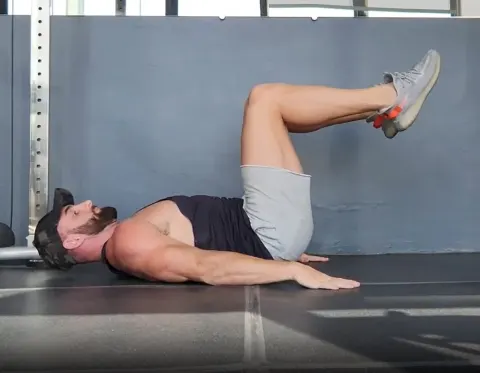
swap: Lying Leg Raise, Dead Bug, Bicycle Crunch
Day 3
Full Body C
Single-leg + chest + back
-
Quads, Glutes · Bodyweight
- Sets
- 2
- Reps
- 8–10 / side
- Rest
- 90s
- Effort
- RPE 7
swap: Reverse Lunge, Walking Lunge, Split Squat
-
Upper Back, Lats · Bodyweight
- Sets
- 2
- Reps
- 8–10
- Rest
- 90s
- Effort
- RPE 7
swap: Doorway Row, Reverse Snow Angel
-
Core · Bodyweight
- Sets
- 2
- Reps
- 30–60 sec
- Rest
- 45s
- Effort
- controlled
swap: Bird Dog, Plank, Lying Leg Raise
8-week progression: what to change each week
Same exercises for the whole block. Weeks move the reps, then the load; the last week is a deload.
| Week | Load | Reps | Effort | What to watch |
|---|---|---|---|---|
| 1 | Light: learn the movements | bottom of range (8) | RPE 6–7 | Stop every set 3 reps before failure; film one set per exercise to check form. |
| 2 | Same weight | +1 rep per set (9) | RPE 8 | Same exercises, same order; only the reps move. |
| 3 | Same weight | top of range (10) | RPE 8 | All sets at the top of the range → add load next week. Missed a set? Repeat the week. |
| 4 | next dumbbell / harder variation | bottom of range (8) | RPE 8 | New weight feels hard at low reps; that is the plan working. |
| 5 | Same weight | +1 rep per set (9) | RPE 8 | Keep rest periods the same. |
| 6 | Same weight | top of range (10) | RPE 8–9 | Second time at the top: take the last set of each main lift to 1 rep in reserve. |
| 7 | next dumbbell / harder variation | bottom of range (8) | RPE 8 | Bodyweight moves: slow the lowering phase to 3 s or move to the harder variation. |
| 8 | Deload: 60 % | bottom of range | RPE 5–6 | Half the sets, then regenerate a variation or change the split for the next block. |
How to progress
- First 2 weeks: focus on form with light weights, stop each set 3 reps before failure.
- Double progression: hit the top of the rep range on every set, then add weight (2.5–5 %) and start from the bottom of the range.
- Bodyweight moves: add reps, then slow the tempo (3 sec down), then move to a harder variation.
- Deload every 6–8 weeks: same exercises, half the sets.
Notes for this plan
- Home setup: if a weight gets too light, slow the lowering phase to 3–4 seconds or add a pause at the hardest point.
- Sessions can move between days; keep at least one rest day between hard sessions for the same muscles.
Bodyweight training works when you treat it like lifting: a fixed set of movements, a rep range and a rule for making each one harder. Without that rule it turns into endless push-ups and squats that stopped being difficult months ago. This page is about the rule.
Leverage is your weight plate
You cannot add 2.5 kg to a push-up, but you can change how much of your body the working muscles have to carry. Bodyweight training has three dials:
- Angle. With hands on a kitchen counter you press roughly 40 % of your body weight. On the floor it is about 65 %, and with feet on a chair more again.
- Limbs. Two legs share the load in a squat. A split squat shifts most of it to the front leg, and a single-leg version takes all of it.
- Speed. A 3-second lowering phase and a 1-second pause add time under tension without changing the exercise.
Every progression below is one of these dials turned a notch.
Progression ladders for the four basics
| Pattern | Rung 1 | Rung 2 | Rung 3 | Rung 4 |
|---|---|---|---|---|
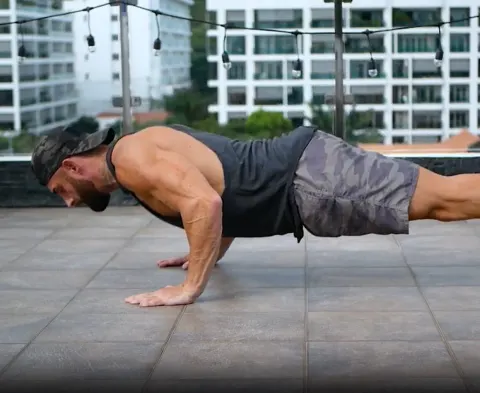
| Push | Incline push-up | Knee push-up or a lower incline | Push-up | Decline or diamond push-up |
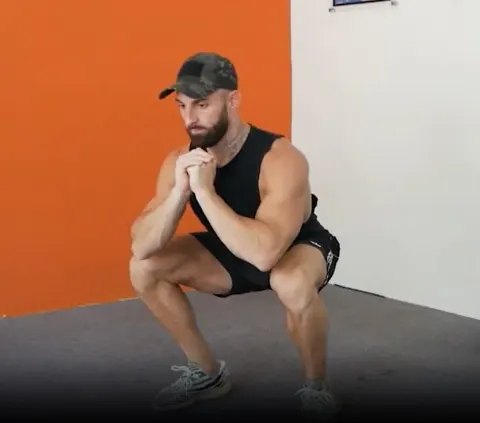
| Squat | Chair squat | Bodyweight squat | Split squat | Step-up, then pistol squat practice |
| Hinge | Glute bridge, bodyweight good morning | Single-leg hip hinge with a hand on the wall | Single-leg glute bridge | Sliding leg curl, free-standing single-leg hinge with a 3-second lowering |
| Core | Dead bug | Plank | Side plank, plank shoulder tap | Hollow body hold, V-up |
Find your rung with a simple test: the right variation is the one where a clean set ends between 8 and 12 reps with 2–3 still in reserve, or 20–40 seconds for holds. Different patterns will sit on different rungs. Most people squat a rung or two ahead of where they push.
When to climb a rung
The rule has three stages, always in this order:
- Add reps. Take every set to the top of the listed range.
- Slow down. Keep the variation, lower for 3 seconds and build the reps back up.
- Move up. Switch to the next rung and begin at the bottom of the range.
A worked example for a push written as 2 sets of 8–10:
- Weeks 1–2: incline push-ups on a table go from 8, 8 to 10, 10.
- Weeks 3–4: same table, 3-second lowering. Reps drop to 8, 7 and climb back to 10, 10.
- Week 5: hands move down to a sofa seat. Back to 8, 8.
Stage two is the one people skip, and it is why they stall. Jumping from an easy 10 on the table straight to the floor often means 4 ugly reps. The slow stage closes that gap. It is the bodyweight form of double progression.
How the example week applies it
The example week above is a general fitness plan: three full-body sessions of about 30 minutes on non-consecutive days, 2 sets per exercise, 8–10 reps on the main movements, 45–90 seconds of rest and an effort of about RPE 7. Day A is built around a squat, a push and a row, day B around a hinge, a second row and a shoulder-biased push, day C around a lunge, another pressing angle and a third row. There is no vertical pull, because that needs a bar.
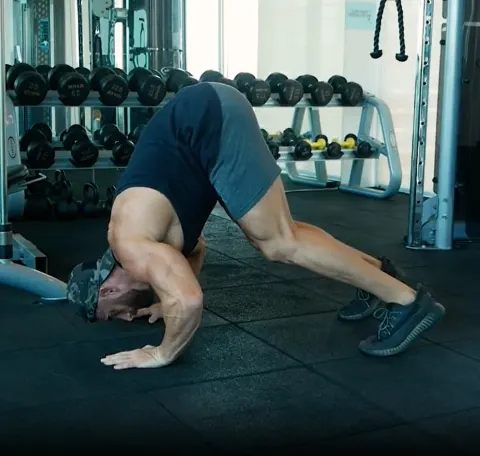
The exercises shown are the default rung, and for some of them that default is ambitious. If floor push-ups stop short of 8 clean reps, use the incline version on every pushing day; if a pike push-up is too much, raise your hands onto a chair. Each exercise in the plan comes with alternatives of the same pattern, so drop or climb a rung and keep the sets and reps. The complete version is the 3-day no-equipment plan for general fitness. If size is the aim, the 3-day no-equipment plan for muscle gain uses the same ladders with more sets and harder efforts.
The pulling problem
Gravity only pulls down, so pushing and leg work come free and pulling does not. A week without rows builds the front of the body and neglects the back. Fixes, from zero cost upward:
- A door frame. The doorway row is light, but it is a real row. Walk your feet forward to make it harder.
- A sturdy table. Lie underneath, grip the edge and do an inverted row. Bent knees are the easy rung, straight legs the middle one, feet on a chair the hard one. Test the table with your full weight first.
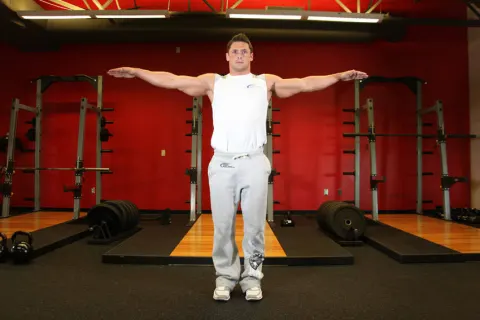
- The floor. Reverse snow angels and prone Y raises train the upper back and rear shoulders with nothing at all. They do not replace rows, but they belong in every warm-up.
- A bar. The only route to vertical pulling.
When a pull-up bar is worth it
Buy one when inverted rows with straight legs pass 12 reps. Before that, cheaper progress is still available. After that, a doorway bar opens a new ladder: scapular pull-ups, slow negatives (jump up, lower for 5 seconds), then chin-ups, while hanging knee raises give the core ladder a fifth rung. Once the bar is up, switch the equipment setting to Calisthenics, which is bodyweight plus a bar: the 3-day calisthenics plan for muscle gain builds the same kind of week around those pulls.
Why there is no bodyweight strength plan
The catalog has bodyweight plans for general fitness, weight loss and muscle gain on 2 to 6 days a week, but none for pure strength. Strength programming means 4–6 heavy reps and a small, fixed amount of load added every few weeks. Bodyweight variations move in big, uneven steps, and the hardest ones (pistol squats, handstand push-ups) are limited by balance and mobility as much as by force.
You will still get stronger: going from table push-ups to feet-elevated ones is a large jump in pressing strength. But if your goal is a number on a bar, read the strength training program page instead.
Bodyweight training mistakes
- Chasing rep counts. Fifty squats in a row is conditioning. If a set goes past 15, climb a rung.
- Skipping rungs. Half-range floor push-ups are worth less than full-range ones on a chair.
- Collecting skills. Handstands and levers are fun, but they are practice, not the plan. Do them after the main sets.
- Bouncing. Speed hides weakness. A 1-second pause at the bottom of every squat and push-up keeps the reps honest.
- Ignoring the hinge. Bridges and single-leg hinges look easy and get dropped. Hamstrings and glutes then fall behind the quads.
Signs you have outgrown bodyweight
Three markers: 15 slow split squats per leg with the rear foot raised, 15 feet-elevated push-ups, and no harder row left to try. At that point external load is the simpler path. The dumbbell workout plan keeps the same weekly structure, and the home workout plan overview compares the other options. The longer read on building muscle this way is our no-equipment guide.
Bodyweight Workout Plan: all 63 plans
- 2-Day Bodyweight Workout Plan for Weight Loss (Women)
- 2-Day Bodyweight Workout Plan for Weight Loss (Men)
- 2-Day Bodyweight Workout Plan for Weight Loss (Over 50)
- 2-Day Bodyweight Workout Plan for Muscle Gain
- 2-Day Bodyweight Workout Plan for Muscle Gain (Beginners)
- 2-Day Bodyweight Workout Plan for Muscle Gain (Women)
- 2-Day Bodyweight Workout Plan for Muscle Gain (Men)
- 2-Day Bodyweight Workout Plan for Muscle Gain (Over 50)
- 2-Day Bodyweight Workout Plan for General Fitness
- 2-Day Bodyweight Workout Plan for General Fitness (Beginners)
- 2-Day Bodyweight Workout Plan for General Fitness (Women)
- 2-Day Bodyweight Workout Plan for General Fitness (Men)
- 2-Day Bodyweight Workout Plan for General Fitness (Over 50)
- 3-Day Bodyweight Workout Plan for Weight Loss (Women)
- 3-Day Bodyweight Workout Plan for Weight Loss (Men)
- 3-Day Bodyweight Workout Plan for Weight Loss (Over 50)
- 3-Day Bodyweight Workout Plan for Muscle Gain
- 3-Day Bodyweight Workout Plan for Muscle Gain (Beginners)
- 3-Day Bodyweight Workout Plan for Muscle Gain (Women)
- 3-Day Bodyweight Workout Plan for Muscle Gain (Men)
- 3-Day Bodyweight Workout Plan for Muscle Gain (Over 50)
- 3-Day Bodyweight Workout Plan for General Fitness
- 3-Day Bodyweight Workout Plan for General Fitness (Beginners)
- 3-Day Bodyweight Workout Plan for General Fitness (Women)
- 3-Day Bodyweight Workout Plan for General Fitness (Men)
- 3-Day Bodyweight Workout Plan for General Fitness (Over 50)
- 4-Day Bodyweight Workout Plan for Weight Loss (Women)
- 4-Day Bodyweight Workout Plan for Weight Loss (Men)
- 4-Day Bodyweight Workout Plan for Weight Loss (Over 50)
- 4-Day Bodyweight Workout Plan for Muscle Gain
- 4-Day Bodyweight Workout Plan for Muscle Gain (Beginners)
- 4-Day Bodyweight Workout Plan for Muscle Gain (Women)
- 4-Day Bodyweight Workout Plan for Muscle Gain (Men)
- 4-Day Bodyweight Workout Plan for Muscle Gain (Over 50)
- 4-Day Bodyweight Workout Plan for General Fitness
- 4-Day Bodyweight Workout Plan for General Fitness (Beginners)
- 4-Day Bodyweight Workout Plan for General Fitness (Women)
- 4-Day Bodyweight Workout Plan for General Fitness (Men)
- 4-Day Bodyweight Workout Plan for General Fitness (Over 50)
- 5-Day Bodyweight Workout Plan for Weight Loss (Men)
- 5-Day Bodyweight Workout Plan for Muscle Gain
- 5-Day Bodyweight Workout Plan for Muscle Gain (Women)
- 5-Day Bodyweight Workout Plan for Muscle Gain (Men)
- 5-Day Bodyweight Workout Plan for General Fitness
- 5-Day Bodyweight Workout Plan for General Fitness (Women)
- 5-Day Bodyweight Workout Plan for General Fitness (Men)
- 6-Day Bodyweight Workout Plan for Weight Loss (Women)
- 6-Day Bodyweight Workout Plan for Weight Loss (Men)
- 6-Day Bodyweight Workout Plan for Muscle Gain
- 6-Day Bodyweight Workout Plan for Muscle Gain (Women)
- 6-Day Bodyweight Workout Plan for Muscle Gain (Men)
- 6-Day Bodyweight Workout Plan for General Fitness
- 6-Day Bodyweight Workout Plan for General Fitness (Women)
- 6-Day Bodyweight Workout Plan for General Fitness (Men)
Related programs
Frequently asked questions
Can you build muscle with a bodyweight workout plan?
Yes, if the variation is hard enough that you run out of reps somewhere between 6 and 15. A push-up you can do 40 times builds endurance; a decline push-up you can do 9 times builds muscle. Pick the rung of each progression that lands in that range and move up when you pass it.
How do you progress bodyweight exercises without adding weight?
In three steps. First add reps until every set hits the top of the range. Then slow the lowering phase to 3 seconds and build the reps back. Then switch to the next variation, for example from push-up to decline push-up, and restart at the bottom of the range.
Do I need a pull-up bar for bodyweight training?
Not in the first 2–3 months. Rows under a sturdy table or from a door frame train the back well enough to start. A doorway bar is worth buying once you can do 12 or more inverted rows with straight legs, because nothing else at home loads the lats as heavily.
Is it OK to do bodyweight workouts every day?
Hard sessions for the same muscles need roughly 48 hours between them, so daily full-body training is a poor idea. Three full-body days suit most people. Six-day bodyweight plans exist, but they rotate push, pull and legs, so each muscle still gets two days off before it is trained again.
Why is there no bodyweight plan for pure strength?
Strength plans use sets of 4–6 reps with small, regular load increases, usually 2.5 kg at a time. Bodyweight exercises jump in large steps between variations, so that kind of loading is not possible. You still get much stronger, but the plans are written for muscle gain, weight loss or general fitness.