How to Do a Pull-Up: An 8-Week Progression to Your First Rep
How to do your first pull-up: a step-by-step progression from dead hangs and scapular pulls to negatives and band-assisted reps, with an 8-week plan.
To do your first pull-up, build up in stages: hang from the bar, learn to pull your shoulder blades down, lower yourself slowly from the top, then practise full reps with a band. Train three times a week and most beginners get their first unassisted rep within 6 to 12 weeks. You also need a bar, patience and a horizontal row to build the muscles in between.
What a good pull-up looks like
Before chasing the rep, know the target:
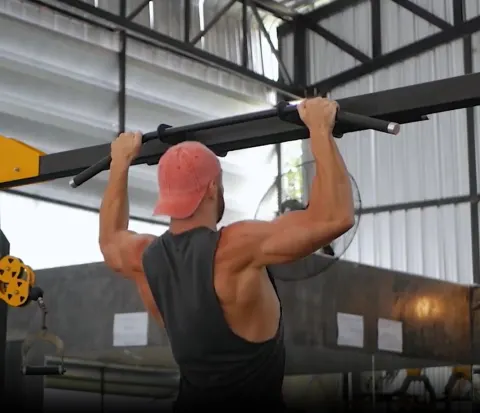
- Start from a full hang, hands just outside shoulder width, palms facing away.
- Set the shoulders. Pull your shoulder blades down and slightly together, as if putting them in your back pockets. Your body rises a few centimetres before the elbows bend.
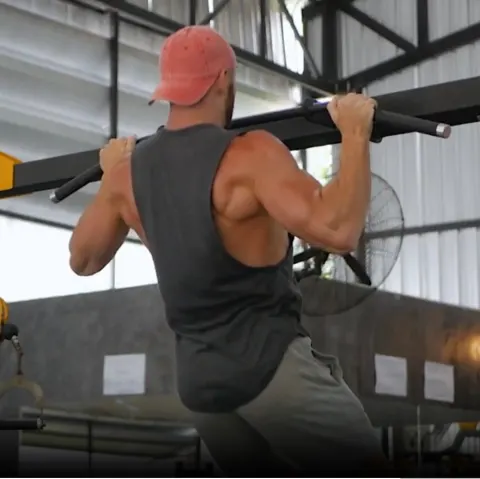
- Pull your elbows down towards your ribs until your chin clears the bar. Keep legs together, ribs down, no kicking.
- Lower under control to straight arms.
The main muscles are the lats, the mid and lower traps, the biceps and the forearms. Your abs keep the body from swinging. See the full pull-up page for form cues and video.
The five building blocks
1. Dead hang
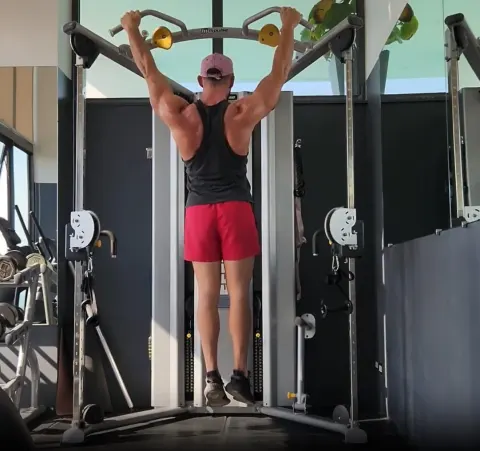
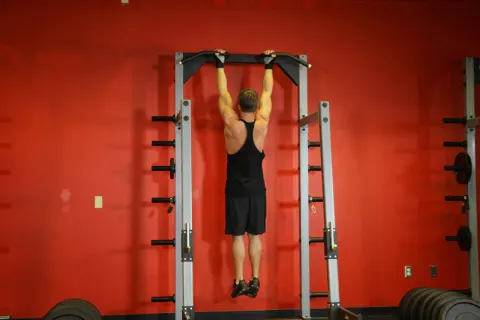
Hang from the bar with straight arms and relaxed legs. This builds grip and gets your shoulders used to carrying your weight. Work up to 3 holds of 30 seconds. If you cannot hang for 10 seconds yet, keep your toes lightly on a box.
2. Scapular pull-up
From a dead hang, keep your arms straight and pull your shoulder blades down so your body lifts slightly, then relax back. The scapular pull-up teaches the first few centimetres of the movement, which is exactly where most beginners get stuck.
3. Inverted row
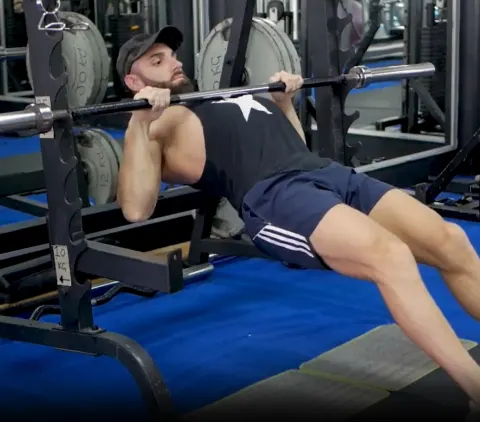
Lie under a low bar, a sturdy table edge or rings, and pull your chest up to it with a straight body. The inverted row trains the same muscles at a fraction of your body weight, and you can make it harder by lowering the bar or raising your feet. At a gym, the lat pulldown does a similar job for vertical pulling.
4. Negative pull-up
Step or jump to the top position with your chin over the bar, then lower yourself as slowly as you can. You are stronger lowering than lifting, so the negative pull-up lets you train the full range before you can pull through it. Aim for 3–5 seconds per descent, then build to 8.
5. Band-assisted pull-up
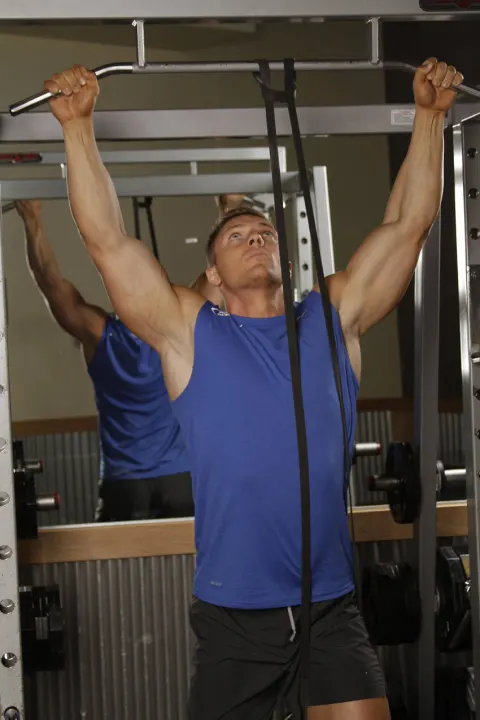
Loop a resistance band over the bar and put a knee or foot in it. The assisted pull-up lets you practise complete reps. Choose a band that allows 4–6 clean reps, and move to a thinner one when you reach 8.
The 8-week progression
Train three non-consecutive days a week. Rest 90–120 seconds between sets; pulling strength recovers slowly, as the rest between sets guide explains.
| Weeks | Focus | Each session |
|---|---|---|
| 1–2 | Grip and shoulder control | Dead hang 3 × 15–30 s. Scapular pull-ups 3 × 6–8. Inverted rows 3 × 6–10. |
| 3–4 | Slow negatives | Negatives 4 × 3 (3–5 s down). Inverted rows 3 × 8–12. Hollow hold 3 × 20 s. |
| 5–6 | Assisted full reps | Band-assisted pull-ups 4 × 4–6. Negatives 3 × 2–3 (5–8 s down). Inverted rows 3 × 10. |
| 7–8 | First unassisted reps | One fresh attempt at a full pull-up to start. Then band-assisted 3 × 5 with a lighter band, negatives 2 × 3. |
How to use the table:
- Move on only when you can do the listed work. If week 4 negatives drop like a stone, repeat weeks 3–4. Repeating a block is progress, not failure.
- Test rarely. Try a full rep once a week at most, when fresh. Daily max attempts just tire you out.
- Keep the rows. They are the volume that builds the muscle. Negatives and bands teach the skill.
The hollow hold in weeks 3–4 is there because a tight midsection stops your legs swinging forward and wasting your pull.
Training in a gym instead
A gym gives you two extra tools. The assisted pull-up machine has a pad that pushes up under your knees; lower the assistance by one plate whenever you manage 3 sets of 8. Lat pulldowns let you build the same muscles with precise loading. Use them as you would the band and row work in the table, but keep the hangs and negatives on a real bar, because the machine does not teach you to control a free-hanging body.
Sticking points and fixes
| Problem | Likely cause | Fix |
|---|---|---|
| Cannot start from the bottom | Weak scapular control | More scapular pull-ups; pause 2 s at the top of each |
| Stuck halfway | General pulling strength | More inverted rows and slow negatives with a pause at 90° |
| Chin will not clear the bar | Weak top range | Hold the top position for 5–10 s (flexed-arm hang) |
| Grip gives out first | Forearm endurance | Longer dead hangs; finish sessions with one max hang |
| Elbows ache | Too many negatives too soon | Cut negatives by half for a week; use a neutral or chin-up grip |
Chin-up or pull-up first?
If the overhand version will not come, try a chin-up with palms facing you. Most people find it slightly easier because the biceps help more. Once you can do three chin-ups, the overhand pull-up usually follows within a few weeks.
Body weight matters, and that is fine
A pull-up is a strength-to-weight exercise. Getting stronger is one side of the equation; if you are also losing fat, every kilogram lost makes the rep easier. You do not need to diet to earn a pull-up, but do not be discouraged if a heavier body takes longer. The progression is the same, the timeline is just more generous.
After the first rep
One rep becomes five faster than zero became one.
- Do several singles. Five sets of one rep, two minutes apart, twice a week.
- Add reps slowly. When all singles feel solid, try sets of two.
- Keep one assisted or negative set at the end for extra volume.
- Follow a plan. The 30-day pull-up challenge builds from low numbers, and the calisthenics workout plan puts pull-ups into a balanced week.
For supporting back work, use the back workout at home or the back workout at the gym. If you are new to bodyweight training in general, start with calisthenics for beginners.
Safety notes
Check that your bar is rated for your weight and firmly mounted. Step down from the top instead of dropping. A dull ache in the forearms and lats is normal; sharp pain in the elbow or the front of the shoulder is not. If you have a shoulder or elbow injury, get clearance from a doctor or physiotherapist before hanging work.
Ready plans for this guide
Exercises mentioned
 video
intermediate
 video
beginner
video
beginner
 beginner
 video
beginner
 intermediate
Frequently asked questions
Why can't I do a single pull-up?
Because it is a hard exercise, not because something is wrong with you. A pull-up means lifting your entire body weight with your back and arms, and most adults who have not trained it cannot do one. The usual gaps are grip strength, control of the shoulder blades and plain pulling strength, all of which respond to practice.
How long does it take to do your first pull-up?
Many beginners get there in six to twelve weeks of practising three times a week. Lighter people and those with some rowing or climbing background are often quicker. If you are carrying more body weight or starting from very little upper-body strength, it can take four to six months, and that is still normal.
Are chin-ups easier than pull-ups?
For most people, yes. The palms-facing-you grip of a chin-up lets the biceps contribute more, so beginners often manage a chin-up a few weeks before a pull-up. It trains nearly the same back muscles. Getting a chin-up first and then switching grips is a perfectly sensible route.
Should I use bands or negatives?
Use both, because they fix different problems. Negatives build strength through the whole range, especially control on the way down. Bands let you practise the full movement for several reps, though they help most at the bottom and least at the top. Start with negatives, then add banded reps as you get stronger.
Can I practise pull-ups every day?
Short, easy practice most days works well if every set stops far from failure, for example a few hangs and one or two negatives. Hard sessions with many negatives need a day of rest in between, because lowering under load is tough on elbows and shoulders. If your elbows start to ache, take two days off.