Resistance Band Workout Plan: Three Full-Body Days for Real Muscle
A resistance band workout plan for building muscle on three full-body days: which bands to own, how to anchor them and how to add resistance.
Example week
3-Day Resistance Band Workout Plan for Muscle Gain
A complete week you can start today: exercises, sets, reps and rest for every session, with swaps for each exercise. Open this plan on its own page (PDF) →
Split
Full Body
Sessions / week
3
Avg. session
45 min
Schedule
Mon · Wed · Fri
Warm-up (every session, ~6 min)
- 3–5 min easy cardio: brisk walk, bike, jump rope or marching in place.
- Dynamic mobility: 10 leg swings each way, 10 hip circles, 10 arm circles, 8 cat-cows.
- Ramp-up sets on the first exercise: 1–2 light sets of 8 before your working sets.
Day 1
Full Body A
Squat + push + pull
-
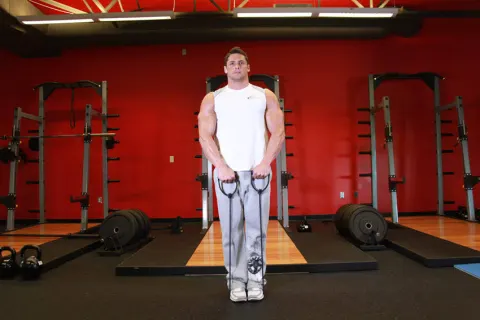
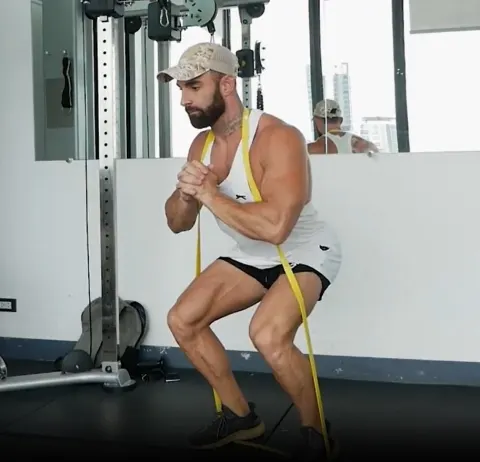
Quads, Glutes · Resistance Band
- Sets
- 3
- Reps
- 6–10
- Rest
- 120s
- Effort
- RPE 8
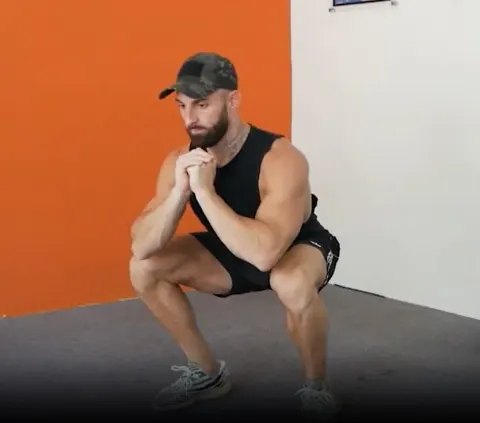
swap: Bodyweight Squat, Chair Squat
-
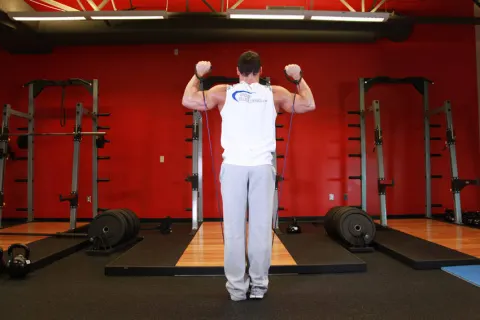
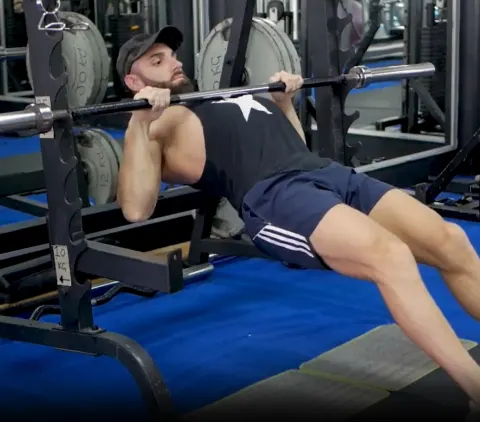
Upper Back, Lats · Resistance Band
- Sets
- 3
- Reps
- 6–10
- Rest
- 120s
- Effort
- RPE 8
-
Hamstrings, Glutes · Resistance Band
- Sets
- 2
- Reps
- 8–12
- Rest
- 90s
- Effort
- RPE 8
swap: Bodyweight Hip Hinge, Bodyweight Good Morning, Single-Leg Hip Hinge
-
Obliques, Core · Bodyweight
- Sets
- 3
- Reps
- 12–15
- Rest
- 60s
- Effort
- controlled

Day 2
Full Body B
Hinge + vertical push/pull
-
Hamstrings, Glutes · Bodyweight
- Sets
- 3
- Reps
- 6–10
- Rest
- 120s
- Effort
- RPE 8
swap: Bodyweight Hip Hinge, Banded Good Morning, Single-Leg Hip Hinge
-
Lats, Upper Back · Resistance Band
- Sets
- 3
- Reps
- 6–10
- Rest
- 120s
- Effort
- RPE 8
-
Quads, Glutes · Bodyweight
- Sets
- 2
- Reps
- 8–12 / side
- Rest
- 90s
- Effort
- RPE 8
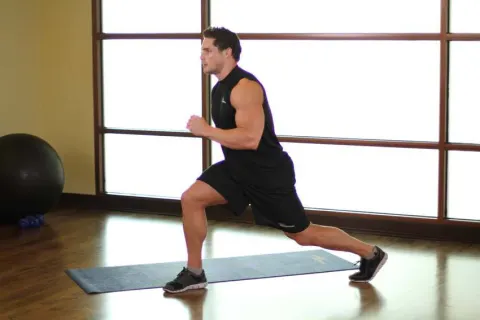
swap: Reverse Lunge, Split Squat, Walking Lunge
-
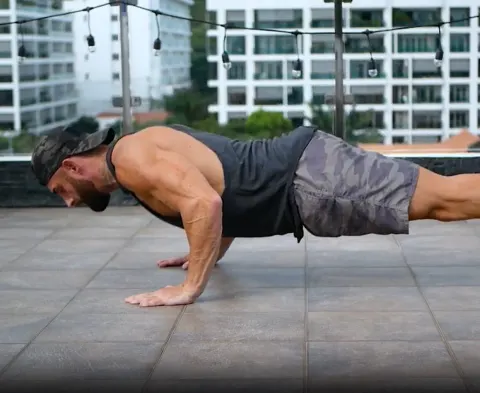
Chest, Triceps · Bodyweight
- Sets
- 3
- Reps
- 10–15
- Rest
- 60s
- Effort
- RPE 8–9
-
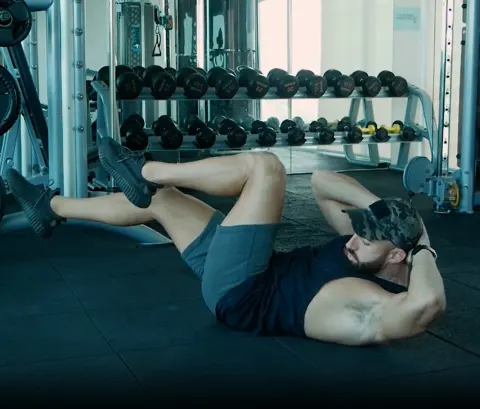
Obliques, Core · Bodyweight
- Sets
- 3
- Reps
- 12–15 / side
- Rest
- 60s
- Effort
- controlled
swap: Crunch, Russian Twist, Dead Bug
Day 3
Full Body C
Single-leg + chest + back
-
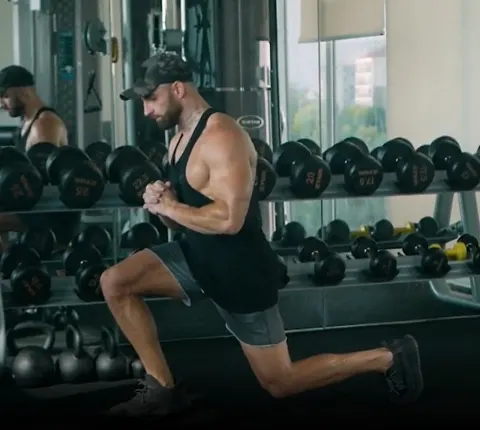
Quads, Glutes · Bodyweight
- Sets
- 3
- Reps
- 6–10 / side
- Rest
- 120s
- Effort
- RPE 8
swap: Reverse Lunge, Walking Lunge, Split Squat
-
Chest, Triceps · Bodyweight
- Sets
- 3
- Reps
- 6–10
- Rest
- 120s
- Effort
- RPE 8
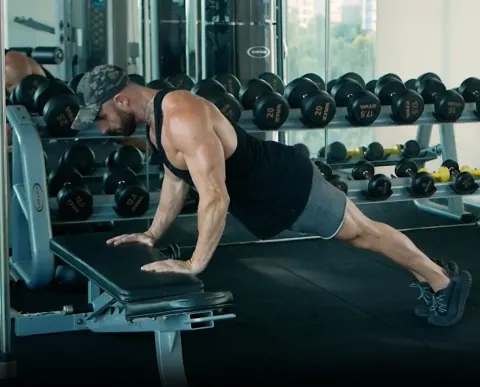
swap: Knee Push-Up, Push-Up, Band Chest Press
-
Upper Back, Lats · Bodyweight
- Sets
- 3
- Reps
- 6–10
- Rest
- 120s
- Effort
- RPE 8
swap: Band Row, Doorway Row, Reverse Snow Angel
-
Glutes · Resistance Band
- Sets
- 2
- Reps
- 8–12 / side
- Rest
- 90s
- Effort
- RPE 8
-
Side Delts, Traps · Resistance Band
- Sets
- 3
- Reps
- 10–15
- Rest
- 60s
- Effort
- RPE 8–9
-
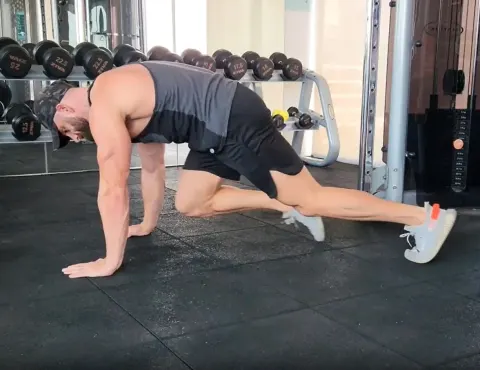
Core, Hip Flexors · Bodyweight
- Sets
- 3
- Reps
- 30–60 sec
- Rest
- 60s
- Effort
- controlled
swap: Plank Shoulder Tap, High Knees, Bear Crawl

8-week progression: what to change each week
Same exercises for the whole block. Weeks move the reps, then the load; the last week is a deload.
| Week | Load | Reps | Effort | What to watch |
|---|---|---|---|---|
| 1 | Light: learn the movements | bottom of range (6–8) | RPE 6–7 | Stop every set 3 reps before failure; film one set per exercise to check form. |
| 2 | Same weight | +1 rep per set (8–9) | RPE 8 | Same exercises, same order; only the reps move. |
| 3 | Same weight | top of range (9–10) | RPE 8 | All sets at the top of the range → add load next week. Missed a set? Repeat the week. |
| 4 | next dumbbell / harder variation | bottom of range (6–8) | RPE 8 | New weight feels hard at low reps; that is the plan working. |
| 5 | Same weight | +1 rep per set (8–9) | RPE 8 | Keep rest periods the same. |
| 6 | Same weight | top of range (9–10) | RPE 8–9 | Second time at the top: take the last set of each main lift to 1 rep in reserve. |
| 7 | next dumbbell / harder variation | bottom of range (6–8) | RPE 8 | Bodyweight moves: slow the lowering phase to 3 s or move to the harder variation. |
| 8 | Deload: 60 % | bottom of range | RPE 5–6 | Half the sets, then regenerate a variation or change the split for the next block. |
How to progress
- First 2 weeks: focus on form with light weights, stop each set 3 reps before failure.
- Double progression: hit the top of the rep range on every set, then add weight (2.5–5 %) and start from the bottom of the range.
- Bodyweight moves: add reps, then slow the tempo (3 sec down), then move to a harder variation.
- Deload every 6–8 weeks: same exercises, half the sets.
Notes for this plan
- Home setup: if a weight gets too light, slow the lowering phase to 3–4 seconds or add a pause at the hardest point.
- Sessions can move between days; keep at least one rest day between hard sessions for the same muscles.
Bands build muscle when you train with them the way you would with weights: a fixed plan, sets taken close to failure and resistance that goes up over the weeks. What changes is the setup. You need the right type of band for each movement, a solid anchor and a way to measure progress without numbers on a plate.
Band types and what each is for
| Type | What it is | Best for | Weak spot |
|---|---|---|---|
| Long loop band (about 1 m, 41 in) | A flat closed loop in 4–5 thicknesses | Squats, good mornings, rows, presses, pulldowns | Thin edges dig into the hands on heavy presses |
| Tube with handles | A round tube with clips and grips, often stackable | Chest press, rows, curls, triceps work | Awkward to stand on or wrap around the body |
| Mini band | A short loop, fabric or latex, worn around the legs | Lateral walks, glute bridges, warm-ups | Too short for anything else |
| Door anchor | A strap with a stopper that shuts into a door | Gives any band a high, middle or low attachment | Needs a solid door that latches |
If you buy one thing, buy a set of long loops with a door anchor. If you already own tubes with handles, they run the same plan; squats and hinges are done with the tube under your feet and the handles at your shoulders.
Anchoring decides the exercise
The same band becomes a different exercise depending on where it is fixed:
- High (top of the door): band lat pulldown, straight-arm pulldown, triceps extension, face pull.
- Chest height: band row facing the door, band chest press facing away from it.
- Low (bottom of the door): curls, upright rows, hamstring curls.
- Under your feet: squats, shoulder presses, good mornings, lateral raises.
Two safety habits. Stand on the side where your pull closes the door rather than opens it, and lock it if you can. Before the first rep, lean your weight into the band gradually. An anchor that slips at full stretch is the most common way band training goes wrong.
The resistance curve rises
A band is slack at rest and gets harder the further it stretches. A row might be 5 kg at arm’s length and 15 kg at your ribs. That has two consequences for how you train:
- Set up with tension already on. Step back until the band is taut at the start of the rep. If the first third of the movement is slack, a third of every rep is wasted.
- Own the end position. Hold the hardest point for 1 second on rows, pulldowns and bridges. The band does its most useful work there, and rushed reps cut it short.
The curve suits presses and squats, where you are strongest near the top. It underloads the stretched position, so bands reward a slow return: take 2–3 seconds on the way back instead of letting the band snap you home.
How the example week uses bands
The example week above is a beginner muscle-gain plan: three full-body sessions on Monday, Wednesday and Friday. Each takes about 45 minutes. The main movements (a lower-body lift, a push and a pull) are written for 3 sets of 6–10 reps with 2 minutes of rest, and the remaining exercises for 8–15 reps with 60–90 seconds.
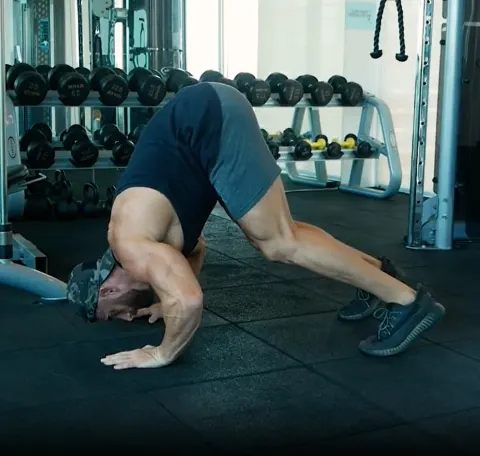
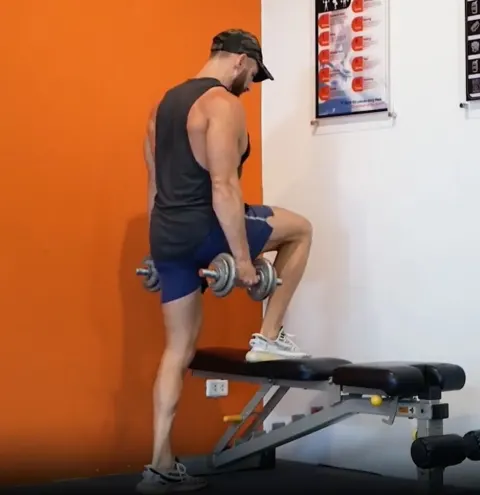
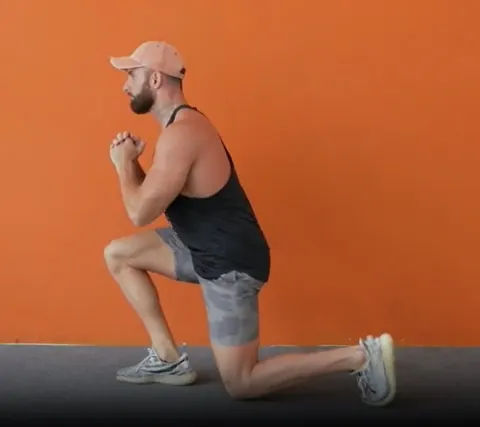
Not every slot is a band exercise. At beginner level the generator mixes in bodyweight moves where they load you as well as a band would: lunges and step-ups, push-up variations, a row under a table. If you want bands throughout, for instance in a hotel room, replace like with like: a band chest press for a push-up, a band row for the table row, a band shoulder press for a pike push-up.
The rep numbers assume a band heavy enough to stop you inside the range. On presses, rows and pulldowns that is easy to arrange. On leg work it often is not, and that is acceptable: if your thickest band lets you squat 15 times, do 15–20 and finish 1–2 reps short of failure. With bands, how close a set comes to the limit matters more than the exact count. For the first two weeks, stay about 3 reps away from it while you learn the setups.
The complete schedule is the 3-day resistance band plan for muscle gain.
Three ways to add resistance
There is no 2.5 kg plate, so progress in this order and change one thing at a time:
- More stretch. Stand one foot-length further from the anchor, or widen your stance on the band for squats and presses.
- Shorter band. Grip 5–10 cm lower on the loop, wrap it once around your hand or choke up on the tube.
- Next band. Move up a thickness, or clip a second tube onto the handle, and return to the bottom of the rep range.
A band row in practice: red band, toes on a tape mark 1.5 m from the door, 3 sets of 6. Over four weeks the sets climb to 10, 10, 10. Move the tape to 1.8 m and start again at 6. When 2.2 m feels comfortable, take the black band back at 1.5 m.
The tape mark is the important part. Distance from the anchor is your “weight”, and without a mark it changes every session. Log three things per exercise: band, position, reps.
Legs: where bands run out
Upper-body muscles can be trained with bands for years. Legs are stronger than any band you can comfortably stand on, so the plan leans on other tools:
- Single-leg work. Lunges and step-ups put most of your body weight on one leg, and a band under the front foot adds to it.
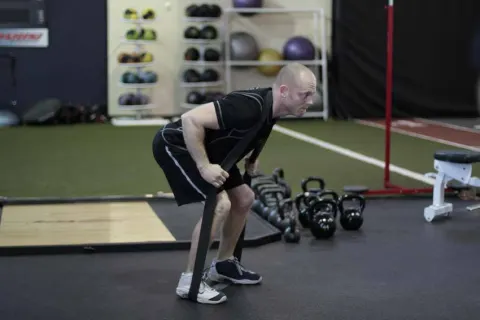
- Hinges. The band good morning loads hamstrings and glutes hardest at the top, so pause there.
- Glute work. Bridges with a band across the hips and the banded lateral walk with a mini band need little resistance to be hard.
- Tempo. Three seconds down, a one-second pause at the bottom, then drive up into the band.
If band squats pass 25 reps even at that tempo, you have outgrown bands for the pattern. Keep them for everything else and load legs another way.
Bands on the road
A full set weighs about a kilogram and rolls up smaller than a pair of shoes. A hotel door takes the anchor, so the band work travels unchanged and only the table row needs a band row in its place. Check that the door latches before you trust it. If there is no usable door, loop the band around your feet for seated rows and stand on it for presses, curls and hinges. Two weeks away then cost you nothing.
Mistakes with band plans
- One band for the whole session. Your lats are several times stronger than your rear shoulders. Match the band to the muscle.
- Letting the band pull you back. The return is half the rep. Control it.
- Stopping at the number. Ten easy reps with five in the tank build very little. Adjust the distance until the range is hard.
- Unmarked positions. Without a tape mark or a fixed grip point you cannot tell progress from guesswork.
- Old latex. Nicks, cracks and pale stress lines mean the bin, not one more session.
Limits and the next step
Band plans in the catalog cover muscle gain, weight loss and general fitness on 2–4 days a week. There are no 5 or 6-day band plans and no dedicated strength plans, because heavy sets of 4–6 reps need exact, repeatable loading. With a fourth day free, the 4-day resistance band plan for muscle gain splits upper and lower body.
When legs stall, pair bands with weights: the dumbbell workout plan shows that route, and the home workout plan overview compares every home setup. Protein still does its part at 1.6–2.2 g per kg per day, which the protein intake calculator converts into grams. For technique on each movement, see the resistance band training guide.
Resistance Band Workout Plan: all 45 plans

- 2-Day Resistance Band Workout Plan for Weight Loss (Men)
- 2-Day Resistance Band Workout Plan for Weight Loss (Over 50)
- 2-Day Resistance Band Workout Plan for Muscle Gain
- 2-Day Resistance Band Workout Plan for Muscle Gain (Beginners)
- 2-Day Resistance Band Workout Plan for Muscle Gain (Women)
- 2-Day Resistance Band Workout Plan for Muscle Gain (Men)
- 2-Day Resistance Band Workout Plan for Muscle Gain (Over 50)
- 2-Day Resistance Band Workout Plan for General Fitness
- 2-Day Resistance Band Workout Plan for General Fitness (Beginners)
- 2-Day Resistance Band Workout Plan for General Fitness (Women)
- 2-Day Resistance Band Workout Plan for General Fitness (Men)
- 2-Day Resistance Band Workout Plan for General Fitness (Over 50)
- 3-Day Resistance Band Workout Plan for Weight Loss (Men)
- 3-Day Resistance Band Workout Plan for Weight Loss (Over 50)
- 3-Day Resistance Band Workout Plan for Muscle Gain
- 3-Day Resistance Band Workout Plan for Muscle Gain (Beginners)
- 3-Day Resistance Band Workout Plan for Muscle Gain (Women)
- 3-Day Resistance Band Workout Plan for Muscle Gain (Men)
- 3-Day Resistance Band Workout Plan for Muscle Gain (Over 50)
- 3-Day Resistance Band Workout Plan for General Fitness
- 3-Day Resistance Band Workout Plan for General Fitness (Beginners)
- 3-Day Resistance Band Workout Plan for General Fitness (Women)
- 3-Day Resistance Band Workout Plan for General Fitness (Men)
- 3-Day Resistance Band Workout Plan for General Fitness (Over 50)
- 4-Day Resistance Band Workout Plan for Weight Loss (Men)
- 4-Day Resistance Band Workout Plan for Weight Loss (Over 50)
- 4-Day Resistance Band Workout Plan for Muscle Gain
- 4-Day Resistance Band Workout Plan for Muscle Gain (Beginners)
- 4-Day Resistance Band Workout Plan for Muscle Gain (Women)
- 4-Day Resistance Band Workout Plan for Muscle Gain (Men)
- 4-Day Resistance Band Workout Plan for Muscle Gain (Over 50)
- 4-Day Resistance Band Workout Plan for General Fitness
- 4-Day Resistance Band Workout Plan for General Fitness (Beginners)
- 4-Day Resistance Band Workout Plan for General Fitness (Women)
- 4-Day Resistance Band Workout Plan for General Fitness (Men)
- 4-Day Resistance Band Workout Plan for General Fitness (Over 50)
Related programs
Frequently asked questions
Is a resistance band workout plan effective for building muscle?
Yes, when sets end 1–2 reps short of failure and the resistance rises over time. Bands load the back, chest, shoulders, arms and glutes well. Three full-body sessions a week bring a beginner close to the 10 weekly sets per muscle where the growth range starts, which is enough to progress.
What resistance bands do I need for a full workout plan?
A set of four or five long loop bands in different thicknesses plus a door anchor covers every band exercise in the plans. Tube bands with handles are a comfortable alternative for presses, rows and curls. Add one fabric mini band for lateral walks and glute work. A single band cannot fit both curls and squats.
How do I know which band resistance to use?
Pick the band and standing distance that make the last 2 reps of the listed range slow and hard. If you could do 5 more reps at the end of a set, step further from the anchor or take the next band. Expect to use three different bands in a single session.
Can resistance bands replace weights?
For the upper body and glutes, largely yes for the first year or two. For legs, only partly: a band squat runs out of resistance once you pass 20–25 reps, and no band matches a heavily loaded hinge. Many people keep bands for pulls, shoulders and travel and add dumbbells for legs later.
How long do resistance bands last?
There is no fixed lifespan, but with regular use many latex bands need replacing after a year or two. Keep them out of sunlight, avoid stretching them beyond about 2.5 times their resting length, and check for nicks and pale stress marks before every session. Replace a damaged band immediately.