Muscle Building Workout Plan for Men: Weekly Sets and a Lean Bulk
A muscle building workout plan for men past the beginner stage: five days of push/pull/legs plus upper/lower, weekly sets per muscle and lean-bulk numbers.
Example week
5-Day Gym Workout Plan for Muscle Gain (Men)
A complete week you can start today: exercises, sets, reps and rest for every session, with swaps for each exercise. Open this plan on its own page (PDF) →
Split
PPL + Upper / Lower
Sessions / week
5
Avg. session
35 min
Schedule
Mon · Tue · Wed · Fri · Sat
Warm-up (every session, ~6 min)
- 3–5 min easy cardio: brisk walk, bike, jump rope or marching in place.
- Dynamic mobility: 10 leg swings each way, 10 hip circles, 10 arm circles, 8 cat-cows.
- Ramp-up sets on the first exercise: 1–2 light sets of 8 before your working sets.
Day 1
Push
Chest, shoulders, triceps
-
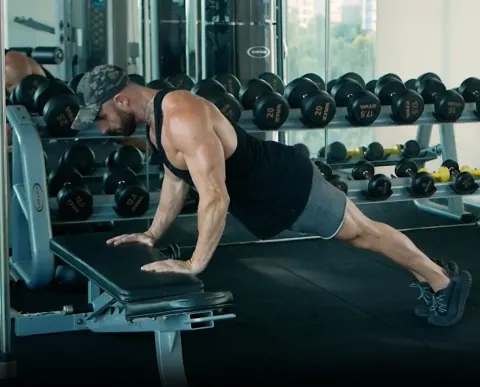
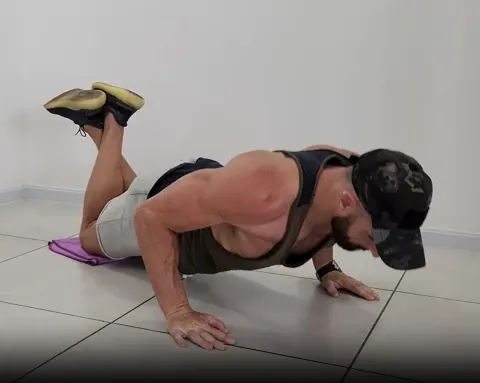
Chest, Front Delts · Dumbbell
- Sets
- 3
- Reps
- 6–10
- Rest
- 120s
- Effort
- RPE 8
swap: Machine Chest Press, Dumbbell Bench Press, Dumbbell Floor Press
-
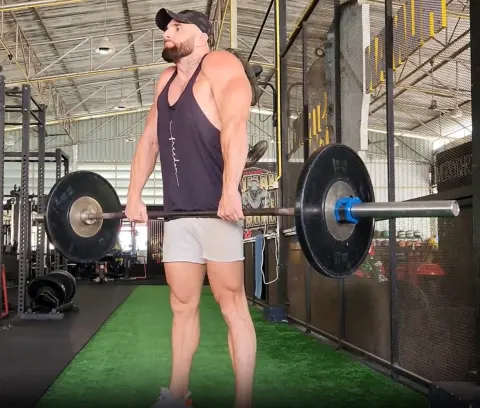
Front Delts, Chest · Barbell
- Sets
- 2
- Reps
- 8–12 / side
- Rest
- 90s
- Effort
- RPE 8
swap: Dumbbell Shoulder Press, Kettlebell Press, Incline Dumbbell Press
-
Traps · Barbell
- Sets
- 3
- Reps
- 10–15
- Rest
- 60s
- Effort
- RPE 8–9
swap: Dumbbell Shrug, Face Pull, Band Upright Row
-
Triceps · Cable
- Sets
- 3
- Reps
- 10–15
- Rest
- 60s
- Effort
- RPE 8–9



Day 2
Pull
Back, rear delts, biceps
-
Lats, Upper Back · Pull-Up Bar
- Sets
- 3
- Reps
- 6–10
- Rest
- 120s
- Effort
- RPE 8
-
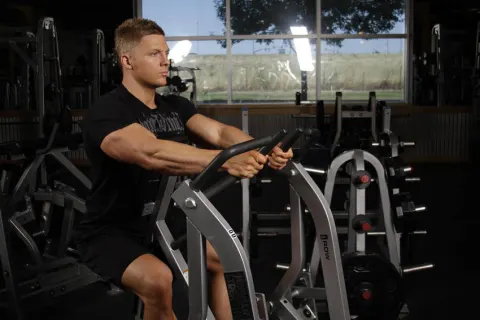
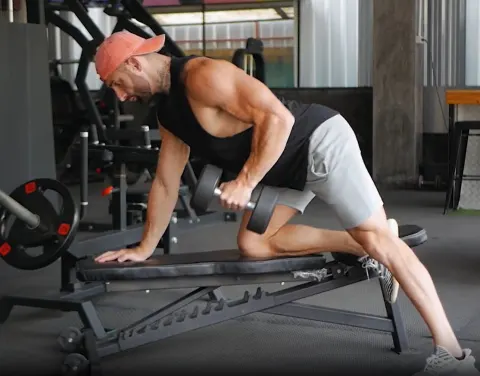
Upper Back, Lats · Machine
- Sets
- 3
- Reps
- 6–10
- Rest
- 120s
- Effort
- RPE 8
-
Rear Delts, Upper Back · Cable
- Sets
- 3
- Reps
- 10–15
- Rest
- 60s
- Effort
- RPE 8–9
-
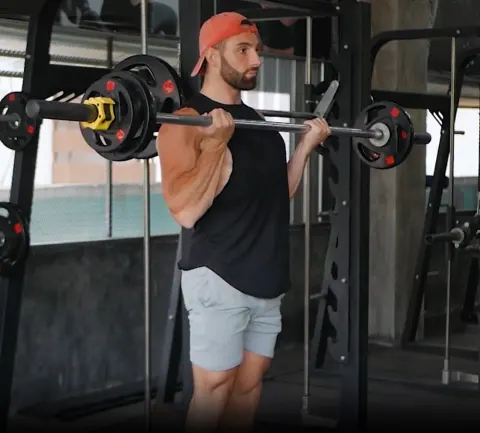
Obliques, Core · Cable
- Sets
- 3
- Reps
- 12–15 / side
- Rest
- 60s
- Effort
- controlled
swap: Side Plank, Suitcase Carry, Russian Twist



Day 3
Legs
Quads, hamstrings, glutes, calves
-
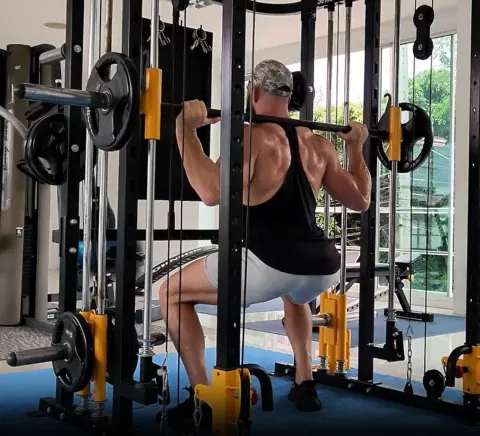
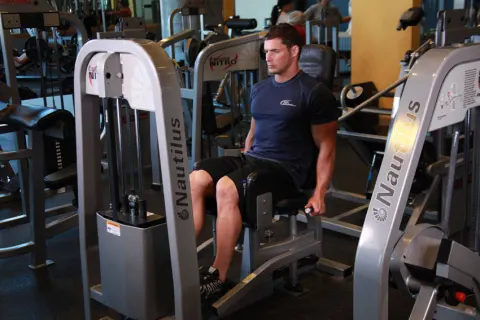
Quads, Glutes · Machine
- Sets
- 3
- Reps
- 6–10
- Rest
- 120s
- Effort
- RPE 8
swap: Leg Press, Goblet Squat, Banded Squat
-
Glutes, Quads, Hamstrings · Barbell
- Sets
- 3
- Reps
- 6–10
- Rest
- 120s
- Effort
- RPE 8
swap: Kettlebell Deadlift, Goblet Squat, Banded Good Morning
-
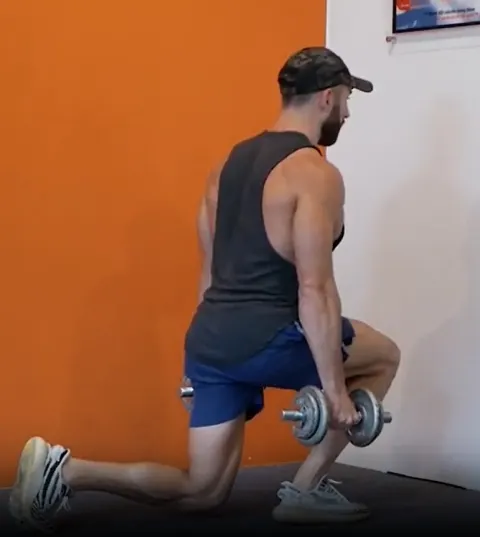
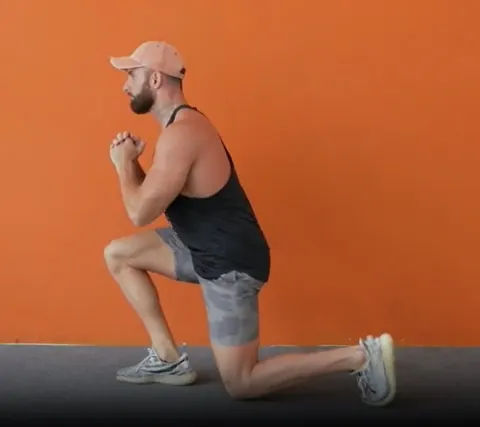
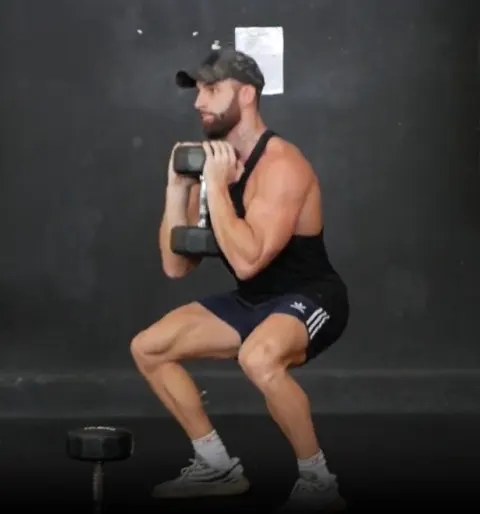
Quads, Glutes · Dumbbell
- Sets
- 2
- Reps
- 8–12 / side
- Rest
- 90s
- Effort
- RPE 8
swap: Reverse Lunge, Split Squat, Step-Up
-
Glutes · Machine
- Sets
- 2
- Reps
- 8–12
- Rest
- 90s
- Effort
- RPE 8
-
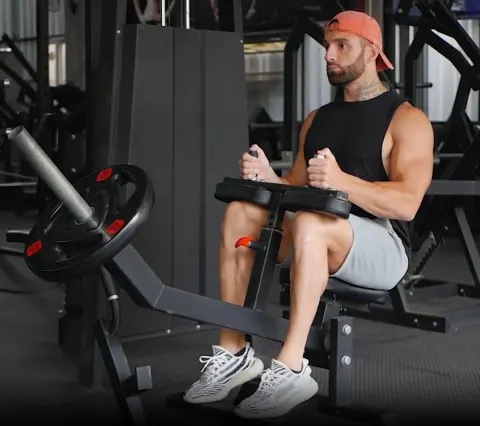
Calves · Machine
- Sets
- 3
- Reps
- 10–15
- Rest
- 60s
- Effort
- RPE 8–9

Day 4
Upper A
Chest + back, strength bias
-
Chest, Triceps · Machine
- Sets
- 3
- Reps
- 6–10
- Rest
- 120s
- Effort
- RPE 8
-
Upper Back, Lats · Cable
- Sets
- 3
- Reps
- 6–10
- Rest
- 120s
- Effort
- RPE 8
swap: Machine Row, Chest-Supported Row, Band Row
-
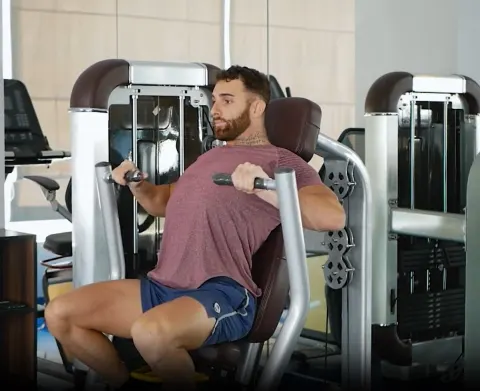
Front Delts, Side Delts · Dumbbell
- Sets
- 2
- Reps
- 8–12
- Rest
- 90s
- Effort
- RPE 8
swap: Dumbbell Shoulder Press, Machine Shoulder Press, Band Shoulder Press
-
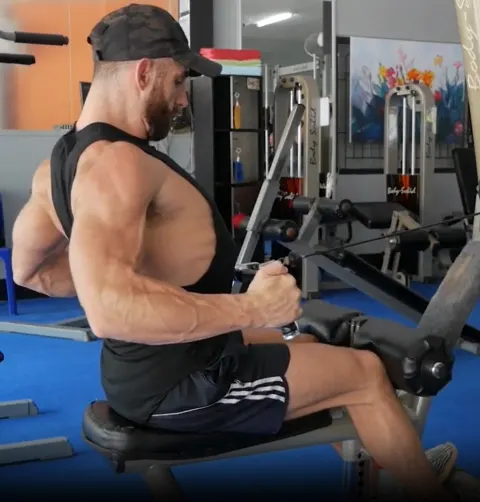
Lats · Cable
- Sets
- 2
- Reps
- 8–12
- Rest
- 90s
- Effort
- RPE 8
swap: Straight-Arm Pulldown, Lat Pulldown, Band Lat Pulldown



Day 5
Lower B
Hinge focus
-
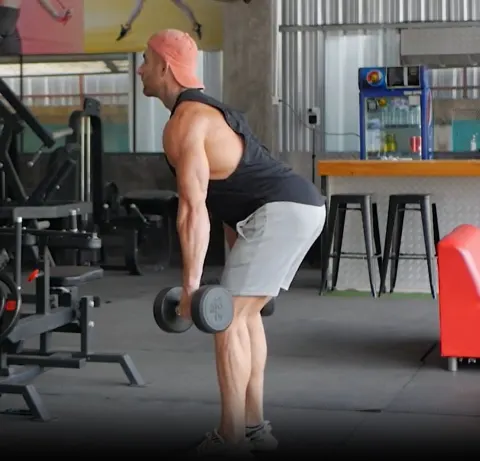
Hamstrings, Glutes · Dumbbell
- Sets
- 3
- Reps
- 6–10
- Rest
- 120s
- Effort
- RPE 8
swap: Dumbbell Romanian Deadlift, Kettlebell Deadlift, Trap Bar Deadlift
-
Quads, Glutes · Dumbbell
- Sets
- 2
- Reps
- 8–12
- Rest
- 90s
- Effort
- RPE 8
-
Glutes · Cable
- Sets
- 2
- Reps
- 8–12 / side
- Rest
- 90s
- Effort
- RPE 8
swap: Donkey Kick, Hip Thrust, Banded Lateral Walk
-
Hamstrings · Machine
- Sets
- 3
- Reps
- 10–15
- Rest
- 60s
- Effort
- RPE 8–9
swap: Seated Leg Curl, Banded Hamstring Curl, Dumbbell Romanian Deadlift



8-week progression: what to change each week
Same exercises for the whole block. Weeks move the reps, then the load; the last week is a deload.
| Week | Load | Reps | Effort | What to watch |
|---|---|---|---|---|
| 1 | Light: learn the movements | bottom of range (6–8) | RPE 6–7 | Stop every set 3 reps before failure; film one set per exercise to check form. |
| 2 | Same weight | +1 rep per set (8–9) | RPE 8 | Same exercises, same order; only the reps move. |
| 3 | Same weight | top of range (9–10) | RPE 8 | All sets at the top of the range → add load next week. Missed a set? Repeat the week. |
| 4 | +2.5 kg (5 lb) | bottom of range (6–8) | RPE 8 | New weight feels hard at low reps; that is the plan working. |
| 5 | Same weight | +1 rep per set (8–9) | RPE 8 | Keep rest periods the same. |
| 6 | Same weight | top of range (9–10) | RPE 8–9 | Second time at the top: take the last set of each main lift to 1 rep in reserve. |
| 7 | +2.5 kg (5 lb) | bottom of range (6–8) | RPE 8 | Bodyweight moves: slow the lowering phase to 3 s or move to the harder variation. |
| 8 | Deload: 60 % | bottom of range | RPE 5–6 | Half the sets, then regenerate a variation or change the split for the next block. |
How to progress
- First 2 weeks: focus on form with light weights, stop each set 3 reps before failure.
- Double progression: hit the top of the rep range on every set, then add weight (2.5–5 %) and start from the bottom of the range.
- Bodyweight moves: add reps, then slow the tempo (3 sec down), then move to a harder variation.
- Deload every 6–8 weeks: same exercises, half the sets.
Notes for this plan
- Sessions can move between days; keep at least one rest day between hard sessions for the same muscles.
Once the easy first-year progress is gone, muscle comes from numbers you manage on purpose: sets per muscle per week, how close each set runs to failure, and a food surplus small enough to keep you lean. The five-day week on this page is the frame for those numbers. It is not a starting point, and the first section says who should use a shorter version.
Who should run five days, and who should start with three or four
| Training background | Start with | Why |
|---|---|---|
| Under 6 months of steady lifting | 3 days, full body | Each lift is practised often, and 8–12 weekly sets per muscle are enough |
| 6–12 months, still adding load most months | 4 days, upper/lower | More sets per muscle while sessions stay under an hour |
| 1 year or more, progress slowing on 4 days | 5 days, push/pull/legs + upper/lower | The same muscles spread over more, shorter sessions |
The beginner series in the catalog stops at four days, and that is deliberate. A new lifter grows from almost any sensible dose, so extra days add fatigue, not muscle.
If you belong in the first two rows, use the 3-day gym plan for muscle gain for men or the 4-day version. The general muscle building workout plan page explains the principles for every level.
How the five days fit together
The example week above runs push on Monday, pull on Tuesday, legs on Wednesday, then an upper day on Friday and a lower day on Saturday. Thursday and Sunday are off. This is the push/pull/legs + upper/lower split.
Every muscle is trained twice, three to four days apart: chest and shoulders on Monday and Friday, back on Tuesday and Friday, legs on Wednesday and Saturday. Each session holds five exercises. With five training days the optional accessory slots are dropped, so weekly volume stays sane and a session takes about 35 minutes at the set counts shown, or about 45 at intermediate level. For how this hybrid compares with a classic body-part split, see the 5-day workout plan page.
The hypertrophy numbers behind the week
- Reps and rest. Main lifts for 6–10 reps with 2 minutes of rest. Secondary lifts for 8–12 with 90 seconds. Accessories for 10–15 with 60 seconds.
- Effort. RPE 8 on main lifts, 8–9 on accessories. In practice that means 1–3 reps in reserve on every counted set.
- Volume. 10–20 hard sets per muscle per week is the growth range.
Training volume is the number to audit. The week above uses the generator’s entry-level set counts: 3 sets on main lifts and accessories, 2 on secondary lifts, 68 working sets in total. Choosing Intermediate in the plan generator adds a set to every main and secondary lift.
Count working sets per muscle across all five days and compare:
| Muscle | Days that train it | Direct sets in the week above | Target once sets rise |
|---|---|---|---|
| Chest | Push, Upper | About 9 | 10–14 |
| Back, lats included | Pull, Upper | About 11 | 12–16 |
| Quads | Legs, Lower | About 7 | 10–14 |
| Hamstrings and glutes | Legs, Lower | About 13 | 10–14 |
| Shoulders | Push, Pull, Upper | About 7 | 6–10 |
| Biceps, triceps | Pull, Push, Upper | 3–6 each | 6–8 each |
Chest and back start just under or at the low end of the growth range, which still drives progress in a first block. Quads are the gap, so that is the first place to add a set. Arms look low because presses, rows and pull-ups already work them.
A set counts only if it ends within about 3 reps of failure. Twenty easy sets are worth less than twelve hard ones.
Bringing up shoulders, upper chest and back width
Plans for men give chest and lats a small head start. Three areas shape the look most men are after, and each has a simple lever.
Shoulder width. Overhead presses mainly build the front of the shoulder. Width comes from the side head, and the week above spends its shoulder accessory slot on a shrug. If width is your priority, swap that for the dumbbell lateral raise: 10–15 reps, light enough to lift without a swing, the last reps slow.
Upper chest. An incline of 30–45° moves the work towards the collarbone, which is why the push day above already leads with an incline press. At intermediate level the barbell incline bench press is the natural upgrade. If your flat press is far ahead of your incline, keep the incline first for a full 8-week block.
Back width. Pull-ups and pulldowns grow the lats when each rep starts from a full stretch and the elbows travel down towards the hips. Rows add thickness, not width, so keep both.
Specialise one area at a time. Add 2–4 weekly sets for the lagging part, hold everything else steady, and review after 8 weeks. Adding sets everywhere just lands you above 20.
Lean-bulk numbers
- Surplus: about 250–300 kcal above maintenance. Get the baseline from the TDEE calculator.
- Rate: roughly 0.25–0.5 kg per month for non-beginners. Weigh on three or four mornings a week and compare monthly averages, not single days.
- Protein: 1.6–2.2 g per kg of body weight. At 80 kg that is 130–175 g a day.
- Sleep: 7–9 hours. Five sessions on six hours of sleep is a four-day plan with extra fatigue.
- Supplements: none are required. Creatine monohydrate at 3–5 g a day is well studied and optional, and it matters far less than food, sleep and the logbook.
If your waist grows faster than your lifts, the surplus is too big. Trim 100–150 kcal and keep training the same way.
Progressing across an 8-week block
Each plan comes with an 8-week wave. Week 1 starts at the bottom of the rep range, week 2 adds a rep per set, week 3 reaches the top. Week 4 adds load and drops back down, weeks 5–6 climb again, week 7 adds load once more.
Example: a main press at 60 kg starts at sets of 6 and builds to sets of 10 by week 3, then goes to 62.5 kg in week 4 and 65 kg in week 7. Small lifts move in bigger relative steps. From 8 to 10 kg on a lateral raise is 25 %, so earn the full 15 reps first.
Week 8 is a deload at about 60 % of the load with half the sets. The deload week guide explains why skipping it costs more than it saves.
Bulking mistakes
- The dirty bulk. A surplus of 500 kcal or more adds fat faster, not muscle faster.
- Bulking from a high body fat. If your waist is already over half your height, lose first. The workout plan for men page shows how to choose.
- Junk volume. Extra sets stopped five reps early pad the count and nothing else.
- Adding days to fix a recovery problem. Stalled lifts on poor sleep need rest, not a sixth session.
- Treating Saturday’s lower day as optional. Skip it and legs are back to once a week.
What comes after
Open the full week as the 5-day gym plan for muscle gain for men and run an 8-week block before changing anything. The first step up is the intermediate version of the same week, with one more set on main and secondary lifts. If you still recover well and want more, the 6-day workout plan repeats push/pull/legs twice. If lifts stall for three weeks despite good sleep and food, four days is the smarter move, not a step back.
Muscle Building Workout Plan for Men: all 26 plans








- 2-Day Gym Workout Plan for Muscle Gain (Men)
- 2-Day Kettlebell Workout Plan for Muscle Gain (Men)
- 2-Day Resistance Band Workout Plan for Muscle Gain (Men)
- 2-Day Calisthenics Workout Plan for Muscle Gain (Men)
- 3-Day Gym Workout Plan for Muscle Gain (Men)
- 3-Day Kettlebell Workout Plan for Muscle Gain (Men)
- 3-Day Resistance Band Workout Plan for Muscle Gain (Men)
- 3-Day Calisthenics Workout Plan for Muscle Gain (Men)
- 4-Day Gym Workout Plan for Muscle Gain (Men)
- 4-Day Kettlebell Workout Plan for Muscle Gain (Men)
- 4-Day Resistance Band Workout Plan for Muscle Gain (Men)
- 4-Day Calisthenics Workout Plan for Muscle Gain (Men)
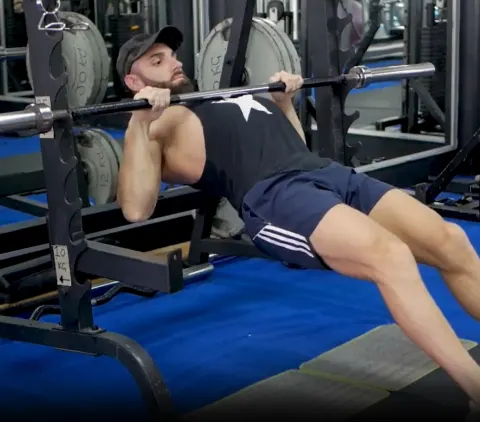
- 5-Day Gym Workout Plan for Muscle Gain (Men)
- 5-Day Kettlebell Workout Plan for Muscle Gain (Men)
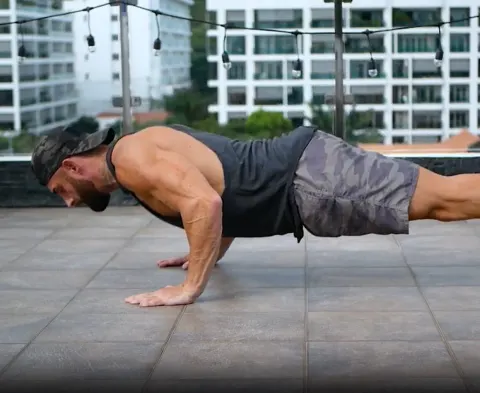
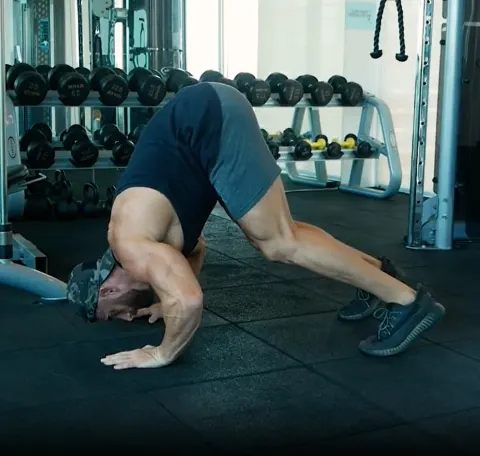
- 5-Day Calisthenics Workout Plan for Muscle Gain (Men)
- 6-Day Dumbbell Workout Plan for Muscle Gain (Men)
- 6-Day Gym Workout Plan for Muscle Gain (Men)
Related programs
Frequently asked questions
How many days a week should a man lift to build muscle?
Enough to train each muscle about twice a week with 10–20 hard sets. Three full-body days do that for a beginner, four days as upper/lower for most intermediates, and five days suit men with a year or more of consistent training who want shorter sessions and more total volume.
How much muscle can a man gain in a month?
Past the beginner stage, expect roughly 0.25–0.5 kg of body weight per month on a small surplus, most of it muscle if training is hard. Beginners can gain a little faster in their first year. Scale jumps of 2 kg a month are mostly fat and water.
How many calories should a man eat to build muscle?
About 250–300 kcal above maintenance, with 1.6–2.2 g of protein per kg of body weight. For an 80 kg man who maintains on 2,700 kcal, that is close to 3,000 kcal and 130–175 g of protein a day. Adjust by 100–150 kcal if weight has not moved for three weeks.
Is a 5-day split better than a 4-day split for muscle growth?
Only when recovery supports it. Five days spread the same muscles over more sessions, so each one is shorter and volume per muscle can sit higher in the 10–20 set range. If sleep is under seven hours or lifts are stalling, four days will build more muscle.
What rep range is best for muscle growth in men?
Most work belongs between 6 and 12 reps: 6–10 on the main lifts, 8–12 on secondary lifts and 10–15 on isolation work such as lateral raises. Each set should end 1–3 reps before failure. The exact range matters less than adding reps or load over time.