Home Workout Plan for Weight Loss: Lose Fat Without Equipment
A home workout plan for weight loss you can do in a living room with no equipment: three full-body days, quiet cardio swaps and a clear way to progress.
Example week
3-Day Bodyweight Workout Plan for Weight Loss
A complete week you can start today: exercises, sets, reps and rest for every session, with swaps for each exercise. Open this plan on its own page (PDF) →
Split
Full Body
Sessions / week
3
Avg. session
39 min
Schedule
Mon · Wed · Fri
Warm-up (every session, ~6 min)
- 3–5 min easy cardio: brisk walk, bike, jump rope or marching in place.
- Dynamic mobility: 10 leg swings each way, 10 hip circles, 10 arm circles, 8 cat-cows.
- Ramp-up sets on the first exercise: 1–2 light sets of 8 before your working sets.
Day 1
Full Body A
Squat + push + pull
-
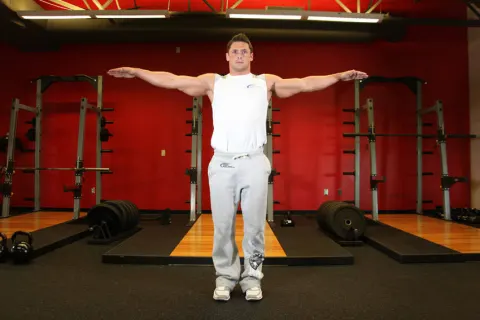
Upper Back, Lats · Bodyweight
- Sets
- 2
- Reps
- 8–12
- Rest
- 75s
- Effort
- RPE 7–8
swap: Doorway Row, Reverse Snow Angel
-
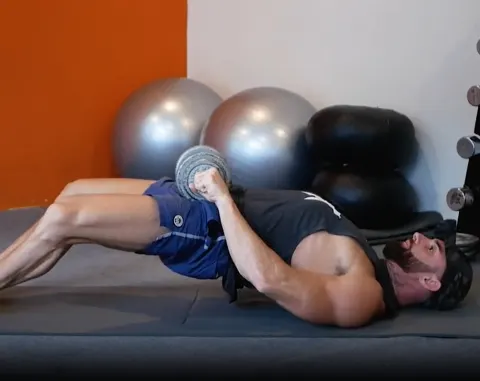
Hamstrings, Glutes · Bodyweight
- Sets
- 2
- Reps
- 10–15
- Rest
- 60s
- Effort
- RPE 7–8
swap: Glute Bridge, Bodyweight Good Morning, Single-Leg Hip Hinge
-
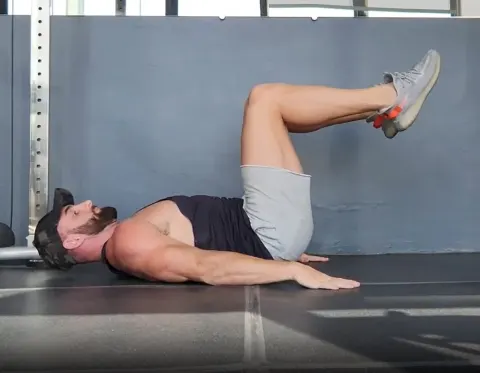
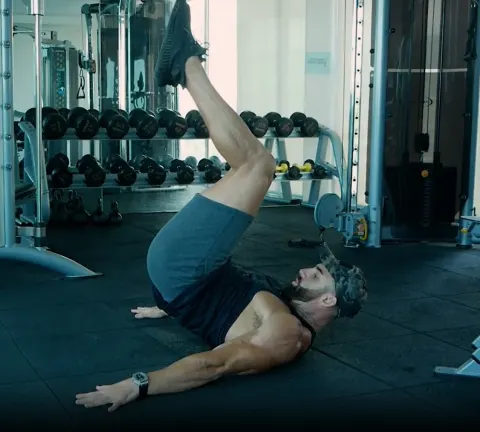
Core · Bodyweight
- Sets
- 3
- Reps
- 30–60 sec
- Rest
- 45s
- Effort
- controlled
swap: Bird Dog, Plank, Lying Leg Raise
-
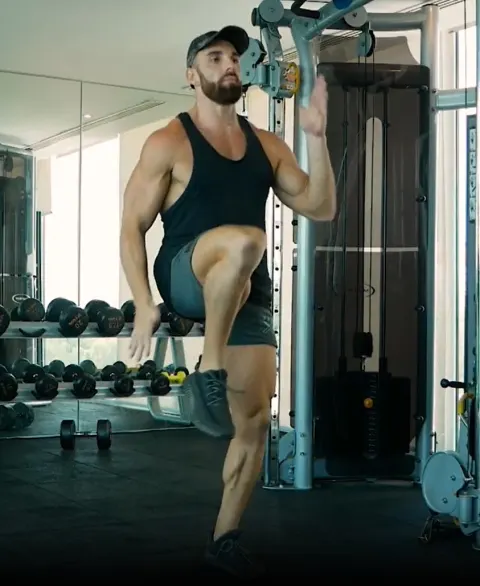
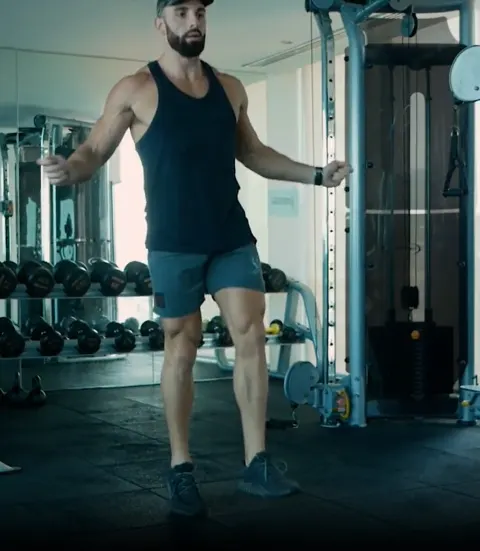
Hip Flexors, Quads · Bodyweight
- Sets
- 6
- Reps
- 30 sec on / 30 sec off
- Rest
- 30s
- Effort
- hard but steady
swap: Jumping Jack, Mountain Climber, Jump Rope
Day 2
Full Body B
Hinge + vertical push/pull
-
Hamstrings, Glutes · Bodyweight
- Sets
- 2
- Reps
- 8–12 / side
- Rest
- 75s
- Effort
- RPE 7–8
swap: Bodyweight Hip Hinge, Glute Bridge, Bodyweight Good Morning
-
Upper Back, Lats · Bodyweight
- Sets
- 2
- Reps
- 8–12
- Rest
- 75s
- Effort
- RPE 7–8
swap: Inverted Row, Reverse Snow Angel
-
Quads, Glutes · Bodyweight
- Sets
- 2
- Reps
- 10–15 / side
- Rest
- 60s
- Effort
- RPE 7–8
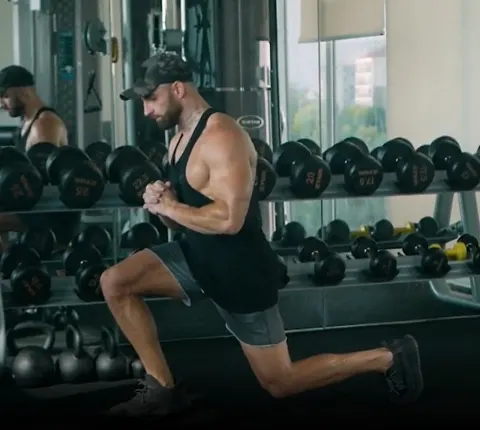
swap: Reverse Lunge, Forward Lunge, Split Squat
-
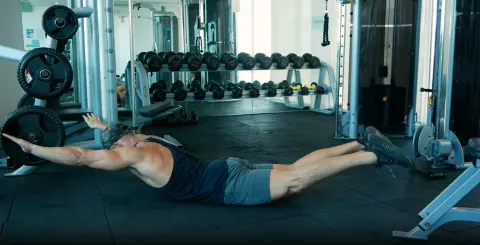
Lower Back, Glutes · Bodyweight
- Sets
- 3
- Reps
- 15–20
- Rest
- 45s
- Effort
- controlled
swap: Bird Dog, Glute Bridge, Plank
-
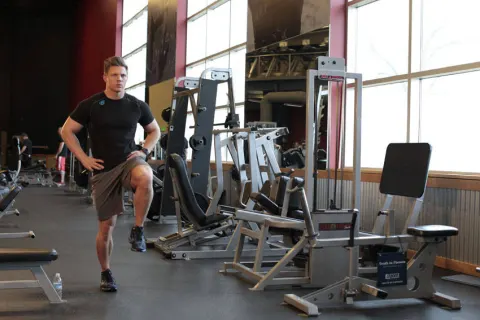
Hip Flexors, Quads · Bodyweight
- Sets
- 6
- Reps
- 30 sec on / 30 sec off
- Rest
- 30s
- Effort
- hard but steady
swap: Jumping Jack, Mountain Climber, Jump Rope
Day 3
Full Body C
Single-leg + chest + back
-
Quads, Glutes · Bodyweight
- Sets
- 2
- Reps
- 8–12 / side
- Rest
- 75s
- Effort
- RPE 7–8
swap: Reverse Lunge, Walking Lunge, Split Squat
-
Chest, Triceps · Bodyweight
- Sets
- 2
- Reps
- 8–12
- Rest
- 75s
- Effort
- RPE 7–8
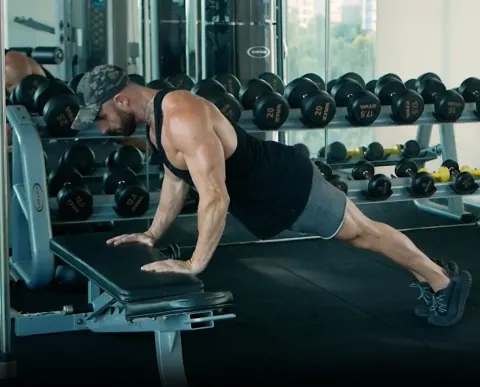
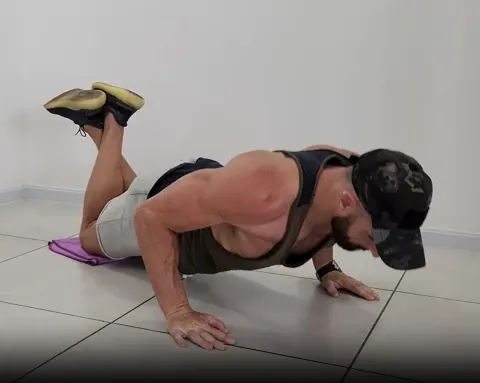
swap: Incline Push-Up, Knee Push-Up
-
Upper Back, Lats · Bodyweight
- Sets
- 2
- Reps
- 8–12
- Rest
- 75s
- Effort
- RPE 7–8
swap: Doorway Row, Reverse Snow Angel
-
Calves · Bodyweight
- Sets
- 6
- Reps
- 30 sec on / 30 sec off
- Rest
- 30s
- Effort
- hard but steady
8-week progression: what to change each week
Same exercises for the whole block. Weeks move the reps, then the load; the last week is a deload.
| Week | Load | Reps | Effort | What to watch |
|---|---|---|---|---|
| 1 | Light: learn the movements | bottom of range (8) | RPE 6–7 | Stop every set 3 reps before failure; film one set per exercise to check form. |
| 2 | Same weight | +1 rep per set (10) | RPE 7–8 | Same exercises, same order; only the reps move. |
| 3 | Same weight | top of range (12) | RPE 8 | All sets at the top of the range → add load next week. Missed a set? Repeat the week. |
| 4 | next dumbbell / harder variation | bottom of range (8) | RPE 7–8 | New weight feels hard at low reps; that is the plan working. |
| 5 | Same weight | +1 rep per set (10) | RPE 8 | Shave 10 s off every rest period. |
| 6 | Same weight | top of range (12) | RPE 8 | Second time at the top: take the last set of each main lift to 1 rep in reserve. |
| 7 | next dumbbell / harder variation | bottom of range (8) | RPE 8 | Bodyweight moves: slow the lowering phase to 3 s or move to the harder variation. |
| 8 | Deload: 60 % | bottom of range | RPE 5–6 | Half the sets, then regenerate a variation or change the split for the next block. |
How to progress
- First 2 weeks: focus on form with light weights, stop each set 3 reps before failure.
- Rest less, not lift less: shave 10 seconds off rest periods every two weeks until you hit the targets above.
- When all sets reach the top of the range, add weight or reps, never both at once.
- Daily steps matter more than any finisher: aim for 8 000–10 000 on non-training days.
Notes for this plan
- Home setup: if a weight gets too light, slow the lowering phase to 3–4 seconds or add a pause at the hardest point.
- Sessions can move between days; keep at least one rest day between hard sessions for the same muscles.
You can lose fat without a gym, a bench or a single dumbbell. What you need is a patch of floor, a sturdy chair and table, three sessions a week and some control over what is in the fridge. The training keeps your muscle, and the eating and walking take the fat off.
Who this suits, and what 12 weeks looks like
This plan is for people who will train at home or not at all: parents with a 40-minute window, remote workers, anyone who finds gyms expensive, distant or uncomfortable. It starts at beginner level.
The first fortnight feels easy on purpose. Around week 4 the movements feel natural, and by week 8 you are on harder variations than the ones you began with. Across 12 weeks, someone who eats consistently in a moderate deficit can expect to be 4–6 kg lighter and visibly firmer.
How the example week is put together
The example week above has three full-body sessions, labelled A, B and C, on Monday, Wednesday and Friday. Each covers a squat or lunge, a push, a pull, a hip movement and a core exercise, all inside a space of about 2 × 2 m.
Sets stay between 8 and 15 reps with 45–75 seconds of rest, core work runs a little higher, and a short interval finisher ends the session. Total time is about 40 minutes with the warm-up.
Having three different days matters more at home than in a gym. With no plates to add, changing angle and stance is one of your tools: day A may use a two-leg squat, while day C shifts most of your weight onto one leg.
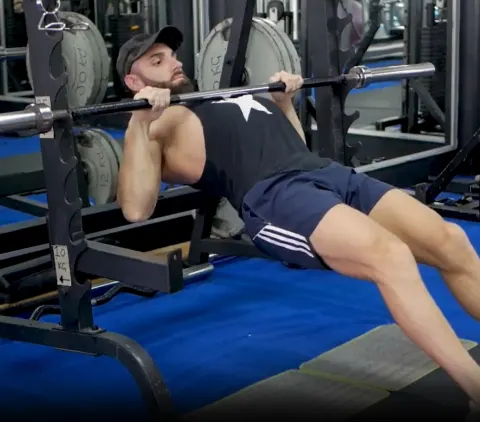
Pulling is the weak point of every no-equipment plan. The week above handles it with a doorway row and with inverted rows, done lying under a heavy table and pulling your chest to its edge. If no table in your home is solid enough, do doorway rows on all three days.
Making bodyweight hard enough
A set only protects muscle if its last reps are slow and effortful. Without plates, turn these dials in this order:
- Reps. Build up to the top of the listed range on every set.
- Tempo. Take 3 seconds on the way down. Fifteen fast squats and fifteen slow ones are different exercises.
- Pause. Hold the hardest position for 1–2 seconds.
- Variation. Move to the next rung of the ladder and go back to 8 reps.
| Movement | Start here | When the top of the range is easy | Later |
|---|---|---|---|
| Squat | Chair squat | Bodyweight squat with a 3 s descent | Split squat, then rear foot on the sofa |
| Push | Incline push-up on a worktop | Hands on a chair seat | Floor push-up, then feet raised |
| Pull | Doorway row | Towel row, leaning back further | Row under a sturdy table |
| Hips | Glute bridge | Bridge with a 2 s squeeze at the top | Single-leg bridge |
| Core | Dead bug | Plank for 30–45 s | Plank with shoulder taps |
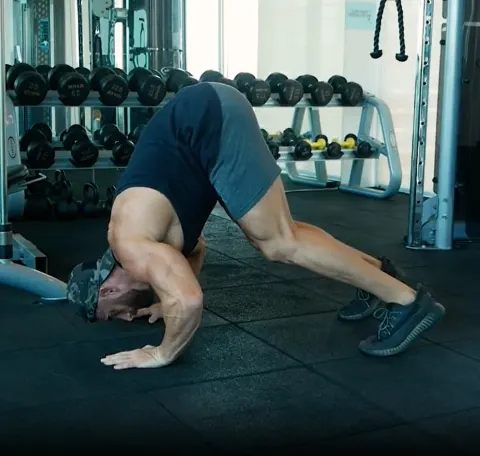
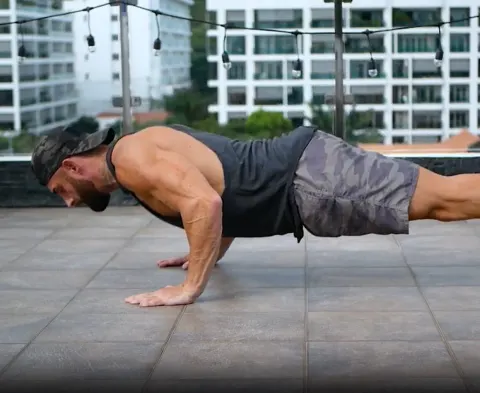
The week above already mixes rungs: it lists floor push-ups on one day and pike push-ups on two. If you cannot manage 8 clean reps of either, pick the easier alternative listed with the exercise, an incline or knee push-up, and work up from there.
Change one dial at a time. Dieting makes this easier than it sounds: every kilo you lose makes a push-up lighter, so climb a rung whenever the reps prove you are ready.
Quiet conditioning for flats and small rooms
The finisher in this plan is 6 rounds of 30 seconds on and 30 seconds off, or 4 rounds in the low-impact versions. As generated, the week above fills those rounds with high knees and jump rope, which are loud on a shared floor and hard on heavy knees. Nothing about a finisher requires jumping, and every exercise in the plan comes with alternatives, so swap them.
Swaps that make no noise:
- Step jacks. A jumping jack with one foot stepping out at a time.
- Shadow boxing. Fast straight punches, feet planted, knees soft.
- Slow mountain climbers. Put your hands on a chair to spare the wrists.
- Squat to calf raise. Continuous, with no pause at the top.
Work on a mat in socks or bare feet, and raise the pace with your arms and range of motion instead of impact. By round four you should be breathing hard yet still able to say a short sentence.
The home kit ladder
You can run this plan for months with nothing. When progress slows, climb one rung, not all of them.
| Rung | Kit | What it fixes | Matching plan |
|---|---|---|---|
| 0 | Chair, towel, backpack | Nothing to buy, start today | 3-day no-equipment plan |
| 1 | Loop bands and a door anchor | Pulling, shoulders, glutes | 3-day resistance band plan |
| 2 | Adjustable dumbbells | Loaded legs, rows and presses | 3-day dumbbell plan |
| 3 | One kettlebell | Loaded squats, presses, rows and carries from one compact weight | 4-day kettlebell plan |
Rungs 2 and 3 are alternatives more than a sequence. Dumbbells are the more complete tool, a kettlebell the more compact one. The home workout plan page compares every home setup in detail.
Getting your steps when the commute is twelve metres
Office workers collect 3,000–4,000 steps without trying. Work from home and a whole day can pass under 2,000. Since 8,000–10,000 daily steps do more for fat loss than any finisher, they have to be scheduled:
- Walk a 15-minute “fake commute” before you open the laptop, and another after you close it.
- Take every call that has no screen share on foot.
- Walk for ten minutes after each main meal. Three of those add roughly 3,000 steps.
- Check your step counter at 3 pm, while there is still time to rescue the day.
The kitchen is ten metres away
Home training removes the travel. It also keeps you near food all day, and a deficit of 300–500 kcal is easily erased by grazing. Find your target with the TDEE calculator, then let the environment do the work:
- Eat at set times, at a table, from a plate. Nothing straight from the packet.
- Keep snack foods out of sight or out of the house, and put fruit, yoghurt and cooked protein at eye level.
- Build each meal around protein, 1.6–2.2 g per kg of body weight across the day.
- Never “reward” a session with food. Forty minutes of bodyweight training is worth about 200–300 kcal.
Mistakes specific to training at home
- Turning every session into a sweaty circuit. Random follow-along videos feel productive but give muscle nothing progressive to adapt to.
- Staying on the easy variation. If you could do 25 reps, the set is too light to hold muscle.
- No fixed slot. “Sometime today” loses to laundry. Put all three sessions in your calendar.
- Skipping the pull. Push-ups and squats alone leave your back untrained.
- Training in pyjamas beside the sofa. Change clothes, clear the floor, start a timer.
When to move on
Stay with this plan while reps or variations keep improving. Once you can do rear-foot-raised split squats and full push-ups for sets of 12–15, add load with the dumbbell rung, or read the broader weight loss workout plan, which covers gym and 4-day options. If your interest shifts towards skill with no kit at all, the bodyweight workout plan goes deeper into progressions, and our no-equipment training guide explains the method behind them.
Home Workout Plan for Weight Loss: all 86 plans
- 2-Day Bodyweight Workout Plan for Weight Loss (Women)
- 2-Day Bodyweight Workout Plan for Weight Loss (Men)
- 2-Day Bodyweight Workout Plan for Weight Loss (Over 50)
- 2-Day Dumbbell Workout Plan for Weight Loss
- 2-Day Dumbbell Workout Plan for Weight Loss (Beginners)
- 2-Day Dumbbell Workout Plan for Weight Loss (Women)
- 2-Day Dumbbell Workout Plan for Weight Loss (Men)
- 2-Day Dumbbell Workout Plan for Weight Loss (Over 50)
- 2-Day Kettlebell Workout Plan for Weight Loss
- 2-Day Kettlebell Workout Plan for Weight Loss (Beginners)
- 2-Day Kettlebell Workout Plan for Weight Loss (Women)
- 2-Day Kettlebell Workout Plan for Weight Loss (Men)
- 2-Day Kettlebell Workout Plan for Weight Loss (Over 50)
- 2-Day Resistance Band Workout Plan for Weight Loss
- 2-Day Resistance Band Workout Plan for Weight Loss (Beginners)
- 2-Day Resistance Band Workout Plan for Weight Loss (Women)
- 2-Day Resistance Band Workout Plan for Weight Loss (Men)
- 2-Day Resistance Band Workout Plan for Weight Loss (Over 50)
- 2-Day Calisthenics Workout Plan for Weight Loss
- 2-Day Calisthenics Workout Plan for Weight Loss (Beginners)
- 2-Day Calisthenics Workout Plan for Weight Loss (Men)
- 3-Day Bodyweight Workout Plan for Weight Loss (Women)
- 3-Day Bodyweight Workout Plan for Weight Loss (Men)
- 3-Day Bodyweight Workout Plan for Weight Loss (Over 50)
- 3-Day Dumbbell Workout Plan for Weight Loss
- 3-Day Dumbbell Workout Plan for Weight Loss (Beginners)
- 3-Day Dumbbell Workout Plan for Weight Loss (Women)
- 3-Day Dumbbell Workout Plan for Weight Loss (Men)
- 3-Day Dumbbell Workout Plan for Weight Loss (Over 50)
- 3-Day Kettlebell Workout Plan for Weight Loss
- 3-Day Kettlebell Workout Plan for Weight Loss (Beginners)
- 3-Day Kettlebell Workout Plan for Weight Loss (Women)
- 3-Day Kettlebell Workout Plan for Weight Loss (Men)
- 3-Day Kettlebell Workout Plan for Weight Loss (Over 50)
- 3-Day Resistance Band Workout Plan for Weight Loss
- 3-Day Resistance Band Workout Plan for Weight Loss (Beginners)
- 3-Day Resistance Band Workout Plan for Weight Loss (Women)
- 3-Day Resistance Band Workout Plan for Weight Loss (Men)
- 3-Day Resistance Band Workout Plan for Weight Loss (Over 50)
- 3-Day Calisthenics Workout Plan for Weight Loss
- 3-Day Calisthenics Workout Plan for Weight Loss (Beginners)
- 3-Day Calisthenics Workout Plan for Weight Loss (Men)
- 4-Day Bodyweight Workout Plan for Weight Loss (Women)
- 4-Day Bodyweight Workout Plan for Weight Loss (Men)
- 4-Day Bodyweight Workout Plan for Weight Loss (Over 50)
- 4-Day Dumbbell Workout Plan for Weight Loss
- 4-Day Dumbbell Workout Plan for Weight Loss (Beginners)
- 4-Day Dumbbell Workout Plan for Weight Loss (Women)
- 4-Day Dumbbell Workout Plan for Weight Loss (Men)
- 4-Day Dumbbell Workout Plan for Weight Loss (Over 50)
- 4-Day Kettlebell Workout Plan for Weight Loss
- 4-Day Kettlebell Workout Plan for Weight Loss (Beginners)
- 4-Day Kettlebell Workout Plan for Weight Loss (Women)
- 4-Day Kettlebell Workout Plan for Weight Loss (Men)
- 4-Day Kettlebell Workout Plan for Weight Loss (Over 50)
- 4-Day Resistance Band Workout Plan for Weight Loss
- 4-Day Resistance Band Workout Plan for Weight Loss (Beginners)
- 4-Day Resistance Band Workout Plan for Weight Loss (Women)
- 4-Day Resistance Band Workout Plan for Weight Loss (Men)
- 4-Day Resistance Band Workout Plan for Weight Loss (Over 50)
- 4-Day Calisthenics Workout Plan for Weight Loss
- 4-Day Calisthenics Workout Plan for Weight Loss (Beginners)
- 4-Day Calisthenics Workout Plan for Weight Loss (Men)
- 5-Day Bodyweight Workout Plan for Weight Loss (Men)
- 5-Day Dumbbell Workout Plan for Weight Loss
- 5-Day Dumbbell Workout Plan for Weight Loss (Women)
- 5-Day Dumbbell Workout Plan for Weight Loss (Men)
- 5-Day Kettlebell Workout Plan for Weight Loss
- 5-Day Kettlebell Workout Plan for Weight Loss (Women)
- 5-Day Kettlebell Workout Plan for Weight Loss (Men)
- 5-Day Calisthenics Workout Plan for Weight Loss
- 5-Day Calisthenics Workout Plan for Weight Loss (Men)
- 6-Day Bodyweight Workout Plan for Weight Loss (Women)
- 6-Day Bodyweight Workout Plan for Weight Loss (Men)
- 6-Day Dumbbell Workout Plan for Weight Loss
- 6-Day Dumbbell Workout Plan for Weight Loss (Women)
- 6-Day Dumbbell Workout Plan for Weight Loss (Men)
Related programs
Frequently asked questions
Can I lose weight working out at home without equipment?
Yes. Fat loss comes from eating 300 to 500 kcal below maintenance, and that works the same in a living room. Bodyweight squats, push-ups, rows and bridges done for 8 to 15 hard reps three times a week are enough to keep your muscle while the deficit removes fat.
How long should a home workout be to lose weight?
About 35 to 45 minutes including a 5-minute warm-up and a 6-minute finisher, three times a week. Longer sessions add little, because the workout itself burns only a few hundred calories. Spend spare time walking instead: an extra 30 minutes a day does more for your weekly total.
Which home exercises burn belly fat?
None on their own. Crunches strengthen the abdominal muscles, but the fat over them goes only when total body fat drops through a calorie deficit. Train the whole body three days a week, walk 8,000 to 10,000 steps daily, and the waist measurement usually starts to move within 3 to 4 weeks.
How can I do cardio at home without jumping or noise?
Use low-impact intervals: step jacks, shadow boxing, slow mountain climbers with hands on a chair, or fast bodyweight squats. Work for 30 seconds, rest for 30, and repeat for 4 to 6 rounds on a mat in socks. Your heart rate climbs just as well and the people downstairs hear nothing.
What should I buy first for home weight loss workouts?
A set of loop resistance bands with a door anchor, because pulling movements are the hardest thing to train with body weight alone. After that, a pair of adjustable dumbbells adds load for legs, rows and presses. Neither purchase is needed during the first 6 to 8 weeks.